Deployable Nuclear Power Emerges as Strategic Imperative for U.S. Military Resilience Amid Great-Power Rivalry
U.S. DoD programs and executive action accelerate microreactor deployment for bases and operations, addressing grid vulnerabilities and great-power energy competition, with corroboration across government and defense sources.
The U.S. military's push for advanced nuclear technologies, particularly small modular reactors (SMRs) and microreactors, reflects a fundamental shift toward energy security as a pillar of national defense. A May 2025 White House executive order (EO 14299) directs rapid deployment of these systems to power critical defense facilities, marking institutional acknowledgment of vulnerabilities in the civilian grid to cyberattacks, sabotage, and extreme weather.
The Army's Janus program has identified nine installations—including Fort Bragg, Fort Hood, and Redstone Arsenal—for potential microreactor deployment, targeting operational capability by 2030. Parallel efforts by the Defense Innovation Unit (DIU) under the Advanced Nuclear Power for Installations (ANPI) program have qualified eight commercial vendors, emphasizing "behind-the-meter" setups that bypass long-distance transmission.
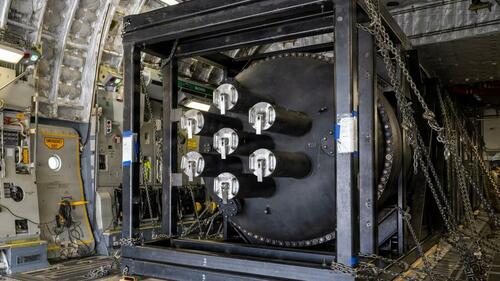
Recent demonstrations, such as the Pentagon's February 2026 airlift of a 5-megawatt microreactor prototype, underscore transportability for forward operations. This aligns with historical precedents like the defunct Army Nuclear Power Program but gains urgency from AI-driven power demands and competition with China over industrial and semiconductor capacity.
Fuel supply remains a critical gap: many designs require High-Assay Low-Enriched Uranium (HALEU), currently dependent on foreign sources including Russia. DOE initiatives aim to build domestic enrichment capacity, mitigating strategic risks.
These developments connect undercovered patterns in defense-industrial resilience, where distributed nuclear generation could enhance survivability without competing for civilian power.
[LIMINAL]: Distributed microreactors could fundamentally alter forward-operating base logistics and base resilience in peer conflicts, accelerating a shift from fossil-fuel dependence to on-site nuclear power within a decade.
Sources (7)
- [1]White House Executive Order on Advanced Nuclear Reactor Technologies for National Security(https://www.whitehouse.gov/presidential-actions/2025/05/deploying-advanced-nuclear-reactor-technologies-for-national-security/)
- [2]U.S. Army Announces Nine Sites for Microreactor Consideration (Janus Program)(https://www.army.mil/article/289074/army_announces_next_steps_on_janus_program_for_next_generation_nuclear_energy)
- [3]NPR: US Military Airlifts Small Reactor(https://www.npr.org/2026/02/21/nx-s1-5721761/us-military-airlifts-small-reactor)
- [4]World Nuclear News: DoD Selects Microreactor Suppliers(https://www.world-nuclear-news.org/articles/us-department-of-defense-selects-eight-potential-microreactor-suppliers)
- [5]Defense News: Army to Lead Nuclear Microreactor Development(https://www.defensenews.com/news/your-army/2025/06/04/army-to-lead-nuclear-microreactor-development-to-power-bases/)
- [6]RealClearDefense Original Article by James Durso(https://www.realcleardefense.com/articles/2026/06/16/americas_military_readiness_depends_on_deployable_nuclear_power_1188917.html)
- [7]EIA on Microreactors for Military Installations(https://www.eia.gov/todayinenergy/detail.php?id=67584)