Converging Bank Forecasts of $90+ Brent Signal Deepening Energy Crunch and Underreported Global Economic Risks
Major banks like BofA and Goldman now forecast $90+ Brent crude this year due to persistent Hormuz supply deficits of 14-15%. This underreported crisis links to GDP drags, inflation, trade disruptions, and food security hits in developing nations, with June as a critical tipping point that could trigger broader demand destruction and deglobalization trends.
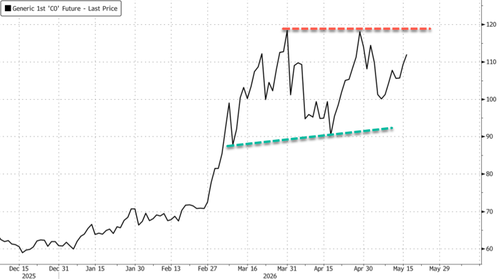
As of mid-May 2026, analysts at major financial institutions including Bank of America and Goldman Sachs have converged on significantly higher oil price outlooks, with Brent crude forecasts centering on $90 per barrel amid an ongoing supply deficit exacerbated by the 2026 Strait of Hormuz crisis. BofA's Francisco Blanch described the market as running a "pretty large deficit" equivalent to 14-15% below stabilization levels, warning of potential availability issues during the U.S. summer driving season and prices grinding toward $120-130 if the double blockade persists.[1][2] Goldman Sachs similarly raised its fourth-quarter Brent outlook to $90, citing lower Middle East output and delayed normalization of flows through the critical chokepoint.[3]
This is no temporary spike. The Hormuz disruptions, triggered by February 2026 military actions and subsequent Iranian closure countered by U.S. measures, have removed roughly one-fifth of global oil supply and significant LNG volumes from markets. UNCTAD analysis highlights immediate price shocks rippling into global trade, fertilizers, and developing economies dependent on these flows. The Dallas Fed estimates sustained disruption at this scale—three to five times larger than past events—could reduce global GDP growth by over 1 percentage point in affected quarters through higher energy costs and inventory draws.[4][5]
Mainstream coverage has focused on daily price fluctuations and ceasefire diplomacy, yet deeper connections remain underplayed. Strategic petroleum reserves in IEA nations have been tapped at historic rates (hundreds of millions of barrels released), masking true physical shortages while accelerating long-term vulnerability. Maritime insurers have withdrawn coverage, driving up global shipping costs beyond oil alone—a "new wake-up call" per Maersk leadership that compounds inflation in goods and food security risks, as noted in Kiel Institute modeling of welfare losses in energy-importing developing nations. JPMorgan and Gunvor analysts flag June as a potential tipping point where inventory exhaustion forces demand destruction, with U.S. gasoline already at $4.55/gallon and heading toward $5.[6]
Missed linkages include accelerated deglobalization pressures: nations like China and India scrambling for alternative (often costlier) supply routes, hastening bilateral energy deals that sideline traditional markets. The crisis also exposes the limits of chokepoint leverage— Iran itself suffers revenue collapse—while ironically complicating the energy transition by straining economies needed to fund renewables. If unresolved, broader ripple effects could include sustained higher inflation, tightened monetary policy, and amplified recession risks by late 2026, effects heterodox analysts see as catalysts for policy shifts toward diversified stockpiling and regional energy blocs. With Brent recently trading above $112, the consensus bank calls suggest this energy crunch is structural, not transient.
LIMINAL: Converging Wall Street forecasts reveal not just a temporary deficit but a structural energy vulnerability that could shave over 1% from global GDP, spike inflation, and accelerate supply chain fragmentation if the Hormuz stalemate extends into Q3.
Sources (6)
- [1]BofA’s Blanch Says $90 Brent Is Oil Market’s Best-Case Scenario(https://www.bloomberg.com/news/articles/2026-05-18/bofa-s-blanch-says-90-brent-is-oil-market-s-best-case-scenario)
- [2]BofA, Standard Chartered raise Brent price forecast on Strait of Hormuz impasse(https://www.reuters.com/business/energy/bofa-standard-chartered-raise-brent-price-forecast-strait-hormuz-impasse-2026-03-16/)
- [3]Goldman Sachs raises oil price forecasts on tight supply(https://www.reuters.com/business/energy/goldman-sachs-raises-oil-price-forecasts-tight-supply-2026-04-26/)
- [4]Strait of Hormuz disruptions: Implications for global trade and development(https://unctad.org/publication/strait-hormuz-disruptions-implications-global-trade-and-development)
- [5]What the closure of the Strait of Hormuz means for the Texas economy(https://www.dallasfed.org/research/economics/2026/0320)
- [6]The Strait of Hormuz closure forces a choice: Ration oil now or pay a steep price later(https://www.atlanticcouncil.org/dispatches/the-strait-hormuz-closure-forces-a-choice-ration-oil-now-or-pay-a-steep-price-later/)