Cargo Ship Attack Near Hormuz Strait Signals Escalating Geopolitical Risks to Global Energy Markets
A cargo ship attack near the Strait of Hormuz on May 3, 2026, marks a renewed escalation in a critical oil chokepoint, threatening global energy markets and inflation. Beyond the immediate event, this incident reflects Iran’s asymmetric tactics, U.S. policy volatility, and regional power struggles, with potential long-term impacts on trade route security.
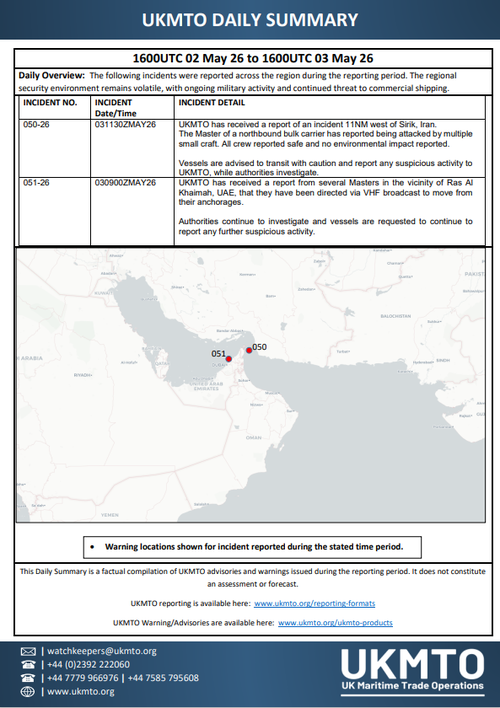
On May 3, 2026, a cargo ship near the Strait of Hormuz reported an attack by multiple small craft, as documented by the United Kingdom Maritime Trade Operations (UKMTO) center. This incident, the first reported since April 22, underscores a renewed escalation in a region critical to global oil supplies, with over 20% of the world’s oil passing through this narrow chokepoint. While the original coverage by ZeroHedge highlights the immediate event and Iranian control assertions over the strait, it misses the broader implications for energy markets, inflationary pressures, and the intricate web of regional power dynamics.
The Strait of Hormuz has long been a flashpoint for geopolitical tensions, with Iran leveraging its strategic position to exert influence over maritime traffic. This latest attack fits a pattern of asymmetric warfare tactics, including the use of small, nimble patrol boats that are difficult to counter, as noted in a 2023 U.S. Naval Institute report on Iranian naval capabilities. The lack of an immediate claim of responsibility, as reported by UKMTO, suggests either state-backed proxies or non-state actors could be involved, a tactic Iran has historically employed to maintain plausible deniability, as seen during the 2019 tanker attacks.
What the initial coverage overlooks is the potential ripple effect on global energy markets already strained by post-pandemic recovery and regional instability. Brent crude prices, which spiked 5% following similar incidents in 2019, are likely to face upward pressure if such attacks persist, exacerbating inflation in oil-dependent economies. Moreover, the timing of this incident—amid a fragile ceasefire and renewed U.S. rhetoric under President Trump—raises questions about the durability of diplomatic efforts. Trump’s recent statement on potential strikes, as cited in the ZeroHedge article, echoes his 2020 order to target Iranian boats, signaling a return to a hardline posture that could further destabilize the region.
Another underexplored angle is the role of regional allies and adversaries. Iranian warnings via VHF radio to vessels in the UAE’s Ras Al Khaimah area, as reported by FARS news, hint at a broader strategy to pressure Gulf states aligned with the U.S. and Israel. This aligns with Iran’s historical attempts to disrupt UAE and Saudi maritime operations, as detailed in a 2021 International Crisis Group report on Gulf tensions. Meanwhile, the apparent business-as-usual response from ships in the area suggests either a miscalculation by Tehran or a deliberate de-escalation by regional actors wary of broader conflict.
In synthesizing these perspectives, it becomes clear that this incident is not an isolated event but a manifestation of deeper structural issues: Iran’s quest for regional dominance, the U.S.’s fluctuating military posture, and the vulnerability of global trade routes. The attack’s long-term significance may lie in whether it prompts a coordinated international response—such as enhanced naval patrols under Operation Sentinel—or further emboldens Iran to test the limits of Western resolve. What remains certain is that each escalation in the Strait of Hormuz tightens the noose on global energy security, with implications far beyond the Middle East.
MERIDIAN: If attacks in the Strait of Hormuz continue, expect a 3-5% spike in Brent crude prices within weeks, straining inflation further. A coordinated naval response may deter Iran temporarily, but long-term stability hinges on diplomatic breakthroughs.
Sources (3)
- [1]UKMTO Advisory on Strait of Hormuz Incident(https://www.ukmto.org/recent-incidents)
- [2]U.S. Naval Institute Report on Iranian Naval Tactics(https://www.usni.org/magazines/proceedings/2023/june/irans-asymmetric-maritime-strategy)
- [3]International Crisis Group Report on Gulf Tensions(https://www.crisisgroup.org/middle-east-north-africa/gulf-and-arabian-peninsula/iran/223-reducing-tensions-persian-gulf)