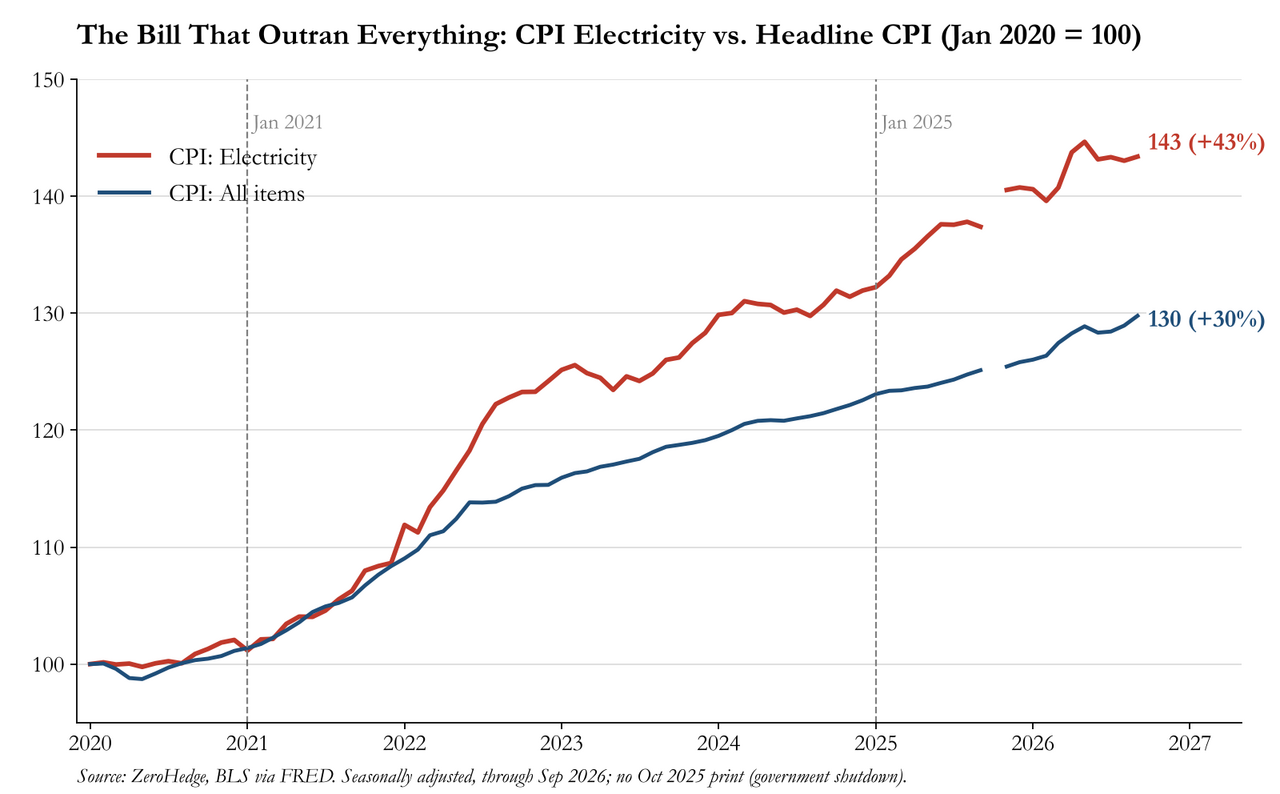
Electricity CPI Up 43% Since 2020 as Delivery Charges Shift Share from Generation
Rising electricity prices reflect a structural shift toward delivery and policy charges that varies by utility rather than uniform commodity pressure. Primary EIA and utility filing data document the 43% CPI increase and changing cost shares. Midterm races now confront these localized bill components directly.
Electric bills now split into supply, delivery and policy charges whose weights differ sharply by utility territory. Goldman Sachs analysis of Con Edison and New Jersey utilities shows delivery and taxes comprising 70% of a New York bill versus supply dominating 70%+ in adjacent New Jersey territories. This geographic variance undercuts uniform national narratives about federal policy responsibility.
EIA price series confirm the 46% rise in average cents per kWh since January 2020, with transmission and distribution each gaining several percentage points of total cost. Goldman tracks the same pattern through utility filings where infrastructure spending and state-mandated programs now drive incremental increases more than commodity swings in many regions.
Voters in nine states will elect utility regulators this cycle while candidates in others face mailers highlighting specific bill line items. Primary commission records show rate cases already embedding higher capital recovery for grid hardening and clean-energy mandates without corresponding federal offsets.
Continued separation of generation and delivery cost trajectories will test whether state-level rate design or wholesale market reforms produce measurable bill relief by mid-2026.
EIA: Average US residential price per kWh exceeds 21 cents by December 2026 if transmission investment filings approved in 2025 remain on schedule.
Sources (2)
- [1]Primary Source(https://www.eia.gov/electricity/monthly/)
- [2]Supporting Source(https://www.goldmansachs.com/insights/pages/affordability-series.html)