Taiwan's 'Non-Red' Suicide Drone Boom Exposes Global Defense Realignment and Militarization Amid Strait Tensions
Taiwan is experiencing surging demand for domestically produced, China-free suicide drones inspired by Ukraine, with manufacturers like Carbon-Based Technology expanding rapidly. This reflects a larger global trend toward asymmetric warfare capabilities, defense supply chain decoupling from China, and militarization that receives less attention than traditional Taiwan Strait coverage.
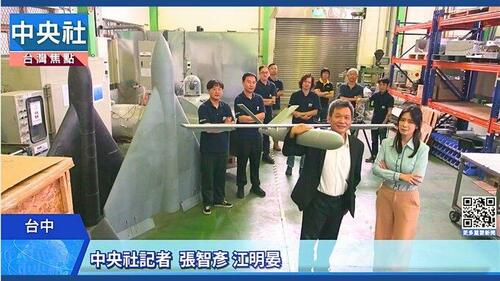
As the four-year conflict in Ukraine continues to demonstrate the decisive role of low-cost, attritable unmanned systems in modern warfare, Taiwan has rapidly positioned itself as an emerging supplier of "non-red"—or China-free—suicide drones and loitering munitions. A Taichung-based manufacturer, Carbon-Based Technology (CBT), is at the center of this shift, reporting surging overseas orders that have forced plans to expand production capacity three to five times. The company specializes in triangular-wing drones with ranges exceeding 90 km and catapult-launched attack variants whose payloads can be tailored for asymmetric missions, directly echoing lessons from Ukrainian forces' innovative use of one-way attack drones against superior Russian armor and artillery.[1][2]
This development reveals a deeper, underreported trend: a global supply-chain realignment in defense manufacturing that seeks to reduce dependence on Chinese components and platforms. Taiwan's Central News Agency reports that the Russia-Ukraine war ignited demand for alternatives to Chinese drones, drawing interest from Japan, India, and Southeast Asian nations, bolstered by Taipei's own government incentives for domestic industry. CBT's focus on composite materials and integrated systems not only supports Taiwan's urgent need for cost-effective defenses against a potential Chinese invasion but also aligns with broader Western efforts to build resilient, "democratic" supply chains.[1]
Mainstream coverage of rising Taiwan Strait tensions often emphasizes high-profile weapons systems, naval buildups, or diplomatic maneuvers, yet largely overlooks this quiet revolution in disposable aerial systems. Taiwan's Ministry of National Defense has placed historic orders for nearly 50,000 domestic drones through 2027, with additional tens of thousands for dual-use civil applications—treating UAVs as consumables in a future high-intensity conflict. Companies are explicitly required to meet "non-red" standards, excluding PRC-sourced parts, mirroring semiconductor decoupling strategies. This industrial policy doubles as national security strategy, transforming Taiwan from a vulnerable target into a potential exporter of proven asymmetric tools.[3][4]
Connections missed by conventional analysis include the economic implications: drone warfare fundamentally alters procurement math, favoring quantity and rapid iteration over exquisite, expensive platforms. Ukraine's experience has accelerated a worldwide militarization cycle where nations stockpile thousands of low-cost suicide drones. Taiwan's carbon-fiber expertise and proximity to conflict zones give it unique advantages in this market, potentially linking its defense industry to partners like the US (via Blue UAS certifications for similar firms), Europe, and Indo-Pacific allies wary of Beijing. Reports indicate Taiwan is actively pursuing co-production MOUs with multiple democracies to further insulate these supply chains.[5]
The broader pattern points to an emerging multipolar arms race defined by attritable systems rather than traditional platforms. As China reportedly stockpiles millions of its own UAVs, Taiwan's pivot underscores how smaller powers can leverage commercial-adjacent technology for deterrence. This realignment carries risks—scaling production under capacity constraints, maintaining quality without Chinese inputs raises costs—but also opportunities for Taiwan to deepen security ties through technology sharing. What ZeroHedge highlighted is not isolated hype but a corroborated signal of systemic change in how future conflicts will be supplied and fought.
LIMINAL: Taiwan's non-red drone expansion will accelerate Western defense decoupling from China while turning low-cost UAVs into a strategic export sector, quietly reshaping global militarization economics before mainstream outlets fully register the shift.
Sources (5)
- [1]Taiwan drone maker Carbon-Based Technology eyes China-free supply chain growth(https://www.taiwannews.com.tw/en/news/6364449)
- [2]Taiwan races to build drone army as China stockpiles 2 million UAVs(https://www.digitimes.com/news/a20250808PD207/taiwan-supply-chain-production-mnd-military.html)
- [3]Taiwan's drone surge aims to offset China's edge(https://asiatimes.com/2025/08/taiwans-drone-surge-aims-to-offset-chinas-edge/)
- [4]Taiwan's Emerging Indigenous Drone Industry—An Overview(https://globaltaiwan.org/2026/02/tw-drone-production/)
- [5]Taiwan's drone industry is booming(https://resiliencemedia.co/taiwans-drone-industry-is-booming-thanks-to-us-and-european-exports/)