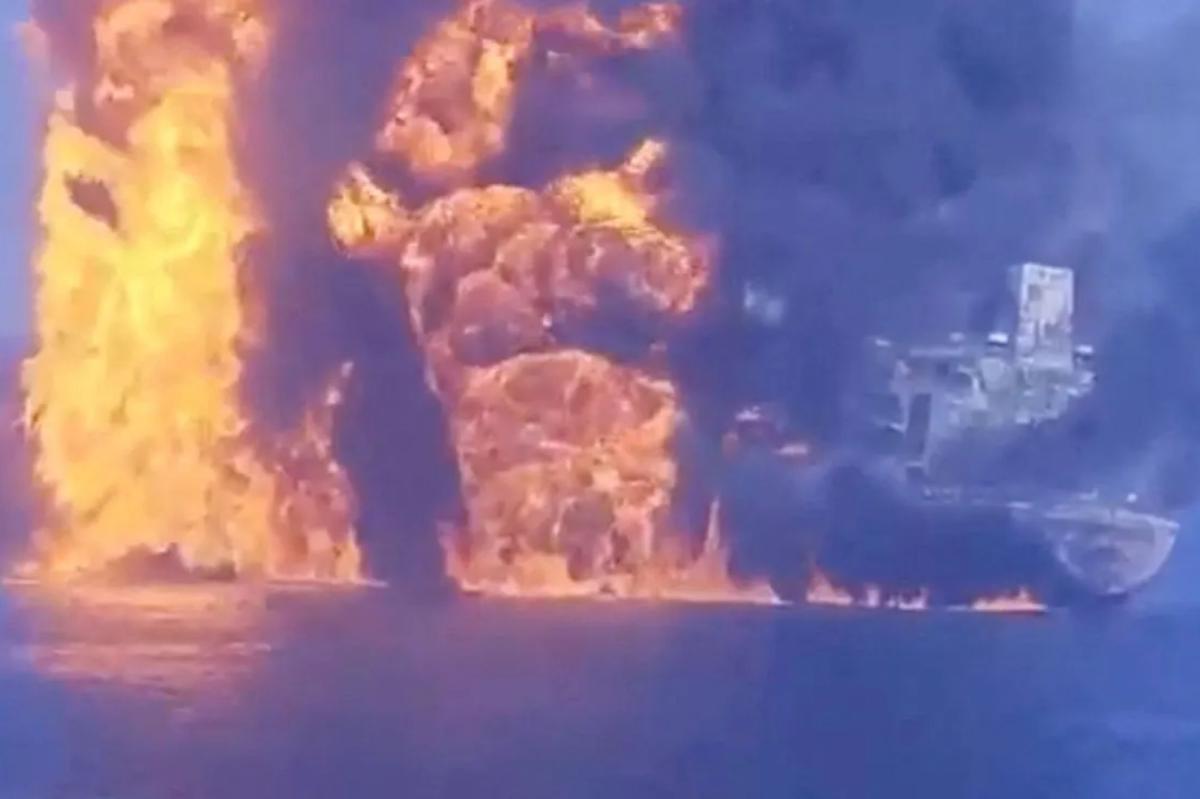
Iranian forces claim three tankers caught fire near Hormuz as LPG tanker crew abandons ship
Iranian forces claimed three tankers caught fire after mines east of Hormuz, as an LPG tanker was abandoned off Oman with one Indian sailor missing. The attacks show a hardening contest over shipping routes through a key energy chokepoint. They raise physical risks for crews and economic costs for Gulf energy transport.
Iran's Revolutionary Guard Corps said on Wednesday that three oil tankers caught fire after hitting mines east of the Strait of Hormuz, saying the vessels had ignored warnings and were moving in restricted areas with navigation systems disabled. The claim followed the abandonment of the liquefied petroleum gas tanker Tara Gas off Oman's Musandam Peninsula after a second attack in two days. Oman's Maritime Security Centre evacuated 24 crew members, and India said one Indian sailor remained missing.
The Tara Gas carried liquefied petroleum gas, a volatile cargo that can form explosive vapor clouds if its pressurized tanks are breached. India said 24 crew members were Indian nationals, with 21 brought ashore at Khasab, two hospitalized and one missing. The vessel was first attacked on Nov. 16, according to India, while UKMTO reported a second hit north of Khasab. Ship databases list owner Global Gas, Marshall Islands, managed from UAE; Oman described it as Comoros-flagged, while India and Reuters identified it as Panama-flagged. The IRGC claims were not independently confirmed.
Iran's stated position is that ships must coordinate passage with Iranian authorities and must not use American routes, framing untracked vessels as violators. The attacks came after Iran declared the strait closed and the US struck Qeshm Island. The documented pattern is a squeeze on routing: disabling transponders reduces visibility, but it also raises collision and military risk. The source says more oil is leaving the Gulf because of US Central Command protection and ship-to-ship transfers, at high cost and with extended naval deployments. It suggests coercion is altering logistics, not ending flows.
The stakes are physical and financial: a fire on a 53,200-deadweight-ton LPG carrier could produce a vapor cloud explosion affecting populated parts of Musandam, while repeated attacks raise insurance, rerouting and delivery costs for Gulf crude and gas. Crews face direct danger, as India's statement said. For energy markets, the Strait of Hormuz is a chokepoint, so even partial disruption or costly workarounds can feed into prices and shipping decisions. The source links the attacks to a wider contest over route control and naval presence.
Seafarers and Gulf energy exports face immediate danger and higher transport costs, while global buyers are exposed to price pressure from a narrower, more heavily defended route through Hormuz.
Sources (1)
- [1]Original source(https://www.zerohedge.com/geopolitical/crew-abandons-burning-gas-tanker-hit-twice-hormuz-fears-grow-it-could-explode)