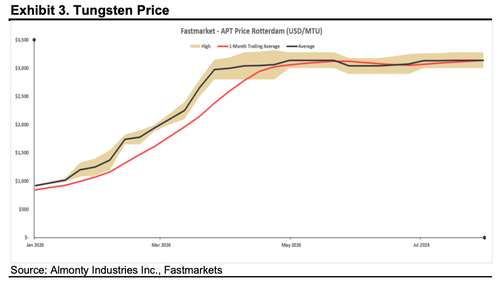
Tungsten Supply Crisis Threatens AI Chip Production and Western Defense as China Tightens Export Controls
Corroborated reports confirm a tungsten supply squeeze driven by Chinese export curbs, factory shutdowns in Japan, and AI/defense demand spikes, with prices surging dramatically and limited near-term relief outside China. Almonty and other non-Chinese projects gain strategic relevance.
China's dominance in tungsten—controlling roughly 80% of global mined supply—has collided with surging demand from AI semiconductors and defense sectors, creating a structural shortage that has driven prices up 300-900% since 2025.[1][2] Beijing's export restrictions, limiting shipments to just 15 approved firms for 2026-2027 and effectively halting key flows to Japan since early 2026, have exacerbated the crunch.[3]
This directly impacts AI infrastructure. Tungsten hexafluoride (WF6) is essential for depositing microscopic tungsten wiring in advanced memory chips used in AI accelerators. Two major Japanese producers, Kanto Denka and Central Glass (accounting for ~25% of global WF6 capacity), ceased operations on July 1, 2026, after exhausting stockpiles of Chinese-sourced feedstock. Samsung and SK Hynix are now racing to qualify alternatives, with WF6 prices reportedly rising 70-90%.[1][4]
Defense applications face parallel pressures. The US Defense Logistics Agency explored stockpile purchases amid tight markets, while a 2027 procurement ban on Chinese-origin tungsten for defense contracts looms. Non-Chinese production remains limited and largely committed, with Western projects like Almonty Industries' Sangdong mine in South Korea (Phase 1 output ~2,300 tonnes/year) positioned as critical alternatives.[2][5]
Japan has pivoted to scrap imports, but US export restrictions on tungsten scrap have compounded shortages for its tool and hardmetal industries. Broader demand growth—from munitions to carbide tools and turbine alloys—projects a persistent ex-China supply gap of 12-21 kt WO3 through 2030, even with new projects.[6]
Efforts to diversify include US and allied mine developments in Idaho, Canada, and elsewhere, alongside recycling pushes, but timelines extend years amid declining Chinese ore grades and policy barriers. The crisis underscores vulnerabilities in concentrated critical mineral supply chains tied to geopolitical tensions.
Almonty Industries: Non-Chinese tungsten producers and recyclers will see sustained pricing power and offtake demand through at least 2028 as AI chip fabs and defense contractors scramble for secure supply, accelerating project timelines and M&A in the sector.
Sources (6)
- [1]Tungsten supplies running on empty amid AI boom(https://cryptobriefing.com/tungsten-supply-crisis-ai-boom/)
- [2]US races to rebuild tungsten supply chain before 2027 deadline(https://interestingengineering.com/energy/us-tungsten-supply-chain-deadline)
- [3]Shortage Of Tungsten, Key For AI, Defense, Is Fueling This Stock(https://www.investors.com/news/tungsten-shortage-almonty-stock-buyback/)
- [4]S&P Global Tungsten Market Report (excerpts)(https://www.spglobal.com/content/dam/spglobal/global-assets/en/special-reports/critical-mineral-market-reports/Market%20Report%20-%20Tungsten%20-%2008052026.pdf)
- [5]Sangdong mine eyes role in securing tungsten for chip industry(https://www.koreatimes.co.kr/business/companies/20260822/sangdong-mine-eyes-role-in-securing-tungsten-for-chip-industry)
- [6]China’s exports of key tungsten material to Japan stay at zero(https://www3.nhk.or.jp/nhkworld/en/news/20260810_05/)