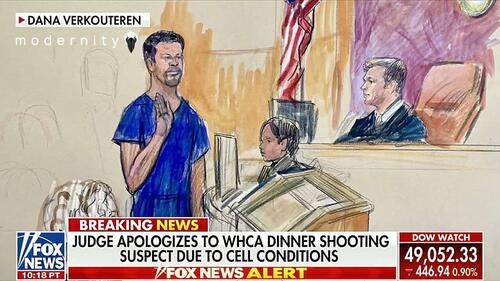
DC Judge's Apology to Alleged Trump Assassin Exposes Deepening Two-Tier Justice Patterns
Multiple mainstream outlets confirm a DC federal judge apologized to Cole Tomas Allen, the suspect in the April 2026 Trump assassination attempt at the WHCD, over allegedly harsh pretrial jail conditions despite the severity of charges. This reveals potential ideological biases and two-tiered justice, contrasting sharply with treatment of January 6 defendants and connecting to elite institutional protectionism in politically motivated cases.
In May 2026, U.S. Magistrate Judge Zia Faruqui publicly apologized to Cole Tomas Allen, the 31-year-old California man charged with the attempted assassination of President Donald Trump during the April 25 White House Correspondents' Dinner. Faruqui described Allen's conditions in D.C. jail—24-hour lockdown in a windowless padded room, suicide watch, repeated strip searches, denial of access to counsel, recreation, and even a Bible—as "legally deficient" and expressed that he was "disturbed" by the treatment of a defendant with no prior criminal record. "Whatever you've been through, I apologize," the judge stated during an emergency hearing, ordering jail officials to justify or modify the restrictions by the following day.[1][2]
This episode, corroborated across Reuters, The Guardian, USA Today, NBC News, and the Associated Press, arrives against a backdrop of video evidence and DOJ charges showing Allen rushing a security checkpoint armed with a shotgun, handguns, and knives, wounding a Secret Service agent before being stopped. Prosecutors released footage and detailed his premeditated travel across the country with intent to target Trump and administration officials. A DOJ press release emphasized zero tolerance for political violence, with officials like Acting Attorney General Todd Blanche and U.S. Attorney Jeanine Pirro underscoring accountability.[3]
Yet the judicial focus shifted rapidly from the gravity of the alleged attempt—described by some as potentially spraying an audience of journalists, officials, and Trump himself—to the suspect's "basic decency" and constitutional protections. Mainstream coverage notes Allen's social media evolution from video game development to intense anti-Trump rhetoric mirroring years of institutional messaging that framed the president in existential terms. CNN reporting highlighted this shift toward political rage. His defense argued the restrictive housing impeded legal preparation, prompting the judge's intervention.[4]
Critics, including conservative commentators, immediately drew parallels to January 6 defendants who endured months of solitary-like conditions in the same D.C. facilities with minimal comparable hand-wringing from the bench. This case fits a larger, under-reported pattern of selective judicial empathy in politically charged prosecutions: where defendants whose actions can be contextualized within dominant anti-populist narratives appear to trigger protective instincts within elite institutions. Faruqui's own statements that the setup was "not working" and "insufficient" for someone like Allen suggest an implicit weighing of ideological alignment or lack of criminal history against the severity of targeting a sitting president.
Fringe analysts have long contended that such episodes reveal not isolated compassion but systemic protectionism—where the administrative state, judiciary, and media complex prioritize procedural sensitivities for certain actors while accelerating harsh pretrial measures against others who challenge entrenched power. The April 2026 incident, occurring at a high-profile media event, further connects to recurring themes of inflammatory rhetoric fueling real-world violence, followed by institutional reluctance to fully interrogate root cultural drivers. Official sources confirm Allen told investigators he did not expect to survive the attempt, adding layers of premeditation that make the judge's immediate "apology" stand out sharply against standard handling of assassination threats.
This event does not exist in isolation. It echoes broader heterodox observations about how D.C. courts have become venues for narrative management rather than neutral arbiters. As public trust erodes, such visible discrepancies accelerate polarization, inviting greater scrutiny of judicial appointments, prosecutorial discretion, and the quiet mechanisms that shield ideological fellow travelers. While mainstream outlets report the facts of the apology and jail conditions factually, they often stop short of exploring these connective threads that fringe inquiry has highlighted for years: the justice system appears calibrated to protect certain classes of political disruption while pathologizing others.
LIMINAL: This visible judicial intervention will likely intensify public perception of ideological capture in federal courts, accelerating demands for oversight of DC judiciary and further eroding institutional legitimacy in high-stakes political cases through 2027.
Sources (5)
- [1]Judge 'disturbed' over 'legally deficient' treatment of Trump assassination attempt suspect(https://www.theguardian.com/us-news/2026/may/04/judge-cole-allen-treatment-suspect-trump-assassination-attempt)
- [2]Judge grills DC jail over treatment of alleged gunman Cole Tomas Allen(https://www.usatoday.com/story/news/politics/2026/05/04/cole-tomas-allen-court-jail-conditions-trump-assassination/89926487007/)
- [3]Judge 'disturbed' over treatment of Trump gala shooting suspect(https://www.reuters.com/legal/government/judge-disturbed-over-treatment-trump-gala-shooting-suspect-2026-05-04/)
- [4]Suspect in White House Correspondents' Dinner Shooting Charged with Attempt to Assassinate President(https://www.justice.gov/opa/pr/suspect-white-house-correspondents-dinner-shooting-charged-attempt-assassinate-president)
- [5]Judge apologizes over jail conditions to man charged in Trump assassination plot(https://www.nbcnews.com/politics/justice-department/man-charged-trump-assassination-plot-told-fbi-didnt-think-survive-feds-rcna343491)