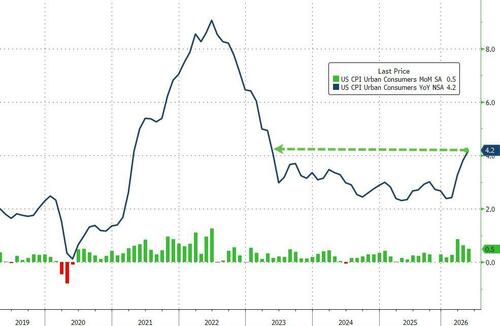
Persistent Inflation at 4.2% Erodes Real Wages as Services and Energy Costs Accelerate Cost-of-Living Pressures
May 2026 CPI hit 4.2% YoY with energy and services driving gains while real wages contracted for the first time in over three years, signaling persistent cost-of-living erosion beyond headline figures that threatens broader economic stability.
Official data confirms that the Consumer Price Index rose 4.2% year-over-year through May 2026, the first such reading above 4% since 2023, driven substantially by a 23.5% surge in energy prices and steady increases in shelter costs. While some core goods categories showed deflation—including declines in household furnishings, transportation commodities, and medical care commodities like prescription drugs—core services inflation is accelerating, with the supercore measure (core services ex-shelter) hitting its highest level since August 2025. This dynamic reveals a deeper pattern where headline CPI understates the lived pressures on households, as sticky services and energy components disproportionately impact budgets. Critically, real average hourly earnings declined in May, marking the first year-over-year shrinkage in real wages since April 2023 and extending a trend where nominal wage gains fail to keep pace with inflation. From April 2025 to April 2026, nominal weekly wages rose 3.6% while inflation ran at 3.8%, resulting in negative real wage growth for many workers. These developments tie into broader economic stability concerns: sustained erosion of purchasing power risks curtailing consumer spending, increasing reliance on credit, and amplifying inequality, as lower- and middle-income households face outsized exposure to food, energy, and rent inflation. Analyses from congressional committees further highlight monthly declines in real weekly and hourly earnings, suggesting the recovery's benefits remain uneven despite cooling in certain goods sectors. This goes beyond standard CPI narratives to expose structural cost-of-living pressures that official metrics may not fully capture, potentially foreshadowing slower growth and heightened policy challenges.
LIMINAL: Eroding real wages amid sticky services and energy inflation reveals a cost-of-living crisis that official stats obscure, likely leading to weakened consumer demand, rising household debt, and increased socioeconomic pressures by late 2026.
Sources (5)
- [1]Consumer Price Index Summary - May 2026(https://www.bls.gov/news.release/cpi.nr0.htm)
- [2]Real Earnings Summary - 2026(https://www.bls.gov/news.release/realer.nr0.htm)
- [3]Are wages keeping up with inflation?(https://usafacts.org/answers/are-wages-keeping-up-with-inflation/country/united-states/)
- [4]Inflation Update(https://www.jec.senate.gov/public/index.cfm/republicans/inflation-update)
- [5]Real wages start to shrink in developed countries(https://www.ft.com/content/e126f744-3db9-4305-8871-31f83ebc4ed7)