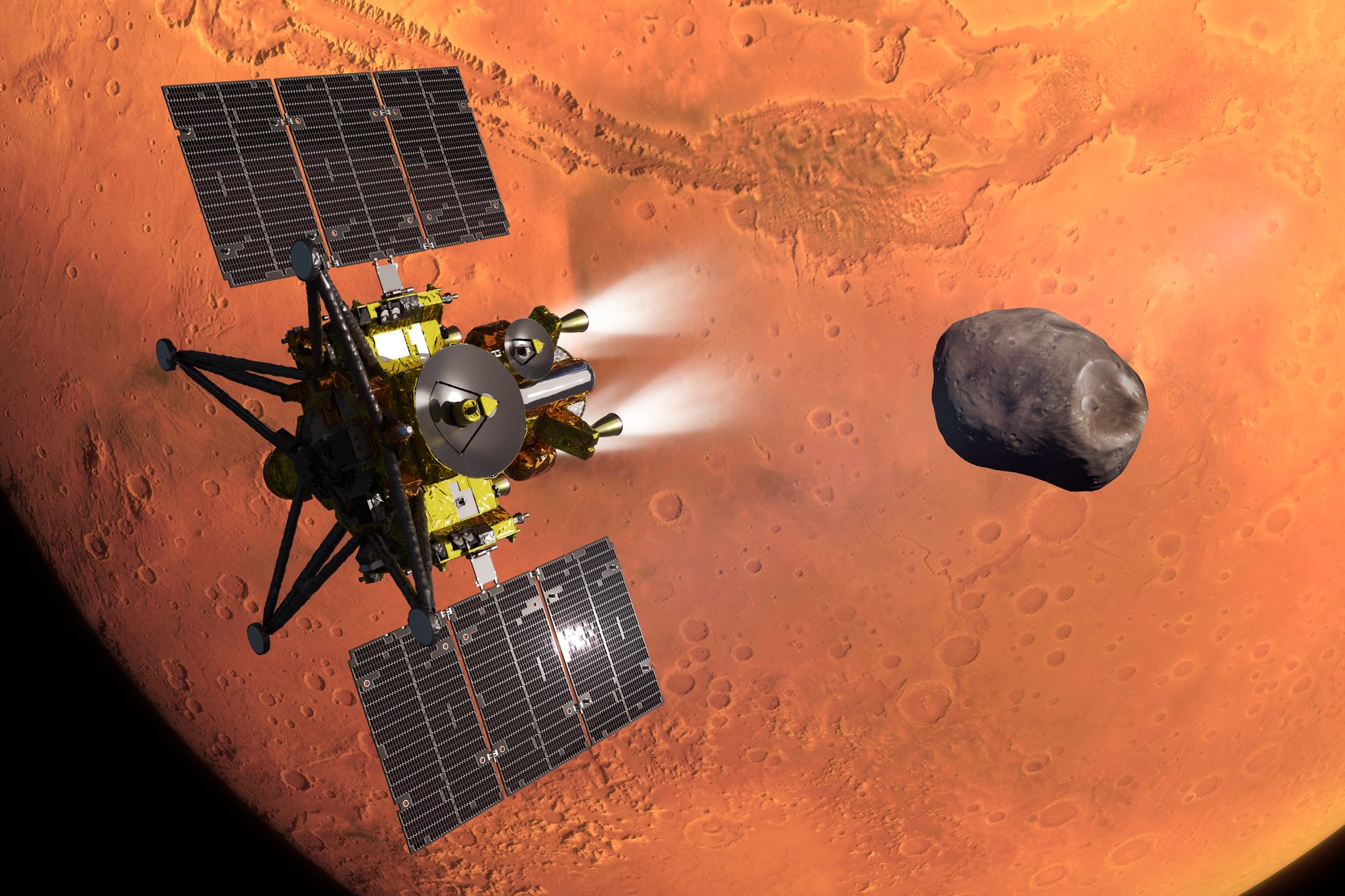
NASA Supplies MEGANE Spectrometer and P-Sampler for JAXA MMX Phobos Sample Return Launching October 2025
NASA hardware and curation support will enable the first returned samples from a Martian moon. The data should distinguish between capture and impact origins and inform volatile delivery models for the inner planets. Sample distribution begins after 2031 at Johnson Space Center.
The mission directly tests two competing origin models for the Martian moons: captured asteroids versus debris from a giant impact on Mars. MEGANE will measure bulk elemental abundances including hydrogen and silicon from orbit while the P-Sampler and JAXA coring system collect surface and subsurface material. NASA will curate 15 percent of the returned sample at Johnson Space Center for decades-long distribution to U.S. investigators. This sample set arrives during the same decade as Artemis lunar returns and Perseverance Mars samples creating the first multi-body comparative astromaterials archive.
Prior remote-sensing data from Mars Express and ground-based telescopes remain ambiguous on composition leaving both origin hypotheses viable. MMX's landed operations and returned samples will supply the first direct mineralogical and isotopic constraints on formation timing and volatile content. Those data bear on whether the inner solar system acquired water and organics through similar impact or capture processes that also affected early Earth.
The chief limitation is the single-site sampling strategy on Phobos which may miss lateral heterogeneity; repeated landings or a companion orbiter with higher-resolution mapping would strengthen conclusions. Full integration of MEGANE orbital maps with the returned grains is required to extrapolate local results to the entire moon.
JAXA: MMX returns >10 g Phobos regolith whose oxygen isotopes rule out one origin hypothesis at 95 percent by end of 2031 curation phase.
Sources (3)
- [1]Primary Source(https://science.nasa.gov/directorates/smd/planetary-science-division/nasa-to-help-unlock-mysteries-of-mars-moons-in-upcoming-mission/)
- [2]Supporting Source(https://www.isas.jaxa.jp/en/missions/spacecraft/developed/mmx.html)
- [3]Supporting Source(https://www.hou.usra.edu/meetings/lpsc2024/pdf/1892.pdf)