Trump's Beijing Visit with Tech CEOs Signals Potential Shift in US-China Trade Dynamics Amid Global Tensions
Trump’s Beijing visit with CEOs from Nvidia and Tesla highlights a potential shift in US-China trade relations, focusing on technology and economic leverage amid tensions over Iran and Taiwan. Beyond ceremonial pomp, the trip reflects strategic negotiations on semiconductor access and global supply chains, with implications for markets worldwide.
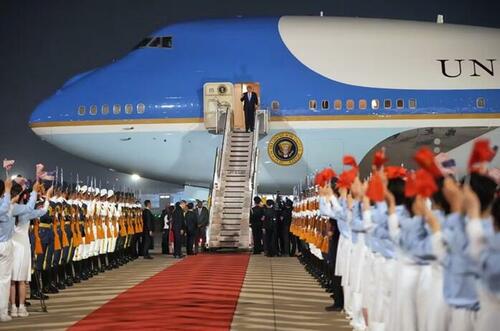
President Donald Trump's arrival in Beijing on May 13, 2026, marked by a lavish red carpet welcome, is more than a diplomatic spectacle. Accompanied by high-profile CEOs such as Nvidia’s Jensen Huang and Tesla’s Elon Musk, the visit underscores a potential pivot in US-China trade relations, with implications for global markets and supply chains. While the original coverage by ZeroHedge focused on the ceremonial aspects and Trump's rhetoric about 'opening up China,' it missed the deeper strategic interplay of technology, geopolitics, and economic leverage at stake. This analysis explores the broader context, unpacks overlooked dimensions, and situates the visit within ongoing global tensions.
First, Trump's decision to bring tech industry titans to Beijing signals a deliberate focus on technology as a bargaining chip. Nvidia, a leader in AI and semiconductor technology, operates under strict US export controls that bar the sale of advanced chips to China due to national security concerns, as outlined in the US Department of Commerce's Entity List updates (Bureau of Industry and Security, 2022). Trump's social media remarks about asking President Xi Jinping to 'open up' China are, as commentator Arnaud Bertrand noted on X, somewhat paradoxical given that the restrictions originate from US policy. What the original coverage glossed over is the potential for Trump to use this visit as a platform to negotiate a relaxation of these controls in exchange for concessions from Beijing—perhaps on issues like intellectual property protection or market access for US firms. This could reshape the global semiconductor supply chain, where China remains a critical player despite US efforts to 'decouple.'
Second, the timing of the visit amid escalating tensions over Iran adds a layer of geopolitical complexity that ZeroHedge only briefly mentioned. Trump's dismissive stance on needing China's help with Iran—stating the US will 'win one way or another'—contrasts with Beijing's growing role as a mediator in Middle Eastern conflicts, evidenced by its brokering of the 2023 Saudi-Iran rapprochement (Joint Statement, March 10, 2023, via China’s Ministry of Foreign Affairs). The passage of a Chinese supertanker through the Strait of Hormuz, as reported, highlights China’s continued energy ties with the region, which could be leveraged to influence US policy on Iran. What’s missing from the initial story is how Trump’s visit might be an attempt to counterbalance China’s regional influence by offering economic incentives, potentially sidelining broader security cooperation.
Third, the economic backdrop of this visit reveals a tension between domestic and international priorities that the original piece downplayed. Trump’s assertion that the financial situation of Americans does not factor into his Iran policy decisions—made at a time of rising gas and food prices—suggests a disconnect from domestic economic pressures. Yet, his focus on business deals in Beijing could be an attempt to secure wins for US corporations like Tesla, which relies heavily on the Chinese market for manufacturing and sales (Tesla Annual Report, 2025). This raises questions about whether Trump’s agenda prioritizes corporate interests over broader national security concerns, a nuance absent from the initial reporting.
Synthesizing these perspectives, Trump’s visit appears less as a standalone diplomatic event and more as a calculated move in a multi-dimensional chess game involving trade, technology, and geopolitics. Historical patterns, such as the US-China Phase One Trade Agreement of 2020, suggest that Trump often uses high-profile visits to push for tangible economic outcomes. However, the presence of unresolved flashpoints like Taiwan—barely mentioned in the ZeroHedge piece—remains a wildcard that could derail any progress. Ultimately, this visit may test whether economic pragmatism can override ideological and security-driven divides between the two superpowers.
MERIDIAN: Trump’s visit could yield a limited trade concession on tech exports, but unresolved issues like Taiwan may prevent a broader thaw in US-China relations.
Sources (3)
- [1]Trump Says 'Open Up China' Before Landing In Beijing For Pomp-Filled Red Carpet Airport Welcome(https://www.zerohedge.com/geopolitical/trump-says-open-china-landing-beijing-pomp-filled-red-carpet-airport-welcome)
- [2]Joint Statement on Saudi-Iran Rapprochement(https://www.fmprc.gov.cn/mfa_eng/zxxx_662805/202303/t20230310_11038803.html)
- [3]Bureau of Industry and Security Entity List Updates(https://www.bis.doc.gov/index.php/policy-guidance/lists-of-parties-of-concern/entity-list)