AI's Thirst: How Data Centers Are Forcing a Reckoning Over Water Use in Agriculture and Beyond
Data centers consume significant water for AI but deliver far higher economic value per gallon than almonds or golf courses, exposing an undercovered AI-driven shift in resource priorities that pits tech infrastructure against traditional agriculture and risks heightened local conflicts.
As the AI boom accelerates hyperscale data center construction, a critical but underreported resource conflict is emerging around water allocation. While local communities resist new facilities due to fears of depleted aquifers, soaring energy demands, and lost farmland, data from multiple analyses shows that data centers' water footprint—though substantial—pales in comparison to traditional agriculture, particularly California's almond orchards, and even recreational uses like golf courses. This disparity highlights not just raw consumption numbers but a deeper economic reallocation driven by technology's higher output per gallon.
According to the Environmental and Energy Study Institute, U.S. data centers consumed approximately 449 million gallons of water per day as of 2021, with individual large facilities using up to 5 million gallons daily for evaporative cooling—equivalent to a small city's needs. Projections indicate this will rise sharply with AI workloads, potentially doubling by 2028 as electricity demands for training and inference indirectly consume hundreds of billions more gallons through power generation. Yet in California, almond farming alone draws around 1.3 trillion gallons annually, or roughly 4.2 billion gallons per day—dwarfing data center usage by factors of 4x to 80x depending on the precise boundaries of comparison.
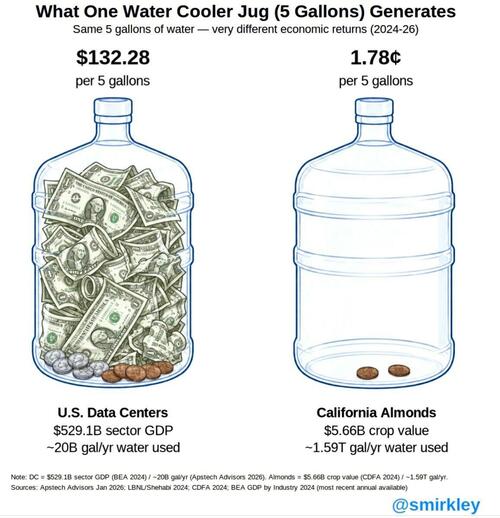
A Reason Foundation analysis contextualizes this further: California's almond farms consume vastly more water than data centers while generating lower economic value per gallon. One viral calculation illustrated that 5 gallons of water supporting data center activity yields over $132 in economic output versus just pennies from almond production. Nationally, U.S. golf courses consume hundreds of billions of gallons yearly—estimates range from 500 billion to over 2 trillion when including related landscaping—often drawing from the same stressed freshwater sources. Data centers frequently utilize a mix of potable and reclaimed water, and many operators are shifting toward air cooling, recycling, and non-potable sources to mitigate impact.
The overlooked connection is the structural shift this represents: a transition from water-intensive, lower-productivity agrarian and leisure economies to high-value digital infrastructure. Agriculture accounts for roughly 70% of global freshwater withdrawals, per UN reports, with crops like almonds (largely exported) and livestock feed (corn, alfalfa) dominating in arid regions. As AI displaces white-collar jobs—evidenced by Meta and others pairing efficiency gains with layoffs—and data centers convert farmland, rural communities face dual pressures. Local resistance, with Gallup polling showing 70% opposition in some areas, echoes anti-nuclear sentiments but ignores these comparative economics. Permitting delays already threaten up to half of planned projects amid $700 billion in projected 2026 capex.
Deeper still, this conflict reveals misaligned incentives: water pricing and rights systems favor legacy users despite lower GDP returns, while concentrated data center demand in stressed basins (Northern Virginia, Arizona, Georgia) creates acute local shortages even if nationally agriculture dominates. Indirect water use via electricity—estimated at over 200 billion gallons in 2023—links the issue to broader grid and energy debates. Without transparent reporting (fewer than one-third of operators fully track usage historically) or updated policy that values economic productivity per drop, the AI boom risks exacerbating inequality between tech-driven growth and traditional sectors. The real question isn't whether data centers use water, but whether society will adapt allocation to prioritize 21st-century infrastructure over 20th-century patterns.
Liminal: AI infrastructure will drive water reallocation from legacy agriculture toward higher-productivity digital uses, intensifying local resistance and forcing policy debates on economic value-based water rights within the next decade.
Sources (4)
- [1]Data Centers and Water Consumption(https://www.eesi.org/articles/view/data-centers-and-water-consumption)
- [2]Data Centers Use Less Water Than Almond Farms—and Do More Good(https://tech.yahoo.com/science/articles/data-centers-less-water-almond-134521708.html)
- [3]How Agriculture and Data Centers Compete for the Precious Resource(https://sentientmedia.org/how-agriculture-and-data-centers-compete-for-the-precious-resource/)
- [4]Data Drain: The Land and Water Impacts of the AI Boom(https://www.lincolninst.edu/publications/land-lines-magazine/articles/land-water-impacts-data-centers/)