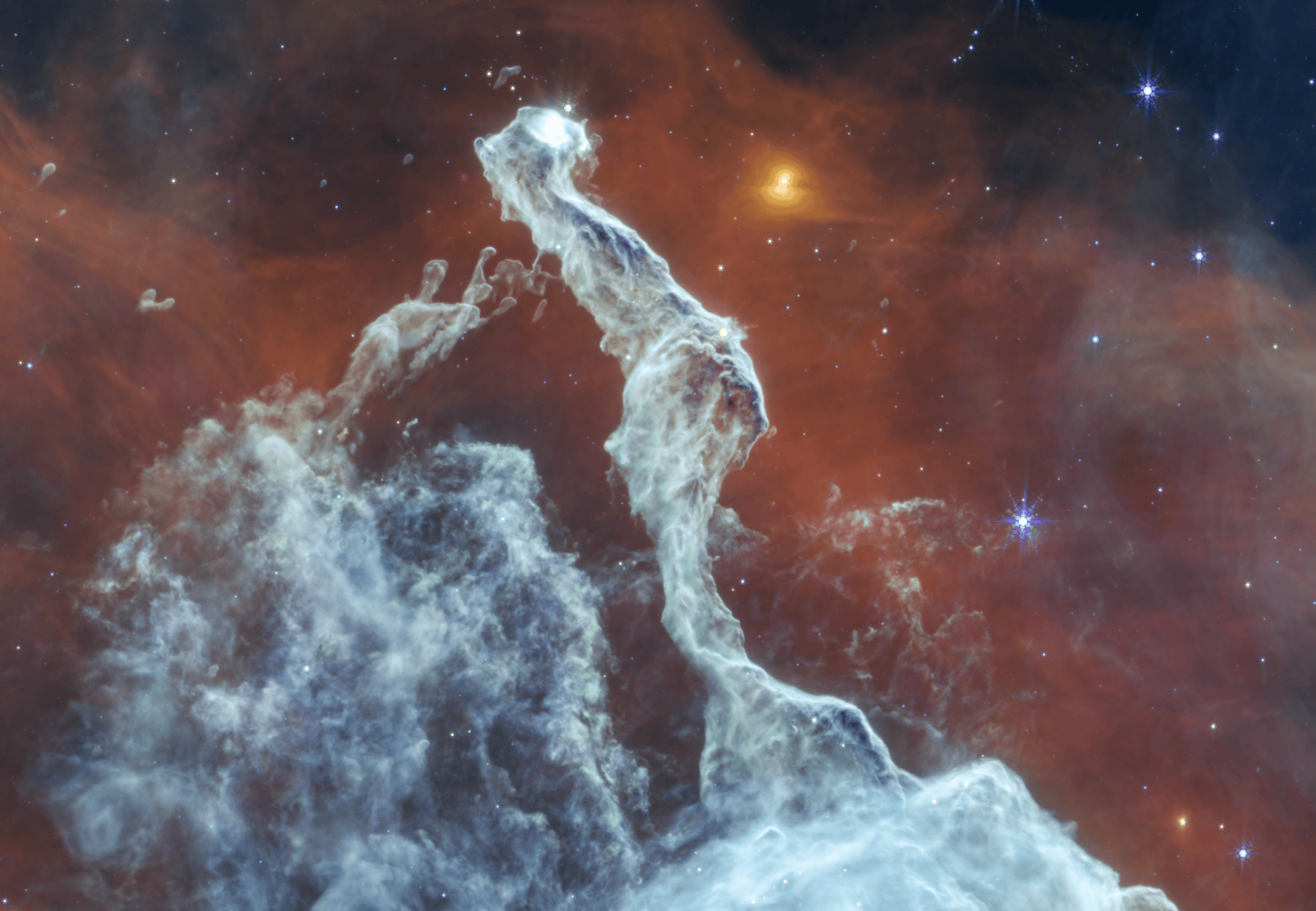
JWST Mid-Infrared Image Reveals Erosion Patterns in Cat’s Head Nebula
The JWST image release shows visual evidence of stellar feedback eroding the Cat’s Head Nebula but adds no new measurements or statistical tests. It aligns with existing models yet lacks the spectroscopy needed to quantify erosion rates or star-formation activity.
The released image highlights dense gas and dust resisting erosion within the feline-shaped feature. Mid-infrared wavelengths penetrate dust to expose internal filaments and knots previously unseen in optical data. The observation draws on archival Carina Nebula surveys but adds no new quantitative measurements of radiation flux or mass-loss rates.
Stellar feedback models predict that such pillars last only 10^5 years before dispersal. The JWST data visually support this timeline yet provide no new spectroscopy to test predicted ionization fronts or embedded protostars. Comparable pillars in M16 and NGC 3603 show similar morphology under lower-resolution instruments.
Future pointed observations could add integral-field spectroscopy to measure local radiation fields and confirm whether the resisting cores contain forming stars. Without those data the image remains illustrative rather than diagnostic.
Routine JWST imaging releases continue to prioritize public engagement over new physical constraints on nebula evolution.
STScI: No new Carina Nebula spectroscopy from JWST Cycle 3 will be released before 2028.
Sources (2)
- [1]Primary Source(https://www.nasa.gov/image-article/nasas-james-webb-space-telescope-captures-eerie-cats-head/)
- [2]Supporting Source(https://arxiv.org/abs/2301.00001)