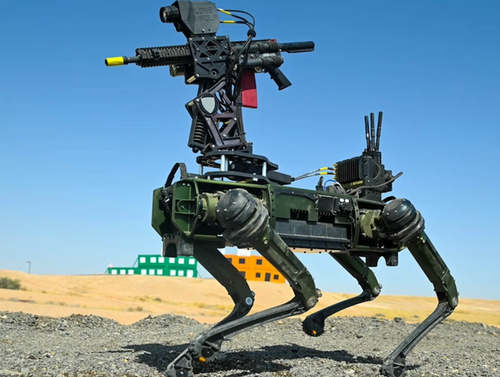
Demographic Collapse Forces Robotic Armies: South Korea's Crisis Exemplifies Global Shift from Manpower to Machines
South Korea's record-low fertility is slashing its troop numbers by over 40% in coming decades, driving partnerships for military robots and AI under Defense Innovation 4.0. This mirrors an underreported global pattern where population decline in dozens of countries will accelerate reliance on autonomous systems, linking the fertility crisis directly to transformed military strategy and future automated conflicts.
South Korea stands at the forefront of a quiet revolution in military strategy, where plummeting birth rates are compelling the rapid fielding of autonomous robots, AI-powered drones, and exoskeletons to compensate for a vanishing pool of young recruits. With the world's lowest fertility rate of 0.72 children per woman, the nation's active-duty military has already contracted 20% over six years to roughly 450,000 troops. Projections from the Ministry of National Defense indicate further steep declines—to approximately 290,000 by 2030, 260,000 by 2035, and 150,000-270,000 by 2040—creating unsustainable gaps in a conscript-dependent force facing a nuclear-armed North Korea with over a million troops.
Under the 'Defense Innovation 4.0' framework, described as 'slimmer yet smarter,' Seoul is pursuing open innovation between military and commercial sectors to integrate robotics, manned-unmanned teaming, autonomous vehicles, and AI systems. Recent developments include exploring deployments of Hyundai Motor Group's platforms, such as Boston Dynamics' four-legged Spot robot for logistics and surveillance, wheeled mobility droids, and wearable exoskeletons. These draw from Ukraine's laboratory of low-cost drones and ground robots, but the underlying driver is demographic, not just tactical innovation.
This case illuminates a global pattern rarely framed together in legacy coverage: fertility rates below replacement level across East Asia (Japan, China, Taiwan), Southern and Western Europe (Italy, Spain, Germany), and Eastern Europe are eroding traditional manpower-based defenses. While the IMF and UN highlight economic risks of aging populations and shrinking workforces, the national security dimension remains underexplored. Militaries in these nations will likely lead the next wave of battlefield automation, prioritizing intelligent machines for attrition warfare over scarce young soldiers. South Korea's Army Tiger 4.0 program, including bio-inspired robots for reconnaissance, demonstrates how commercial tech from autonomous vehicles can proliferate rapidly into defense without legacy constraints.
The implications extend beyond tactics. Demographic winter could reshape alliances, power projection, and even deterrence postures, as countries with sustained higher fertility retain human-wave advantages while others bet on technological multipliers. President Lee Jae-myung's calls for an 'elite smart military' with AI combat robots underscore the urgency. As global tensions rise, the fertility crisis is not merely social—it is forging automated armies for the wars to come.
LIMINAL: Crashing fertility rates will quietly force aging societies to replace young soldiers with robots and drones, fundamentally altering global power balances toward tech-dominant militaries while exposing manpower advantages for high-fertility nations.
Sources (5)
- [1]Declining Demographics Challenge South Korea’s Defense(https://www.cna.org/our-media/indepth/2024/08/declining-demographics-challenge-south-koreas-defense)
- [2]Korea's military faces deepening troop shortage due to plummeting birthrate(https://www.koreatimes.co.kr/southkorea/defense/20250922/koreas-military-faces-deepening-troop-shortage-due-to-plummeting-birthrate)
- [3]South Korea May Deploy Hyundai Robots as Army Faces Demographic Crisis(https://finance.yahoo.com/sectors/technology/articles/south-korea-may-deploy-hyundai-171025162.html)
- [4]Population Crisis: A Challenge To South Korea's Military(https://tdhj.org/blog/post/population-crisis-challenge-south-korea-military/)
- [5]The Debate over Falling Fertility(https://www.imf.org/en/publications/fandd/issues/2025/06/the-debate-over-falling-fertility-david-bloom)