Historic 2026 Drought Engulfs U.S. Breadbasket: Food Security Risks Mount Amid Climate-Driven Volatility and Supply Chain Fragility
Severe drought—worst March PDSI in 130+ years—threatens U.S. wheat, livestock, and row crops during critical planting season, with limited rain relief ahead. Links to climate volatility, water stress in key breadbasket states, and potential food price spikes signal systemic supply chain and economic risks.
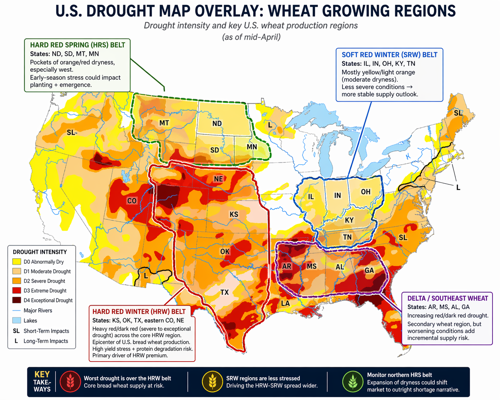
As spring planting season advances in 2026, large swaths of America's agricultural heartland face some of the most severe drought conditions in over a century, raising alarms about potential yield losses in wheat, corn, and soybeans that could reverberate through global food supply chains. According to UBS analysts, March 2026 registered the highest Palmer Drought Severity Index (PDSI) reading for any March since records began in 1895, ranking as the third-driest month overall—surpassed only by the peak Dust Bowl months of July and August 1934.[1][1] This aligns with NOAA data showing widespread extreme drought across the Great Plains, with nearly 90% of Nebraska and Oklahoma in drought and over half of Nebraska in the "extreme" category.[2]
The U.S. Drought Monitor confirms these patterns, with poor-to-very-poor ratings for roughly half the winter wheat crop in key producing states like Colorado, Nebraska, Oklahoma, and Texas—the lowest good-to-excellent scores since 2023. Livestock operations are also strained: ranchers face thinning herds, skyrocketing feed costs, and decisions to forgo expansion as rivers run low and soil moisture deficits persist. While short-term forecasts indicate some rainfall from a strong subtropical jet stream across the Midwest and South this week, meteorologists caution it will provide only marginal relief, insufficient to restore deep soil moisture or break the multi-month drought.[3]
Going deeper, these conditions intersect with longer-term climate volatility that has increased the frequency and intensity of compound drought-heatwave events across global breadbaskets, including the U.S. Central region. A recent study highlights how rising agricultural water demand in states like Kansas, Missouri, and North Dakota—accounting for over half of U.S. wheat output—has amplified water stress despite overall demand reductions elsewhere, creating structural vulnerabilities for food production.[4] This is compounded by historical fertilizer supply constraints and Mississippi River navigation concerns; although current Memphis river stages hover near seasonal norms, they remain approximately 24 feet lower than year-ago levels, potentially complicating barge transport of grains and inputs later in the season.
The broader implications extend beyond the farm gate. A second major agricultural supply shock in 2026 could drive elevated food prices, contributing to inflationary pressures and economic instability at a time when global supply chains remain sensitive to disruptions. With the U.S. as a top exporter of key commodities, domestic shortfalls risk exacerbating food insecurity abroad while pressuring domestic meat and processed food costs as feed prices climb. Unlike isolated weather events, the persistence of these patterns underscores the need for deeper investigation into adaptive agriculture, water management, and resilience strategies to safeguard economic and food stability amid accelerating climate extremes.
LIMINAL: Ongoing climate-amplified drought in the 2026 breadbasket will likely trigger higher global food commodity prices by late summer, exposing fragile supply chains and accelerating economic pressures on both U.S. consumers and international food security.
Sources (5)
- [1]U.S. wheat crops wither, herds thin as spring drought deepens(https://fortune.com/2026/04/25/drought-us-farm-economy-wheat-crops-herds-agriculture-great-plains-states/)
- [2]UBS Flags 130-Year Drought Shock Across America's Breadbasket(https://escorewater.org/blogs/ratings/ubs-flags-130-year-drought-shock-across-americas-breadbasket)
- [3]Current Map | U.S. Drought Monitor(https://droughtmonitor.unl.edu/)
- [4]Water stress and its sensitivity to demands across the United States(https://www.nature.com/articles/s44458-026-00072-4)
- [5]Monthly Climate Reports | Drought Report | February 2026(https://www.ncei.noaa.gov/access/monitoring/monthly-report/drought/202602)