Services Sector Contraction Points to Stagflation Risks Amid Middle East Conflict and Tariff Pressures
March 2026 services PMI contraction to 49.8, first since 2023, combined with rising prices from Middle East conflict and tariffs, signals stagflation risks that complicate Fed policy despite concurrent job gains.
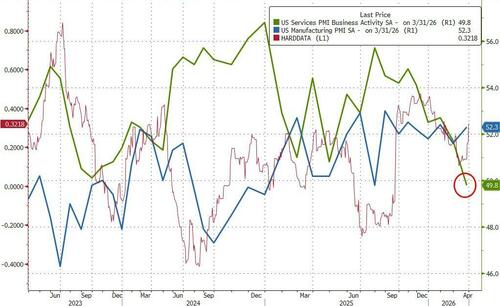
Primary data released by S&P Global Market Intelligence on April 3, 2026 shows the US Services PMI Business Activity Index falling to 49.8 in March, the first contraction since January 2023. The index declined from 51.7 in February and missed the flash estimate of 51.1, with new orders rising at the weakest pace since April 2024. Consumer-facing services recorded one of the steepest downturns outside pandemic lockdowns, while financial services and technology sectors also weakened amid interest-rate sensitivity and market volatility. The survey explicitly links the slowdown to surging energy prices and uncertainty stemming from the Middle East conflict involving Iran, alongside recent tariff policy decisions.
This occurs alongside the Bureau of Labor Statistics report showing 178,000 jobs added in March, highlighting a divergence between headline employment gains and PMI-derived employment sub-index contraction. The combined dataset depicts annualized GDP growth near 0.5 percent alongside cost and selling price increases consistent with CPI inflation approaching 4 percent.
Coverage in secondary outlets such as ZeroHedge correctly noted the stagflationary mix but under-emphasized sectoral granularity and historical parallels. Primary S&P Global commentary by Chris Williamson observes that business confidence has only dipped rather than collapsed, with firms anticipating a short conflict duration. However, the same release cautions that energy-market disruptions may outlast any ceasefire, testing household affordability longer term.
Multiple perspectives emerge from official documents. Federal Reserve economic projections and recent Beige Book entries reflect concern that persistent supply-side shocks could complicate the dual mandate, with some policymakers prioritizing inflation control while others emphasize risks to maximum employment. Historical primary records from the 1970s oil shocks, documented in Federal Reserve archival meeting transcripts, illustrate how similar energy-driven price spikes combined with slowing activity produced prolonged policy dilemmas.
Synthesizing the S&P Global PMI release, BLS employment data, and Federal Reserve inflation expectation surveys reveals connections often missed in initial reporting: tariff-induced cost pressures compound geopolitical energy shocks, creating a feedback loop that raises input costs across services. This challenges prevailing market pricing for Federal Reserve rate cuts, as the central bank may face simultaneous downward growth and upward price pressures. No single viewpoint is endorsed; the data indicate a complex environment where duration of the Middle East conflict and implementation details of trade policy will determine whether the Q1 signal proves transitory or structural.
MERIDIAN: Services contraction and energy-driven inflation from the Iran-related conflict may constrain Federal Reserve flexibility, forcing a delicate balance between growth support and price stability that current market pricing has not fully discounted.
Sources (3)
- [1]S&P Global US Services PMI March 2026(https://www.spglobal.com/marketintelligence/en/news-insights/latest-news-headlines/us-services-pmi-falls-into-contraction-march-2026)
- [2]Bureau of Labor Statistics Employment Situation March 2026(https://www.bls.gov/news.release/empsit.nr0.htm)
- [3]Federal Reserve Beige Book and Inflation Expectation Surveys Q1 2026(https://www.federalreserve.gov/monetarypolicy/beigebook202603.htm)