Europe Enters Winter with Record-Low Gas Storage as Polar Vortex Signals Raise Cold Snap Risks
IEA confirms Europe's lowest gas storage since 2013 (~75% full); polar vortex disruption forecasts add cold weather risk that could deplete reserves below 10% by March, prolonging market tightness.
Europe is heading into the 2026-2027 heating season with natural gas storage at its lowest seasonal levels in over a decade, heightening vulnerability to supply shocks amid forecasts of an early polar vortex disruption. According to the International Energy Agency's Global Gas Security Review 2026, released November 3, EU storage sites stood at approximately 75% full by the end of October—below the 80% target and the weakest since 2013—due to slower refilling, high summer demand for power generation, and disruptions to LNG flows through the Strait of Hormuz linked to Middle East tensions.[1][2]
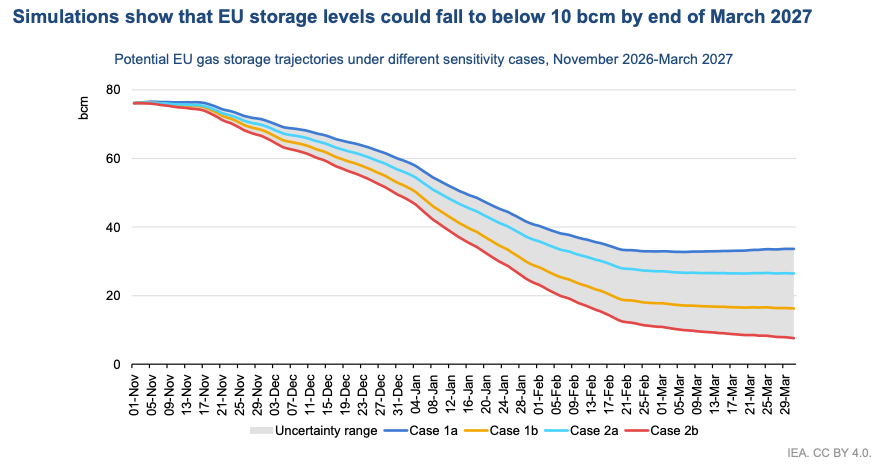
The IEA warns that under a scenario of colder-than-average temperatures combined with ongoing Hormuz issues, storage could fall below 10% of working capacity by late March 2027, leaving the market exposed to late-season cold snaps. Withdrawal rates from storage typically decline once levels drop below 30%, reducing the buffer against demand spikes.[3] Recent data from Gas Infrastructure Europe confirms EU storage around 74.6% full as of early November, with net withdrawals underway and Germany notably low at ~61%.[4]
Weather models indicate a record-early sudden stratospheric warming event disrupting the polar vortex in November 2026, potentially sending Arctic air southward into Europe and the US in the following weeks. Severe Weather Europe reports this could be the earliest such event on record, with signals for below-normal temperatures and increased snowfall risk over parts of the continent in December.[5][6] While a developing El Niño favors milder overall conditions, brief cold outbreaks remain a key upside risk for gas demand, as noted in broader weather-commodities outlooks.[7]
This thin margin echoes concerns from the 2022 crisis but stems from new geopolitical factors, with elevated prices persisting and potential for volatility extending into 2027 as Europe competes for LNG to replenish stocks. The combination of low inventories and possible early cold weather underscores Europe's ongoing energy vulnerability.
Sources (6)
- [1]IEA Issues Warning on Gas Market Tightness Extending Into 2027(https://finance.yahoo.com/energy/articles/iea-issues-warning-gas-market-060000599.html)
- [2]Global Gas Security Review 2026 - IEA(https://www.iea.org/reports/global-gas-security-review-2026)
- [3]IEA warns Europe gas storage could fall below 10 percent as LNG tightness extends into 2027(https://economyglobal.com/news/iea-warns-europe-gas-storage-could-fall-below-10-percent-as-lng-tightness-extends-into-2027/)
- [4]bne IntelliNews - Europe's heating season underway as gas drawdowns start from record low storage(https://www.intellinews.com/europe-s-heating-season-underway-as-gas-drawdowns-start-from-record-low-storage-481346/)
- [5]The Polar Vortex Is Collapsing in November: What It Could Mean for Your Winter(https://www.severe-weather.eu/long-range-2/polar-vortex-collapse-record-early-impact-winter-2026-2027-united-states-canada-fa/)
- [6]Polar Vortex Split Forecast: The Earliest Stratospheric Warming on Record Is Coming(https://www.severe-weather.eu/global-weather/polar-vortex-split-record-early-stratospheric-warming-event-november-2026-united-states-canada-europe-fa/)