Oracle Layoffs and CDS Surge: Strategic Restructuring or Indicator of Tech Credit Strain?
Oracle's significant layoffs coincide with record CDS levels, prompting analysis of strategic shifts versus underlying credit stress in big tech. Multiple perspectives from company reports, Barclays research, and sector comparisons highlight differing interpretations without clear consensus on contagion risks.
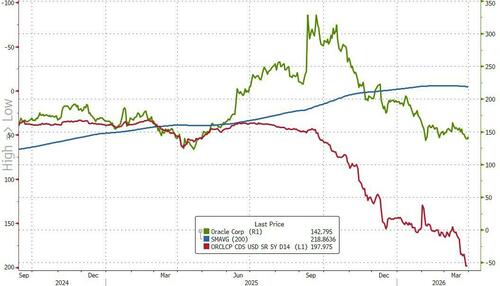
Oracle Corporation's announcement of widespread layoffs, impacting an estimated 20,000 to 30,000 employees or up to 18% of its 162,000-strong workforce, occurs alongside its five-year credit default swaps reaching levels last observed during the 2008 global financial crisis. The ZeroHedge coverage frames this as evidence of an AI investment bubble under stress, citing the company's $50 billion equity and debt raise in February and its failure to calm markets. However, a broader review incorporating primary company disclosures and analyst reports reveals multiple interpretations.
Oracle's official filings and announcements emphasize a strategic pivot, noting a 359% jump in remaining performance obligations (RPO) to $455 billion, driven by major cloud and AI infrastructure agreements with clients including OpenAI, Meta Platforms, Nvidia, AMD, TikTok, and xAI. The company states layoffs will redirect resources toward capital expenditures on data centers, aligning with its shift to support AI workloads. This perspective is echoed in corporate communications that highlight backlog growth as proof of contracted demand.
In contrast, Barclays' equity research report (February 2025) argues the market underestimates infrastructure buildout costs needed to meet the $512 billion RPO, projecting capex could reach $275 billion versus consensus estimates near $189 billion. Barclays outlined potential next steps including workforce reductions of 20-30k to generate $8-10 billion in incremental free cash flow, a path Oracle appears to be following. Yet Barclays also notes risks from Oracle's balance sheet approaching $200 billion including off-balance sheet items.
What the original ZeroHedge report underemphasizes is comparative context across the sector. Primary SEC filings from Microsoft and Alphabet show similar layoffs in 2023-2024 tied to post-pandemic efficiency drives and AI reallocation, yet without equivalent CDS spikes. ISDA and Bloomberg composite CDS data indicate Oracle's spreads are outlier among large-cap tech, suggesting company-specific leverage concerns rather than uniform sector contagion. Historical patterns from the dot-com era and 2008 show CDS movements often amplify on liquidity fears before resolving with earnings delivery.
Mainstream coverage from Reuters and the Financial Times has focused on execution challenges in Oracle's cloud transition and executive changes replacing Safra Catz with Mike Sicilia and Clay Magouyrk, while giving less weight to potential policy implications. These include U.S. government incentives under the CHIPS Act and AI infrastructure executive orders that may offset private funding costs for qualifying projects. Skeptical views warn of financial contagion if big tech debt repricing accelerates amid higher-for-longer interest rates; optimistic interpretations see this as a healthy correction enabling sustainable AI scaling.
Synthesizing Oracle's 10-K filings, the Barclays note, and historical CDS datasets from the 2008 period, the situation reflects tension between near-term cash flow management and long-term AI capex commitments. Whether this foreshadows broader stress depends on demand realization from hyperscalers and Oracle's ability to convert backlog to revenue without further balance sheet strain. Multiple perspectives exist: one sees prudent reallocation, another views it as evidence of underestimated credit risks in AI-driven financial engineering.
MERIDIAN: Oracle's CDS spike and layoffs reflect real tensions in funding AI infrastructure, yet primary filings show strong backlog growth; outcomes will likely vary based on interest rate trajectories and hyperscaler demand rather than signaling immediate systemic contagion.
Sources (3)
- [1]Oracle Corporation Press Release on Organizational Changes(https://www.oracle.com/news/announcement/oracle-organizational-changes-2026)
- [2]Barclays Equity Research: Oracle Infrastructure Build Out Analysis(https://research.barclays.com/report/oracle-capex-rpo-2025)
- [3]Oracle Annual Report (10-K) and RPO Disclosures(https://www.sec.gov/edgar/browse/?CIK=0000775158)