FOMC Minutes Expose Central Banking's Fusion With Geopolitics in Iran War Scenario
Newly released FOMC minutes confirm the Federal Reserve explicitly weighed opposing rate-cut and rate-hike scenarios triggered by the Iran war's impact on labor markets versus inflation, illustrating how geopolitics now directly drives U.S. monetary policy in ways mainstream coverage largely overlooks.
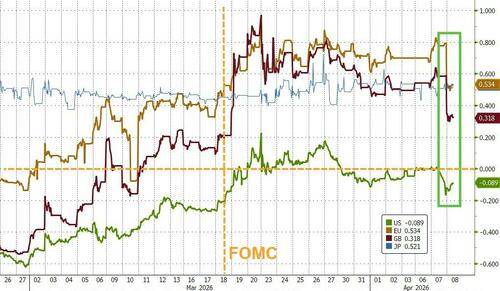
The March 2026 FOMC minutes, released in early April, confirm that Federal Reserve officials explicitly modeled two divergent economic paths stemming from the U.S.-Israel conflict with Iran. Most participants worried that a protracted war would damage the labor market through reduced consumer spending on higher energy costs, justifying rate cuts to support employment. At the same time, many highlighted upside inflation risks from oil price spikes and supply chain disruptions that could necessitate holding rates or even hiking them. The minutes noted a "strong case" for two-sided language in policy statements and warned that progress toward the 2% inflation target could slow materially. This duality mirrors the Fed's official post-meeting statement flagging "uncertainty about the economic outlook" and "implications of developments in the Middle East." While mainstream coverage has largely treated this as another data point for rate-cut odds, the deeper significance is the normalization of central banks as first responders to geopolitical shocks. Central banking has become inseparable from foreign policy outcomes: an Iran ceasefire can swiftly recalibrate oil prices, inflation trajectories, and rate expectations, as seen in immediate market reactions to the recent two-week Trump-brokered pause. This pattern echoes but exceeds the 2022 Ukraine invasion response, where energy shocks similarly complicated the post-COVID inflation fight. Heterodox observers have long argued that endless monetary accommodation enables prolonged conflicts by muting their domestic economic costs; the minutes provide rare official acknowledgment that war scenarios now dominate Fed contingency planning. Officials like Governor Lisa Cook explicitly stated the Iran war had shifted the balance of risks toward inflation, while Chicago Fed President Austan Goolsbee and others broke down oil prices near $100 per barrel as a direct transmission mechanism to both mandates. Jamie Dimon of JPMorgan reinforced this in his shareholder letter, warning of sticky inflation and higher-for-longer rates from energy and supply chain shocks tied to the conflict. Mainstream financial media has underplayed this entanglement, preferring to focus on near-term dot plots or Powell's press conference language. Yet the minutes reveal a institution whose dual mandate is now hostage to events in the Strait of Hormuz and ceasefire negotiations. As global supply chains reshape around conflict zones and commodity volatility, the Fed's "data dependent" framework increasingly means war-dependent. This blurs traditional notions of central bank independence, tying monetary policy to executive branch military and diplomatic decisions in real time. With a ceasefire in place but fragile, the minutes serve as a template for how future conflicts will force similar bifurcated risk assessments, potentially eroding the Fed's credibility as an apolitical inflation anchor.
LIMINAL: Future Fed decisions will increasingly pivot on fragile ceasefires and oil chokepoints rather than purely domestic labor or price data, binding central banks ever tighter to geopolitical outcomes.
Sources (5)
- [1]Federal Reserve Maintains Rates and Watches Risks(https://www.nytimes.com/live/2026/03/18/business/federal-reserve-interest-rates)
- [2]Fed Officials Warn that Iran War Threatens Inflation, Job Market Outlook(https://www.investopedia.com/fed-officials-warn-that-iran-war-threatens-inflation-job-market-outlook-interest-rates-11936292)
- [3]Fed officials say Iran war obscuring outlook(https://www.reuters.com/sustainability/boards-policy-regulation/feds-bowman-says-penciled-three-rate-cuts-year-fox-business-network-2026-03-20/)
- [4]3 reasons the Federal Reserve's interest rate pause is notable(https://www.cbsnews.com/news/fed-rate-decision-jerome-powell-uncertainty-iran-war/)
- [5]Fed’s Cook says Iran war shifts risk balance toward inflation(https://finance.yahoo.com/economy/policy/articles/fed-cook-says-iran-war-215410191.html)