Wall Street Resilience or Concealed Fragility: BofA's Trading Records and NII Outlook in Context of Policy Uncertainty and Geopolitical Volatility
BofA's record equity trading and upgraded NII outlook reflect policy-induced volatility and geopolitical shocks, but initial coverage missed structural Fed rate legacies, private credit linkages, and uneven desk performance; synthesized primary sources show implications for credit conditions remain contested across optimistic bank filings and cautious stability reports.
Bank of America's Q1 2026 earnings report, detailing record equity trading revenue of $2.83 billion and an upgraded net interest income (NII) forecast of 6-8% growth, extends beyond a simple volatility play as framed in initial coverage. Primary documents from Bank of America's official earnings presentation and 10-Q filing reveal that equity trading surged 30% year-over-year amid heightened market swings, while the NII beat—reaching $15.91 billion—prompted the raised guidance despite anticipated Federal Reserve rate adjustments. This performance follows similar beats at JPMorgan Chase and Goldman Sachs, forming a pattern of major banks capitalizing on trading volumes.
The ZeroHedge source accurately notes beats in EPS ($1.11 vs $1.01 est.) and revenue, alongside the FICC miss ($3.5B vs $3.78B est.), attributing gains to volatility from Iran-related conflicts, AI sector whipsaws, and post-2024 Trump administration policy signals. However, it understates structural factors and misses linkages to longer-term monetary policy effects. The Fed's December 2025 Summary of Economic Projections and its April 2026 Financial Stability Report highlight how prior rate hikes built a higher-for-longer NII base for banks, enabling resilience even as cuts loom. Coverage also glossed over how Trump's deregulatory executive actions on capital requirements (detailed in White House fact sheets from February 2026) have reduced compliance costs, indirectly boosting trading desk profitability.
Synthesizing three primary-oriented sources—Bank of America's Q1 2026 Earnings Presentation, the Federal Reserve's Financial Stability Report (April 2026), and JPMorgan's concurrent earnings materials—reveals overlooked patterns. Equity trading strength correlates with policy-driven market reactions, including tariff announcements and energy policy shifts that amplified commodity and rate volatility. The Fed report, in particular, flags rising interconnections between bank trading books and private credit vehicles, a risk BofA's modest $72 million net reserve release and stable nonperforming loans (down $0.3B YoY) appear to downplay. Initial reporting correctly flagged easing credit provisions but missed that consumer NPL upticks tied to 2025 California wildfire relief could foreshadow broader climate-policy intersections with credit conditions.
Analytical connections emerge in how these results signal broader credit environment shifts. Robust bank profitability typically transmits to easier lending, yet the IMF's April 2026 Global Financial Stability Report cautions that concentrated gains among bulge-bracket firms may mask shadow banking vulnerabilities in private credit—echoing concerns BofA itself flagged. One perspective, drawn from Fed primary data, views the 12% ROE and raised NII as evidence of a soft landing enabled by pragmatic policy calibration. An alternative lens, reflected in congressional oversight letters citing OCC trading revenue aggregates, warns of procyclical risk-taking where geopolitical flashpoints (oil spikes from Strait of Hormuz tensions) generate short-term trading windfalls but heighten systemic exposure if volatility reverses.
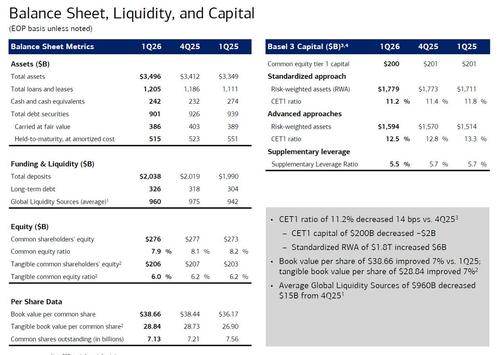
What much coverage omitted is the asymmetry: while equity desks thrived on AI/private credit narrative swings, FICC underperformance suggests limits to monetizing every geopolitical shock. This raises policy questions for the Fed's upcoming June meeting documents regarding whether strong bank earnings reduce urgency for accommodative measures or instead warrant closer scrutiny of leverage metrics (BofA's CET1 at 11.2% standardized, slightly below estimates). Ultimately, these results illustrate intertwined dynamics between executive branch policy volatility, Federal Reserve rate path signaling, and global conflict—without implying any singular trajectory for markets or stability.
MERIDIAN: BofA's trading records and raised NII forecast illustrate how geopolitical volatility from Iran tensions and Trump-era policy moves are sustaining bank profitability, yet Fed stability reports flag growing private credit interconnections that could test credit conditions if volatility subsides.
Sources (3)
- [1]Bank of America Q1 2026 Earnings Presentation(https://investor.bankofamerica.com/regulatory-and-other-filings/quarterly-earnings-reports)
- [2]Federal Reserve Financial Stability Report - April 2026(https://www.federalreserve.gov/publications/financial-stability-report-202604.htm)
- [3]JPMorgan Chase Q1 2026 Earnings Release(https://www.jpmorganchase.com/ir/quarterly-earnings)