EIA Data Exposes AI Boom's Overlooked Energy Reckoning: Data Centers Projected to Dominate 33% of Commercial Electricity by 2050
Synthesizing EIA's 2026 outlook with DOE, EPRI, and regional grid data reveals data centers driving a structural electricity crisis for the AI era, with commercial sector dominance by 2050 highlighting ignored grid, capacity, and economic constraints beneath tech optimism.
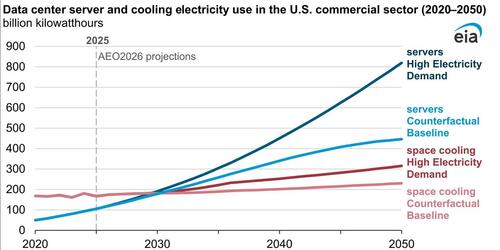
Mainstream narratives around artificial intelligence emphasize transformative potential while downplaying the massive physical substrate required to sustain exponential computational growth. The U.S. Energy Information Administration's Annual Energy Outlook 2026 reveals a stark infrastructure crisis: data center servers alone are projected to consume 22-33% of all commercial building electricity by 2050, with the High Electricity Demand case forecasting 818 billion kWh of server electricity use—more than 16 times 2020 levels. This assumes exponential AI server stock growth through 2050 without efficiency improvements beyond historical trends, causing commercial electricity intensity to surpass the 2003 peak of 14.9 kWh per square foot by 2031-2032. After 15 years of near-flat U.S. electricity demand, recent 2.1% annual growth is expected to moderate to 0.9-1.6% through 2050, yet data centers emerge as the dominant driver, outpacing residential and industrial sectors. Servers already represented an estimated 7% of commercial electricity in 2025.
What policy discourse largely ignores is the systemic strain this places on the grid and the unspoken tradeoffs. Regional hotspots like Virginia already show commercial sales surging due to data center concentration, per EIA analysis. The Department of Energy and Electric Power Research Institute contextualize this with data centers at roughly 4-4.4% of total U.S. electricity in 2023, potentially reaching 9% by 2030, with AI as a key accelerator. Building sufficient new capacity—whether nuclear, renewables with storage, or firm baseload—faces permitting delays, supply chain limits, and competition with electrification goals. Short-term reliance on existing infrastructure risks higher prices, reliability events, and distorted markets where hyperscale operators secure dedicated power at the expense of other users.
This EIA forecast connects to deeper heterodox concerns: the AI narrative of dematerialized intelligence collides with material limits of energy and infrastructure. Exponential server deployment without proportional efficiency leaps exposes the fragility of assuming endless scaling. Congressional reports note data center energy could double or triple near-term, underscoring that the 'cloud' is anything but weightless. Without accelerated nuclear revival, grid modernization, or demand management, the boom risks self-limitation—potentially reshaping tech timelines, economic priorities, and exposing how policy underestimates the hidden costs of computational expansion. The counterfactual baseline still shows significant growth, suggesting this trajectory is baked into current laws and trends rather than fringe speculation.
LIMINAL: The AI infrastructure surge will likely force a collision between hype-driven exponential computing demands and physical energy limits, accelerating either a nuclear/grid renaissance or a de facto slowdown in scaling that undermines narratives of unbounded digital progress.
Sources (5)
- [1]Annual Energy Outlook 2026(https://www.eia.gov/outlooks/aeo/)
- [2]Data center server energy use grows across the commercial building stock(https://www.eia.gov/todayinenergy/detail.php?id=67704)
- [3]Data centers could be 33% of commercial building electricity use by 2050: EIA(https://www.utilitydive.com/news/data-centers-commercial-building-electricity-use-eia/820604/)
- [4]Clean Energy Resources to Meet Data Center Electricity Demand(https://www.energy.gov/oe/clean-energy-resources-meet-data-center-electricity-demand)
- [5]Data Centers and Their Energy Consumption(https://www.congress.gov/crs-product/R48646)