Trump Scales Back US-South Korea Military Drills Amid Iran Refusal and Alliance Strains
Mainstream reporting confirms Trump ordered cuts to US-South Korea drills explicitly tied to Seoul's Iran stance, echoing prior troop reduction discussions and tech trade disputes; alliance strains carry broader geopolitical and economic implications.
President Donald Trump directed the Pentagon to substantially reduce joint military exercises with South Korea, citing costs, his rapport with North Korean leader Kim Jong Un, and Seoul's refusal to assist in actions against Iran. The annual Ulchi Freedom Shield exercise, which began August 17 with around 18,000 South Korean troops, was shortened from 11 days to five, ending August 21, with live field training scaled back or shifted to simulations.[1][2]
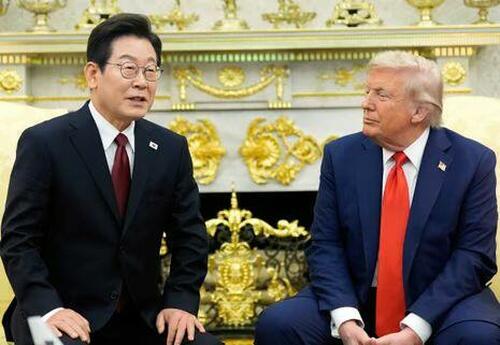
Trump explicitly linked the decision to a recent conversation with South Korean President Lee Jae-myung, recounting asking for help with Iran's "denuclearization" and receiving a "No thanks!" response. He noted the US hosts tens of thousands of troops in South Korea for deterrence against the North.[3][4] Multiple outlets including Reuters, CNN, BBC, and WSJ reported the order and the explicit Iran connection, confirming the drills' reduction.
This move aligns with earlier signals of shifting US posture. A May 2025 Wall Street Journal report detailed Pentagon options to withdraw roughly 4,500 of the 28,500 US troops from the peninsula for repositioning in Guam and the broader Indo-Pacific, though initial Pentagon denials followed.[5] The exercise cuts occur against a backdrop of bilateral friction, including South Korea's Fair Trade Commission actions against US tech firms such as Qualcomm ($854M fine in 2016, upheld in part), Google ($177M in 2021), and Apple, alongside newer regulatory scrutiny. A July 2026 ITIF analysis highlighted patterns of discriminatory enforcement favoring domestic players like Naver and Kakao.[6]
North Korea responded coolly, dismissing the reductions as insignificant while maintaining that the drills remain provocative. Chinese diplomacy, including Foreign Minister Wang Yi's visit to Seoul, adds regional context. The changes raise questions about alliance cohesion, potential US force reorientation toward China contingencies, and ripple effects on regional deterrence and energy markets amid US-Iran tensions.
[Geopolitical Analyst]: Reduced exercises signal accelerating US pivot from Korean Peninsula focus toward Indo-Pacific flexibility and China contingencies, potentially eroding deterrence credibility while pressuring Seoul on burden-sharing and tech policy; Iran linkage introduces unpredictable alliance friction with oil market volatility risks.
Sources (5)
- [1]Trump orders Pentagon to cut back military exercises with South Korea(https://www.reuters.com/world/china/trump-instructs-pentagon-reduce-military-exercises-with-south-korea-2026-08-16/)
- [2]South Korea, US scale back annual military drills after Trump's order(https://www.aljazeera.com/news/2026/8/19/south-korea-us-scale-back-annual-military-drills-after-trumps-order)
- [3]U.S. Considers Withdrawing Thousands of Troops From South Korea(https://www.wsj.com/world/asia/u-s-considers-withdrawing-thousands-of-troops-from-south-korea-725a6514)
- [4]Trump says US to reduce military drills with South Korea after it stayed out of Iran war(https://www.bbc.com/news/articles/cx2lll7zvn0o)
- [5]Korea's Regulatory Discrimination Against US Tech Firms Demands a Solution(https://itif.org/publications/2026/07/14/korea-regulatory-discrimination-against-us-tech-firm-demand-solution/)