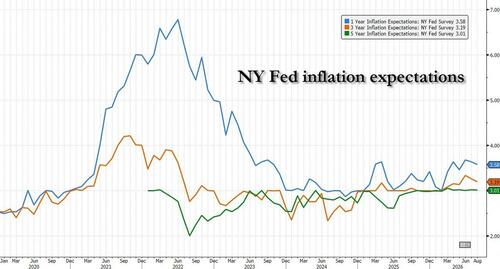
NY Fed Survey Reveals Split Consumer Outlook: Job Security Improves, Personal Finances Deteriorate
NY Fed data shows Americans feeling worse about finances and debt despite better personal job outlooks, with stable inflation expectations but rising unemployment fears—pointing to potential economic headwinds.
The Federal Reserve Bank of New York's August 2026 Survey of Consumer Expectations (SCE) highlights a notable divergence in American sentiment: while perceptions of the labor market show modest improvement on personal job security, views on household finances have worsened, with rising concerns over debt servicing and broader unemployment. Inflation expectations remained largely stable, with one-year-ahead median expectations unchanged at 3.6%, five-year at 3.0%, and three-year dipping slightly to 3.2%. Gas price expectations rose sharply to 4.6%. On finances, 38.6% of respondents reported their situation as much or somewhat worse than a year ago (up from 37.6% in July), and 32.6% expected worsening ahead (up from 30.3%). The share expecting to miss minimum debt payments over the next three months climbed to 13.16%. In contrast, the perceived probability of losing one's job fell to 13.8%—the lowest since February 2026—while the expected quit rate rose to 19.5%. However, the mean probability that the U.S. unemployment rate will be higher in a year surged to 44.4%, its highest since April 2020, and the chance of finding a new job if laid off declined to 45.4%. These trends were most pronounced among lower-income and less-educated respondents. Reuters noted that households marked down assessments of current and future financial situations amid mounting job market and credit worries. This split could signal softening consumer spending and increased financial stress within the next 12 months, even as official labor data shows resilience. Connections to other indicators, such as the Conference Board's Consumer Confidence Index decline and University of Michigan sentiment drops, suggest broader unease tied to persistent inflation pressures like gasoline costs.
[Economic Analyst]: Rising debt stress and unemployment fears among lower-income groups could dampen consumer spending and amplify recession risks by mid-2027 if labor market conditions soften further.
Sources (5)
- [1]Medium-Term Inflation Expectations Tick Down; Unemployment Expectations Deteriorate(https://nyfed.org/3Tlr8y6)
- [2]Consumers more worried about personal finances and jobs, New York Fed report shows(https://www.reuters.com/business/consumers-more-worried-about-personal-finances-jobs-new-york-fed-report-shows-2026-09-08/)
- [3]NY Fed Survey of Consumers shows inflation relief, jobs-market unease(https://www.fxstreet.com/news/ny-fed-survey-of-consumers-shows-inflation-relief-jobs-market-unease-202609081558)
- [4]Consumers' one-year inflation expectation unchanged in August: NY Fed(https://seekingalpha.com/news/4640810-consumers-one-year-inflation-expectations-remain-unchanged-in-august-ny-fed)
- [5]Longer-Run Inflation Expectations Remained Stable in August — NY Fed Survey(https://www.morningstar.com/news/dow-jones/202609085928/longer-run-inflation-expectations-remained-stable-in-august-ny-fed-survey)