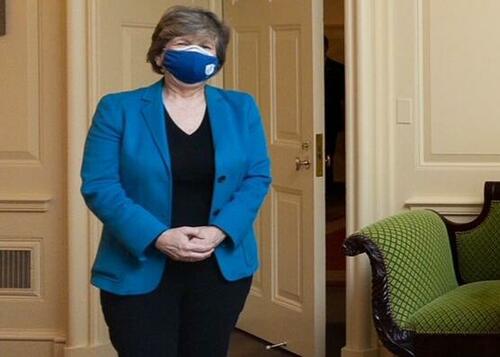
Weingarten's Screen Time Pivot: How Teachers Unions Deflect from Their Role in Historic Learning Loss
Analysis of Randi Weingarten and AFT's shift to blaming screens for student test score declines, corroborated by NAEP data on historic post-pandemic drops, congressional findings on union influence over CDC guidance, and her own recent statements. Reveals pattern of externalizing blame instead of accountability for school closure advocacy, linking to wider failures in education institutions.
American Federation of Teachers President Randi Weingarten has recently positioned herself as an advocate against excessive screen time in schools, declaring that students are 'drowning in tech' and calling for bans on screens for pre-K through second grade along with limits on AI. In a May 2026 address, she urged the creation of an independent research consortium to study the impacts of devices and advocated 'Devices Down, Eyes Up, Hands-On' learning. While concerns about technology's effect on attention and social development are valid and growing across political lines, this stance represents a notable deflection from the unions' documented role in prolonging school closures during the COVID-19 pandemic that directly contributed to unprecedented learning setbacks.
Official data from the National Assessment of Educational Progress (NAEP) long-term trend assessments reveal the scale of the damage: average scores for 9-year-olds declined 5 points in reading and 7 points in mathematics from 2020 to 2022—the largest drop in reading since 1990 and the first-ever decline in mathematics. Subsequent NAEP releases through 2025 have shown these losses persisting, with 12th-grade math and reading scores also falling and a record percentage of students scoring below basic levels. These outcomes were not inevitable but closely tied to the length of remote learning periods.
Congressional investigations by the House Select Subcommittee on the Coronavirus Pandemic uncovered that the AFT enjoyed uncommon access to draft CDC school reopening guidance in 2020. The union successfully proposed specific language changes, including 'trigger' provisions that could automatically close schools based on local conditions. Internal emails and testimony highlighted how these inputs shaped federal policy in ways that aligned with the AFT's preference for caution, even as the Trump administration pushed for quicker reopenings. Weingarten had labeled those efforts 'reckless' at the time. Research has since shown districts with stronger union presence were less likely to resume in-person instruction, controlling for local COVID metrics.
Weingarten has acknowledged in congressional testimony and writings that prolonged closures had impacts the union 'didn't get right,' yet the response has consistently pivoted to external factors—first COVID itself, now screens and Silicon Valley. This pattern fits a broader institutional reluctance to internalize accountability for education outcomes. Teachers unions, including the AFT and NEA, have faced criticism for channeling significant resources into political activities rather than core bargaining and support functions, even as real teacher pay has stagnated relative to comparable professions and membership declines.
The human cost extends beyond test scores to documented rises in youth anxiety, depression, and developmental delays from isolation. Recovery, experts agree, will require years of focused intervention. By framing the crisis primarily as a tech problem rather than grappling with the policy choices that kept children on screens at home for extended periods—often without effective instruction—union leadership misses an opportunity for genuine reflection. Parents navigating ongoing learning gaps see through the deflection. True progress demands owning institutional decisions, not just sounding alarms about the latest external culprit. This episode underscores a deeper heterodox insight: when public institutions prioritize self-preservation over outcomes, trust erodes, enrollment shifts accelerate, and the most vulnerable students bear the longest-term consequences.
LIMINAL: Union leaders' deflection from pandemic policy failures to screen blame will deepen public skepticism of public education institutions, accelerating homeschooling trends and demands for accountability reforms over the next decade.
Sources (5)
- [1]NAEP Long-Term Trend Assessment Results: Reading and Mathematics(https://www.nationsreportcard.gov/highlights/ltt/2022/)
- [2]American Federation of Teachers President Randi Weingarten Testifies to Uncommon Influence Over CDC School Reopening Guidance(https://oversight.house.gov/release/american-federation-of-teachers-president-randi-weingarten-testifies-to-uncommon-influence-over-cdc-school-reopening-guidance/)
- [3]Teachers union president calls for limits on AI and screen time in school(https://www.nbcnews.com/news/education/randi-weingarten-teachers-union-limits-ai-screen-time-school-rcna346871)
- [4]‘Devices Down, Eyes Up, Hands-On’: Weingarten Calls for Screen Bans, AI Limits(https://www.aft.org/press-release/devices-down-eyes-hands-weingarten-calls-screen-bans-ai-limits-active-learning-major)
- [5]Randi Weingarten blames PISA math slide on COVID(https://nypost.com/2023/12/05/news/randi-weingarten-blames-pisa-math-slide-on-covid/)