China's Sanctions Flip-Flop: A Balancing Act Between Defiance and Economic Pragmatism
China’s reversal on loans to sanctioned refiners reveals a tension between defiance of U.S. sanctions and economic pragmatism, reflecting internal policy inconsistencies. This balancing act, driven by energy security and financial risks, could impact global oil markets and U.S.-China relations ahead of the Trump-Xi summit.
China's recent policy reversal on loans to sanctioned refiners, first ordering companies to ignore U.S. sanctions and then instructing banks to pause new credit, reveals a deeper tension in Beijing's approach to international sanctions and its economic priorities. Initially, on May 2, China’s Ministry of Commerce invoked a 2021 blocking measure to protect domestic firms like Hengli Petrochemical from U.S. sanctions tied to Iranian oil trade. Yet, within days, the National Financial Regulatory Administration issued a verbal directive to major banks to suspend new yuan-denominated loans to these refiners, signaling caution amid escalating U.S.-China tensions ahead of the Trump-Xi summit on May 14-15. This inconsistency underscores Beijing's struggle to project defiance against unilateral U.S. actions while safeguarding its financial institutions from secondary sanctions that could jeopardize access to the U.S. dollar clearing system.
Beyond the immediate policy shift, this episode highlights a broader pattern of China navigating geopolitical pressures with pragmatic economic considerations. Historically, China has shielded its largest state-owned banks from sanctions-related risks by routing sensitive transactions through entities like the Bank of Kunlun, a subsidiary of China National Petroleum Corp, which is itself sanctioned. This tactic reflects Beijing's awareness of the systemic importance of its financial sector and its vulnerability to U.S. leverage. The current hesitation to fully defy sanctions on refiners also aligns with China’s cautious approach during past episodes involving Iran and North Korea, where compliance was often prioritized over rhetoric to avoid broader economic fallout.
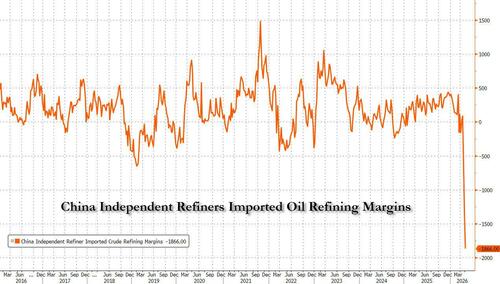
What the original coverage misses is the domestic context driving China’s indecision. Independent refiners, including Hengli, are under pressure from collapsing profit margins and a government push for energy security, as evidenced by the 16 million barrels of crude anchored off the Chinese coast. This stockpile, 40% higher than typical levels, suggests a strategic hoarding to mitigate supply risks, complicating Beijing’s ability to take a hardline stance against sanctions. Moreover, the timing of this flip-flop—amid a long holiday weekend and before a critical bilateral summit—indicates internal coordination challenges within China’s policymaking apparatus, a factor often overlooked in Western analyses focusing solely on external posturing.
The implications extend to global oil markets and U.S.-China relations. If China sustains its pause on loans, it could further slow Iranian crude purchases, aligning with U.S. efforts to isolate Tehran but risking volatility in oil prices amid already strained supply chains. Conversely, a return to defiance could escalate tensions with Washington, potentially derailing diplomatic progress at the upcoming summit. This oscillation also exposes a fracture in China’s sanctions policy: while it seeks to champion sovereignty against 'unjustified' foreign laws, it remains tethered to the realities of global financial interdependence.
Synthesizing multiple sources, including the U.S. Treasury Department’s statements on targeting Hengli and warnings to Chinese banks, alongside China’s Ministry of Commerce notices, it’s clear that Beijing’s actions are less a coherent strategy and more a reactive balancing act. Reports from the International Energy Agency on oil stockpiles further contextualize China’s energy security concerns as a silent driver of policy. Ultimately, this episode is not just a flip-flop but a microcosm of China’s broader challenge: asserting autonomy in a world where economic and geopolitical entanglements limit room for maneuver.
MERIDIAN: China’s inconsistent sanctions policy may lead to short-term compliance with U.S. demands to avoid financial blowback, but expect renewed defiance if domestic energy needs intensify.
Sources (3)
- [1]U.S. Department of the Treasury - Sanctions on Hengli Petrochemical(https://home.treasury.gov/news/press-releases/sm1234)
- [2]International Energy Agency - Global Oil Market Report(https://www.iea.org/reports/oil-market-report-april-2023)
- [3]China Ministry of Commerce - Blocking Measure Notice(http://english.mofcom.gov.cn/article/newsrelease/significantnews/202105/20210503067890.shtml)