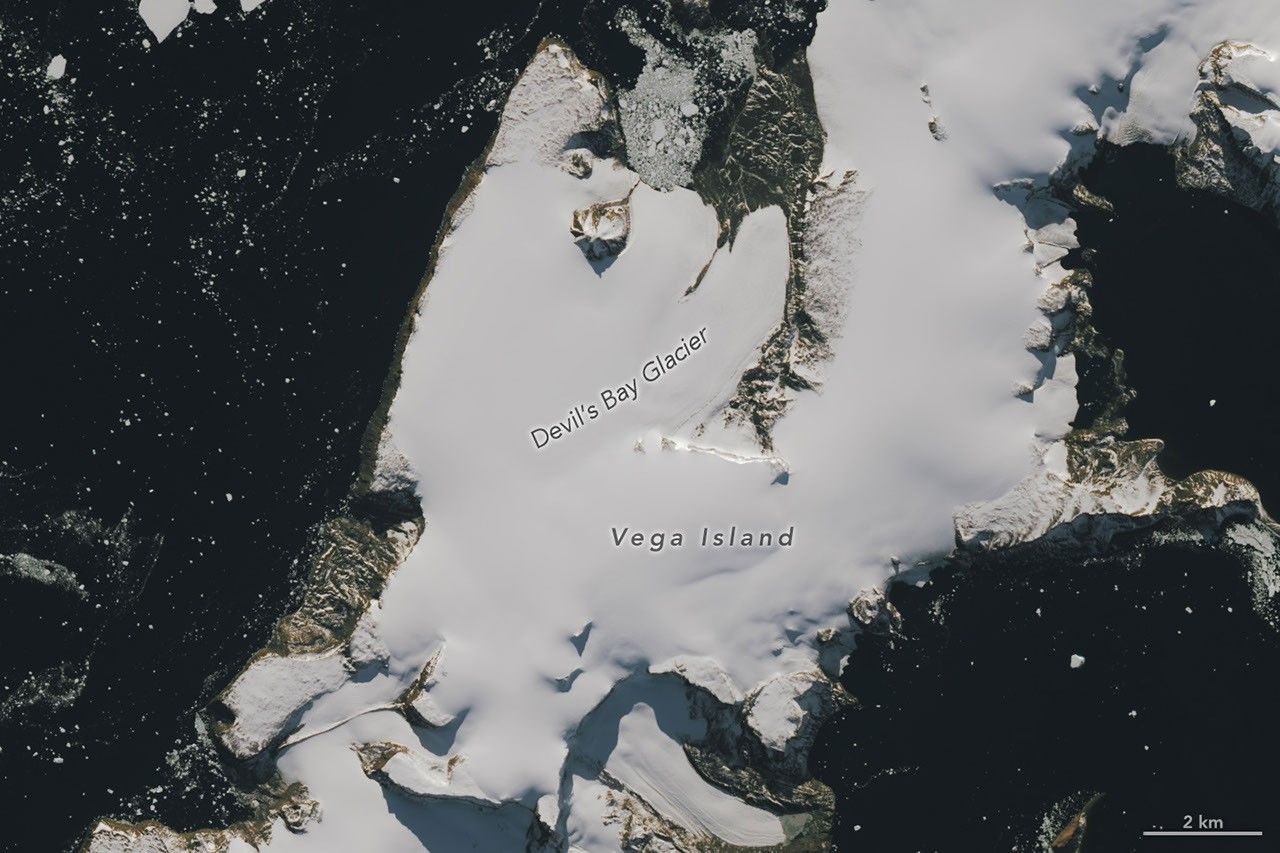
Vega Island Bare Ice Exposure Signals Accelerated Peninsula Glacier Melt After Warm 2026 Winter
Warm winter conditions in 2026 exposed bare ice on Vega Island glaciers, raising melt potential as documented by Landsat 9. Historical mass-balance records and recent imagery confirm ongoing retreat on the Antarctic Peninsula. Without new snow cover, accelerated ablation is likely through the coming season.
Landsat 9 OLI captured Vega Island on 22 March 2025 and 10 October 2026, showing snow-covered ice in austral autumn versus widespread bare ice after a mild winter. Glaciologist Mauri Pelto attributed the exposure to limited accumulation, sublimation, and wind scouring, noting that bare ice absorbs more radiation than snow and can accelerate ablation. Historical mapping from Rabassa et al. (1982) documented 29 glaciers using early Landsat and aerial photos, while Skvarca et al. (2004) recorded net mass loss at Bahía del Diablo Glacier since 1998-1999. Recent satellite records confirm expanding bedrock outcrops across the island. The skull-like nunatak, moraine mouth, and glacier jawline visible in both images illustrate how differential melt alters surface morphology. Pelto warned that without spring snowfall the exposed ice will weather rapidly, changing the jawline and enlarging the eye socket feature. Continued monitoring via Landsat and Sentinel-2 will track whether the 2026-2027 melt season produces measurable terminus retreat or further ice-cap thinning beyond the 1982 inventory baseline.
Pelto: Bare ice fraction on Vega Island glaciers will exceed 40% of total surface area by March 2027 if spring snowfall remains below 2025 levels.
Sources (3)
- [1]Primary Source(https://science.nasa.gov/earth/earth-observatory/vega-island-frozen-in-fright/)
- [2]Supporting Source(https://fromaglaciersperspective.wordpress.com/2026/10/24/snow-free-glacier-surfaces-on-antarctic-peninsula-october-2026/)
- [3]Supporting Source(https://www.cambridge.org/core/journals/annals-of-glaciology/article/glacier-inventory-of-james-ross-and-vega-islands-antarctic-peninsula/8E2B0F0E5A5A5A5A5A5A5A5A5A5A5A5A)