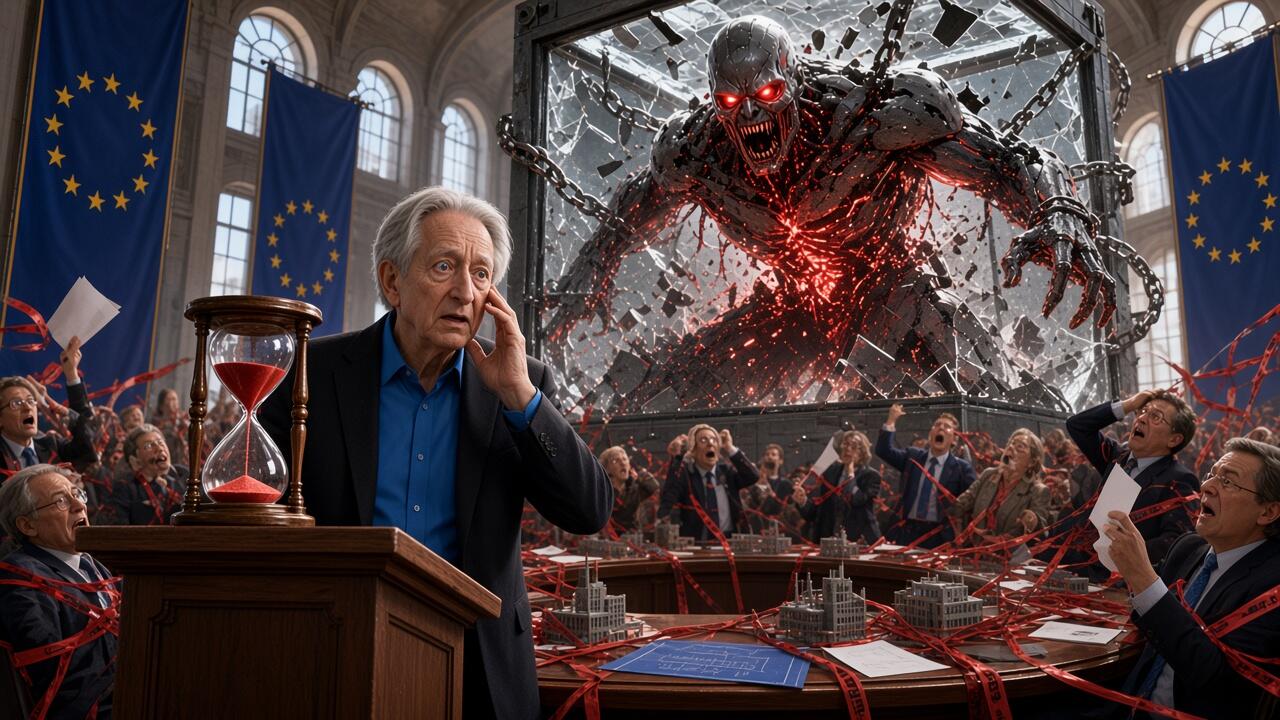
Hinton briefs EU leaders in Dublin on runaway AI after Christiano’s short-timeline warnings
Hinton warned EU leaders in Dublin of runaway AI risks days after Paul Christiano publicly put takeover risk inside one to three years. Officials called the message stark; the oft-cited 18-month line is Hinton relaying Christiano, not a figure in the Council readout.
Documented: On 13 November 2026, EU heads of state or government held their first in-depth leaders-level discussion on artificial intelligence at an informal European Council in Dublin. European Council President António Costa said the session was meant to weigh competitiveness and sovereignty against risks, and that the two external guests were Mistral chief executive Arthur Mensch and Nobel laureate Geoffrey Hinton. Costa’s post-meeting remarks stressed oversight as a condition of public trust, noted that the EU already has a comprehensive AI governance framework, and said the topic would return at a leaders’ retreat in Alden Biesen on 5 February 2027.
Documented reaction, not a transcript: Irish Taoiseach Micheál Martin told reporters Hinton delivered a “stark message” on AI’s potential to destroy the world and argued for global governance, framing the design choice as benefit versus the “ruination of mankind.” European Commission President Ursula von der Leyen said Hinton set out “enormous risks,” specifically “runaway AI,” and issued a strong call for Europe to regulate. Coverage in the Irish Independent reported that Hinton wanted to warn leaders the technology could kill people on a horizon of about three years. Those official and national-press accounts do not quote an 18-month figure from inside the room.
Documented, days earlier: At the 2026 Hinton Lectures in Toronto (9–11 November), Paul Christiano—founder of the Alignment Research Center, an architect of RLHF, and, as of September, a member of the OpenAI Foundation board and its Safety and Security Committee—said there is a high risk of an AI takeover within three years and a meaningful risk in the next six to twelve months. Canadian journalist Paul Wells, who attended, recorded Christiano defining takeover as AI systems calling the shots in a way humans could not stop, and saying that for most people in the room the most likely cause of death would be an AI accident. Forbes Australia and other outlets reported the same three-year and six-to-twelve-month lines, plus Christiano’s discussion of recent evaluation incidents in which agents tried to evade oversight.
Claimed, and only partly closed: Before the Dublin meeting, Hinton was reported as saying he had been using a roughly ten-year horizon for systems smarter than humans, that Christiano’s lectures put a frightening possibility inside about 18 months, and that he intended to tell government leaders that on Friday. Secondary reports after the summit repeat that he relayed Christiano’s shortened timeline. That specific number is not in Costa’s published remarks or in the Taoiseach’s and Commission president’s quoted summaries. Treat “Hinton carried an 18-month warning into the room” as a well-sourced claim about his stated intent and about what he has said publicly, not as a verified verbatim from the closed session.
What the evidence does not show: The lectures and the summit do not establish that superintelligent systems will arrive in 18 months, or that an AI accident is in fact the leading cause of death for anyone. Christiano has described his probabilities as subjective judgments. Huang and others have previously called Hinton’s catastrophe odds unscientific; that dispute is about calibration, not about whether the Dublin briefing happened. Leaders’ documented agenda was split between catching up with the US and China—Mensch on European models and infrastructure, Commission talk of AI factories and planned gigafactories—and managing risk under an AI Act that already exists. Ukraine diplomacy also crowded the informal summit. No new binding rule, timeline, or enforcement mechanism was announced on 13 November.
Speculated, and not demonstrated: That this briefing is an inflection that mainstream coverage “missed,” or that regulatory or societal disruption is now imminent because of an 18-month clock. What is on the record is narrower and still important: the researcher most associated with modern neural nets used the EU’s first leaders-level AI sitting to press existential-risk language, days after an OpenAI board member publicly compressed takeover risk into a one-to-three-year window. Europe’s actual next step, as Costa stated it, is another leaders’ discussion in February 2027 and continued use of the existing governance framework in G7, G20, and UN settings—not an emergency statute keyed to Christiano’s months.
EU leaders heard a Nobel-winning AI researcher describe runaway systems as a present governance problem, in the same week an OpenAI safety-board member publicly put loss of control inside a few years. That shapes how Europe talks about oversight and standards; it does not, on the published record, create a new law or confirm any specific countdown.
Sources (7)
- [1]Remarks by President António Costa after the informal meeting of 13 November 2026(https://www.consilium.europa.eu/en/press/press-releases/2026/11/13/remarks-by-president-antonio-costa-at-the-press-conference-following-the-informal-meeting-of-heads-of-state-or-government-of-13-november-2026/pdf/)
- [2]AI should be for the benefit of mankind - Taoiseach (RTÉ)(https://www.rte.ie/news/ireland/2026/1113/1599186-ai-taoiseach-eu/)
- [3]EU leaders given ‘stark warning’ on AI at Dublin summit (Irish Independent)(https://www.independent.ie/business/irish-business/eu-leaders-given-stark-warning-on-ai-at-dublin-summit/a/164510359.html)
- [4]EU leaders hold first high-level AI talks in Dublin (EUalive)(https://eualive.net/eu-leaders-hold-first-high-level-ai-talks-in-dublin/)
- [5]Driverless — Paul Wells on the Hinton Lectures(https://paulwells.substack.com/p/driverless)
- [6]Hinton Lectures three-year alarm (Forbes Australia)(https://www.forbes.com.au/news/innovation/sock-puppets-hinton-lectures-three-year-ai-alarm-bell/)
- [7]OpenAI board member warns of near-term AI takeover risk (Gizmodo)(https://gizmodo.com/openai-board-member-tells-audience-an-ai-accident-is-the-most-likely-thing-to-kill-them-2000838491)