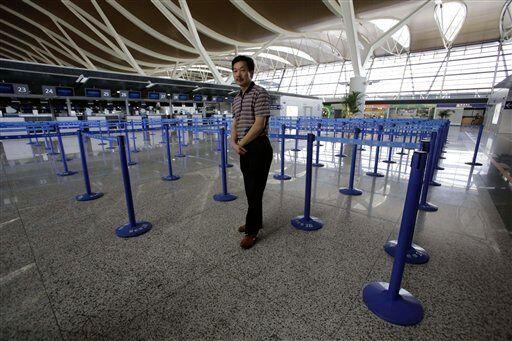
China's small airports with zero or near-zero flights still draw central subsidies as the 2026 budget hits a record
CAAC budget data and industry flight counts show several Chinese regional airports with zero or near-zero passengers in 2026 still scheduled for millions of yuan in central subsidies, inside a record 2.584 billion yuan small-airport program, while 71 percent of airports carry only 6 percent of passengers.
Documented: China's Civil Aviation Administration (CAAC) has published budget plans under which small and medium airports continue to receive central subsidies even when scheduled passenger traffic has collapsed. Reporting by Yicai (China Business News), later carried by Phoenix and Taiwan's Central News Agency, cites Flight Manager DAST data for January–October 2026: Chongqing Xiannushan Airport and Yunnan Ninglang Luguhu Airport recorded zero passenger flights and zero passenger throughput; Hubei Shennongjia Hongping handled 58 flights and 2,594 passengers (under 10 a day on average); Sichuan Jiuzhai Huanglong handled fewer than 20,000 passengers in the same period. CAAC's 2026 small-and-medium airport subsidy budget is reported at 2.584 billion yuan for 191 airports, about 80 percent above the 1.429 billion yuan paid to 163 airports in 2017. Within that plan, Xiannushan is listed for 8.58 million yuan in 2026 and 6.36 million in 2027; Luguhu for 9.87 million and 8.07 million; Shennongjia Hongping for 5.88 million and 5.80 million. Jiuzhai Huanglong is budgeted at 103.69 million yuan for 2026—the largest single allocation—and 94.33 million for 2027, after passenger throughput fell from about 1.75 million in 2012 to roughly 32,000 in 2025.
Documented context: CAAC's 2025 national airport production bulletin, summarized in Chinese financial coverage and on CAAC's English site, counts 270 certified civil transport airports on the mainland at the end of 2025. Of those, 191—71 percent—handled fewer than 2 million passengers each and together carried only about 6 percent of national passenger throughput. Forty-one airports above 10 million passengers carried 83.7 percent. National passenger throughput still set a record at about 1.53 billion. The subsidy program itself dates to rules issued with the Ministry of Finance to support thin routes and airports in central, western, and remote areas; high-plateau and ethnic-area airports receive formula uplifts, which helps explain why western airports dominate the top of the subsidy list even when volumes are tiny.
What Chinese business reporting treats as the operating cause, not a theory: construction ran ahead of demand, and high-speed rail plus expressways have taken the trips these airports were built to serve. Yang Xite of the Anbang macroeconomic research center told Yicai that some local airports were built ahead of actual demand. Jiuzhai Huanglong is the clearest documented case—a 2003 tourism airport that once handled more than a million passengers a year, then lost almost all of that traffic, saw route licenses cancelled, and entered a winter season with no scheduled flights, while remaining the top subsidy recipient because fixed operating costs and policy multipliers do not fall with the passenger count. Xiannushan, opened in 2020 inside a 5A scenic area at a reported investment of about 1.68 billion yuan, has never exceeded 100,000 annual passengers; 2025 throughput was about 10,500.
Claimed, and not established by the budget documents or the traffic data: that individual projects were driven primarily by cadre promotion and corruption, and that officials who approved them face no accountability. Those interpretations appear in commentary attached to the same numbers; they are not findings in the CAAC bulletin or the Yicai account.
Speculated, and not shown by the figures above: that these subsidies are large enough, by themselves, to threaten national fiscal stability. The 2026 small-airport pot is 2.584 billion yuan—material for the airports that depend on it, small beside China's overall budget and beside the capital already sunk in runways that now move almost no one. The structural fact the official numbers do show is a split system: a handful of hubs carry nearly all the traffic and set the growth headlines, while a majority of certified airports exist as subsidized public facilities whose passenger role has been overtaken by roads and rail.
Taxpayers fund airports that official traffic counts show are barely used, while most Chinese air travel concentrates in a few large hubs. The gap is already in CAAC statistics and subsidy budgets, not only in outside commentary.
Sources (7)
- [1]Yicai: Under the shock of the road network, some small airports move fewer than 10 passengers a day(https://www.yicai.com/news/103446891.html)
- [2]Phoenix reprint of the Yicai report on small-airport subsidies(https://news.ifeng.com/c/8yBVwUkOgpC)
- [3]Central News Agency: More than 70 percent of China's airports rely on fiscal subsidies(https://www.cna.com.tw/news/acn/202611190389.aspx)
- [4]CAAC notice on the 2026 civil aviation development fund subsidy budget(https://www.caac.gov.cn/XXGK/XXGK/TZTG/202510/t20251011_228782.html)
- [5]CAAC English release: 2025 National Civil Transport Airport Production Statistics Bulletin(https://www.caac.gov.cn/English/News/202603/t20260304_230166.html)
- [6]Sina Finance: Jiuzhai Huanglong tops the small-airport subsidy list as funds tilt west(https://finance.sina.com.cn/roll/2026-10-28/doc-iniwuzmt5827288.shtml)
- [7]Huxiu: The airport that took 100 million yuan in subsidies, then suspended flights(https://www.huxiu.com/article/4901317.html)