Congo suspends cobalt exports again from November 30 as prices slide
Congo’s minerals regulator ARECOMS will halt all cobalt exports from November 30 until further notice, its second full ban since early 2025, after prices fell again under a quota system that already capped shipments well below recent output.
Documented: The Democratic Republic of Congo, which accounts for roughly 70 to 75 percent of mined cobalt, will suspend all cobalt exports from November 30 until further notice. The regulator ARECOMS said the halt covers industrial and artisanal output and is meant to address oversupply, weak demand, rising inventories, and what it called speculative practices. Reuters, Bloomberg, and the Financial Times reported the decision on the same day, quoting the regulator’s stated aim “to address the oversupply in the international market and to promote a sustainable rebalancing.”
Documented: This is the second full export suspension since early 2025. Congo first halted shipments in February 2025 after prices hit multi-year lows, then replaced that ban in mid-October 2025 with a quota system. Under those rules, fourth-quarter 2025 exports were capped at 18,125 metric tons and annual exports for 2026 and 2027 at 96,600 tons—less than half of 2024 Congolese output, according to Reuters and the International Energy Agency’s policy record of ARECOMS Decision No. 004/2025. China’s CMOC and Glencore received the largest quota allocations. Implementation lagged: Bloomberg reported in late November 2025 that shipments had still not resumed weeks after the ban formally lapsed, and Reuters later described new conditions including a quota verification certificate and a prepaid 10 percent royalty.
Documented: The first intervention lifted prices, then the market gave ground again. Industry reporting citing Fastmarkets and Benchmark Mineral Intelligence describes cobalt hydroxide—the main product shipped from Congo—more than doubling or even quadrupling after the 2025 ban, then falling by roughly half from an April peak by mid-to-late 2026. ARECOMS said prices had declined significantly and persistently since June. It plans to review the new suspension after four months and use the pause to revise quota allocation. A review does not automatically restart exports; any restart would require a separate decision on volumes and conditions.
Claimed, by the regulator and by Kinshasa’s broader policy line: export controls are a deliberate lever to rebalance the market, raise state revenue, and assert control over a byproduct of copper mining that feeds lithium-ion batteries. President Félix Tshisekedi previously described the quota regime, in cabinet minutes reported by Reuters, as “a real lever to influence this strategic market.”
Speculated, not established by the announcement itself: that the halt will hold prices, permanently restructure battery supply chains, or give the Global South a durable chokehold over Western EV industries. The 2025 episode showed that a dominant producer can move the price, and also that refiners seek other feedstocks, inventories rebuild, and demand weakness can overwhelm supply cuts. Cobalt’s role in batteries is also narrowing in some chemistries, so the strategic weight of any single export decision is not the same as Congo’s share of mined supply.
The pattern is still concrete. A country that produces most of the world’s cobalt has now twice chosen to stop selling it rather than accept the prevailing price, and has built a quota-and-royalty apparatus—strategic reserve allocation included—around that choice. Battery makers, Chinese refiners, and miners such as CMOC and Glencore are the parties whose shipments, stockpiles, and contract terms change first.
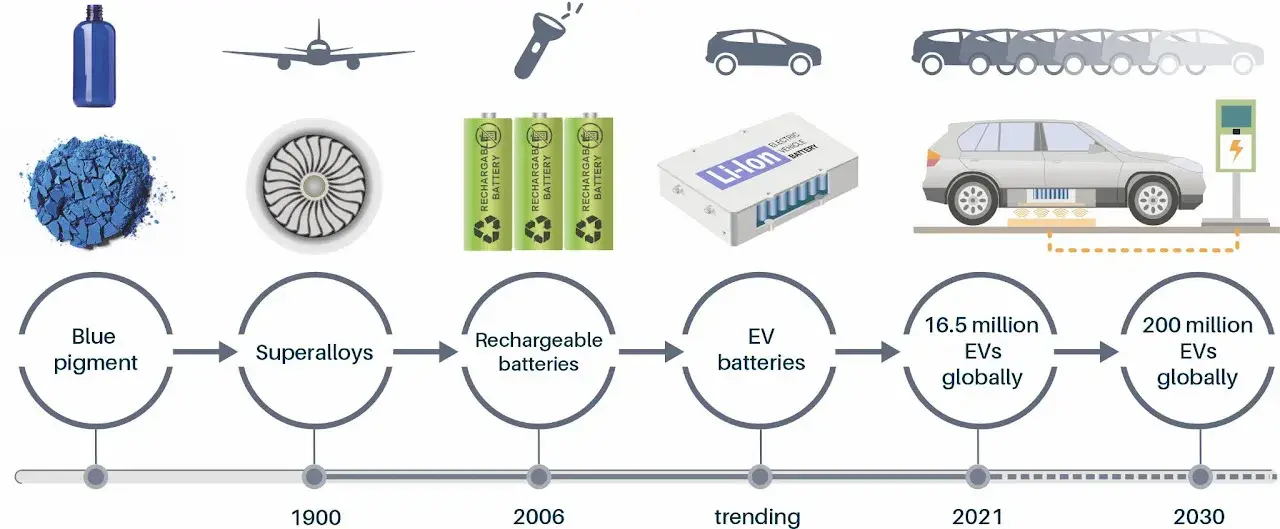
Congo supplies most of the world’s mined cobalt, a metal used in many EV and electronics batteries. A second export halt changes how much material refiners and battery makers can actually buy, and on what terms miners such as CMOC and Glencore can ship it.
Sources (6)
- [1]Congo halts cobalt exports again to tackle oversupply, support prices — Reuters(https://www.reuters.com/world/africa/congo-halts-cobalt-exports-again-tackle-oversupply-support-prices-industry-2026-11-23/)
- [2]Top Cobalt Miner Congo to Ban Exports Again as Prices Fall — Bloomberg(https://www.bloomberg.com/news/articles/2026-11-23/top-cobalt-producer-congo-will-ban-exports-again-as-prices-slide)
- [3]DR Congo reimposes cobalt export ban to shore up prices — Financial Times(https://www.ft.com/content/7421ec30-dde5-409a-971c-64359c21ea3d)
- [4]Congo sets new export conditions to keep tight grip on cobalt — Reuters(https://www.reuters.com/world/africa/congo-sets-new-export-conditions-keep-tight-grip-cobalt-2025-12-05/)
- [5]DRC ARECOMS Decision No. 004/2025 – Cobalt Quota System — IEA(https://www.iea.org/policies/29138-drc-arecoms-decision-no-0042025-cobalt-quota-system)
- [6]DR Congo to end cobalt export ban in favour of quotas — Financial Times(https://www.ft.com/content/89293fb8-69f0-4581-9d5d-29d2bb9e6165)