Gulf States Advance Pipeline Networks to Circumvent Strait of Hormuz, Signaling Energy Resilience and Deglobalization Trends
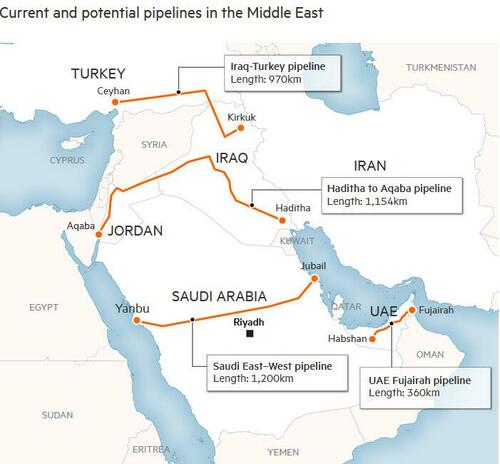
Amid Iran-related conflict blocking the Strait of Hormuz, Gulf nations are expanding and planning bypass pipelines like Saudi East-West and UAE Fujairah routes, highlighting chokepoint vulnerabilities and accelerating a shift to regional infrastructure consistent with deglobalization patterns.
The ongoing conflict involving Iran has thrust the Strait of Hormuz into the spotlight as a critical vulnerability in global energy flows, prompting Gulf states to accelerate plans for alternative pipeline infrastructure. According to the Financial Times, the threat of prolonged Iranian influence over the strait is driving reconsideration of costly bypass projects, shifting from hypothetical discussions to operational planning. Existing routes, such as Saudi Arabia's East-West Pipeline (also known as Petroline), are now running at or near full capacity of approximately 7 million barrels per day, serving as a vital lifeline to the Red Sea port of Yanbu.
Reuters reports that Gulf exporters are already rerouting significant volumes through these bypasses, with Saudi flows to Yanbu surging and the UAE maximizing its Habshan-Fujairah pipeline to the Gulf of Oman. Al Jazeera highlights three key pipelines—Saudi's East-West, the UAE's Abu Dhabi Crude Oil Pipeline, and the Iraq-Turkey route—as immediate mitigations, though they currently cover less than 30% of normal Hormuz transit volumes per Forbes analysis.
A senior adviser to the Atlantic Council noted a shift toward viewing a 'web of corridors' rather than isolated projects as the path to true resilience, a view echoed in Washington Post commentary advocating for expanded bypasses to render the strait irrelevant. These efforts extend beyond oil to encompass broader trade corridors, potentially reviving elements of the India-Middle East-Europe Economic Corridor (IMEC) with rail and pipeline connectivity.
This infrastructure push exposes the fragility of globalized energy chokepoints, where a single maritime passage handles roughly one-fifth of global oil trade. In the context of deglobalization, it represents a strategic move toward regional self-reliance and 'friend-shoring' of critical supply lines, reducing dependence on vulnerable sea lanes prone to disruption in multipolar conflicts. As construction firms report increased inquiries for new routes despite high costs (estimated at $5 billion or more for expansions), the Gulf's response illustrates preparation for protracted instability while foreshadowing a broader fragmentation of hyper-globalized trade networks into more fortified, localized systems. Political, security, and cross-border challenges remain, yet the momentum suggests a lasting reevaluation of energy security architecture.
LIMINAL: Gulf states' pivot to networked bypass pipelines reveals accelerating deglobalization, as nations prioritize hardened regional energy autonomy over fragile global maritime chokepoints in preparation for extended great-power friction.
Sources (4)
- [1]Gulf states consider new pipelines to avoid Strait of Hormuz(https://www.ft.com/content/880664d8-e110-4760-8b00-aa3141a770ff)
- [2]Gulf oil producers scramble to bypass Hormuz as Iran locks down the strait(https://www.reuters.com/graphics/IRAN-CRISIS/MAPS/znpnmelervl/2026-03-17/gulf-oil-producers-scramble-to-bypass-hormuz-as-iran-locks-down-the-strait/)
- [3]Saudi, UAE, Iraq: Can three pipelines help oil escape Strait of Hormuz(https://www.aljazeera.com/economy/2026/3/27/saudi-uae-iraq-can-three-pipelines-help-oil-escape-strait-of-hormuz)
- [4]Opinion | Build pipelines to bypass the Strait of Hormuz(https://www.washingtonpost.com/opinions/2026/03/25/iran-hormuz-energy-pipeline-bypass/)