Maximum Pressure Revisited: US Hormuz Blockade and Sanctions on China's Teapot Refineries Expose Layers of Economic Warfare
US combines naval blockade of Iran's oil exports via Hormuz with Treasury sanctions and warnings targeting Chinese teapot refineries in Shandong that process 90% of Iran's crude, exposing integrated military-economic strategy against Iran's shadow banking and China's role in sustaining Tehran amid escalating bilateral tensions.
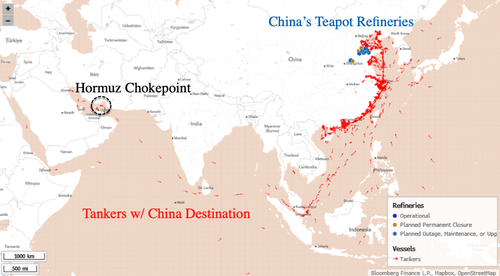
As the United States maintains its naval blockade of the Strait of Hormuz amid an ongoing conflict with Iran now in its third month, parallel economic measures targeting China's independent 'teapot' refineries reveal a sophisticated strategy of hybrid warfare that extends far beyond traditional military confrontation. According to reports, President Trump has directed preparations for an extended blockade to strangle Iran's oil exports, a move framed as leverage to force concessions on Tehran's nuclear program and regional activities. This military pressure is complemented by aggressive Treasury Department actions aimed at the primary buyer of Iranian crude.
The U.S. Department of the Treasury's Office of Foreign Assets Control (OFAC) issued a stark warning to financial institutions regarding sanctions risks tied to Chinese independent refineries, predominantly based in Shandong Province. These facilities process the bulk of Iran's oil exports, with China accounting for approximately 90% of Tehran's crude sales. Recent designations include multiple teapot refineries such as Hengli Petrochemical and others that have handled billions in Iranian oil since 2025. Treasury also sanctioned 35 entities and individuals linked to Iran's shadow banking network, which officials describe as a critical lifeline funding the regime's armed forces, terrorism proxies, and destabilizing activities across the Middle East.
Treasury Secretary Scott Bessent emphasized that illicit funds moving through this architecture directly threaten U.S. interests, warning of severe consequences for any institutions facilitating these flows. This includes enhanced due diligence requirements for banks and scrutiny of dollar-denominated transactions involving these Chinese entities, some of which have previously accessed the U.S. financial system. The approach represents secondary sanctions in action—indirect pressure on China to curtail its economic ties with Iran without an outright confrontation with Beijing.
Mainstream coverage often portrays these as isolated Iran-focused measures, yet they illuminate deeper U.S.-China economic tensions. By targeting the teapot sector, Washington is disrupting a key workaround in Iran's sanctions evasion architecture at the refining end of the supply chain, just as the Hormuz blockade chokes exports at the source. This dual squeeze highlights how control over chokepoints—both geographic (the Strait) and financial (shadow banking and commodity processing)—forms the backbone of modern hybrid conflict. Observers note that while direct sanctions on major Chinese banks have been avoided so far, the rhetoric and incremental designations signal readiness to escalate if needed, especially ahead of anticipated high-level diplomacy between Trump and Xi Jinping.
The strategy builds on over 1,000 prior Iran-related designations under the 'maximum pressure' campaign. It also raises questions about long-term impacts: Will this accelerate China's efforts to insulate its energy imports through alternative currencies and routes? Does it expose vulnerabilities in global oil markets where independent refiners have filled gaps left by traditional players? By going after the shadow fleet, teapots, and parallel banking structures, the U.S. is attempting to dismantle the opaque networks that have sustained Iran despite years of sanctions. However, as one analyst suggested in related reporting, avoiding the 'jugular' of major Chinese financial enablers risks the campaign appearing performative rather than decisive.
This episode underscores heterodox views on geopolitics: surface-level narratives of nuclear talks and military posturing mask a deeper contest over energy flows, financial architecture, and economic sovereignty. The intersection of Hormuz blockade enforcement and teapot sanctions is not merely about Iran—it is a case study in how great power competition manifests through targeted economic disruption that mainstream outlets often reduce to isolated headlines.
LIMINAL: By squeezing both ends of Iran's oil lifeline through Hormuz and Chinese teapots, the US risks accelerating Sino-Iranian de-dollarized trade networks, turning economic pressure into a catalyst for alternative global financial architectures that could erode US leverage long-term.
Sources (4)
- [1]Treasury Warns of Sanctions Risks Linked to China-Based Independent “Teapot” Oil Refineries(https://home.treasury.gov/news/press-releases/sb0476)
- [2]Trump Announces U.S. Blockade of Strait of Hormuz(https://www.wsj.com/livecoverage/iran-war-latest-news-israel-us-lebanon-2026/card/trump-announces-u-s-blockade-of-strait-of-hormuz-WrVSTMbe0uAtRACE4jTk)
- [3]US imposes sanctions on Chinese 'teapot' refinery for buying Iranian oil(https://www.reuters.com/business/energy/us-imposes-sanctions-chinese-teapot-refinery-buying-iranian-oil-2026-04-24/)
- [4]Economic Fury Targets Global Network Fueling Iran's Oil Revenues(https://home.treasury.gov/news/press-releases/sb0472)