Transformer Lead Times Stretch to Record Highs, Exposing Structural US Grid Vulnerabilities Amid AI and Electrification Boom
Credible industry data from Wood Mackenzie and related reports validate record transformer lead times and demand pressures linked to AI/EV growth, highlighting a real grid equipment bottleneck with domestic supply constraints centered on Cleveland-Cliffs GOES production.
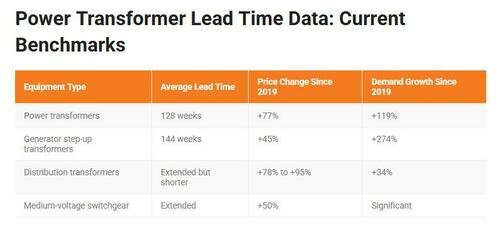
Power transformer delivery times have climbed to averages of 128 weeks, with generator step-up (GSU) units reaching 144 weeks, according to Wood Mackenzie’s Q2 2025 survey data referenced across industry analyses. This marks a continuation of trends first highlighted in 2024 reports showing lead times surpassing 120 weeks, driven by demand surges of 116-119% for power transformers and up to 274% for GSUs since 2019. These bottlenecks have shifted from capital or permitting issues to equipment availability as the primary constraint on new industrial, data center, and grid projects.
Multiple corroborating sources confirm the scale. Wood Mackenzie reports project supply deficits of 30% for power transformers and around 10% for distribution units in 2025, with imports filling roughly 80% of large power transformer needs. Price increases of approximately 77% since 2019 align with raw material pressures, including doubled grain-oriented electrical steel (GOES) costs and rising copper prices. Cleveland-Cliffs remains the sole domestic GOES producer, prompting federal support and company investments such as a new Weirton, WV facility expected online in 2026 to boost capacity.
The surge ties directly to AI data centers, EV infrastructure, renewables integration, and grid modernization, with competing demands outstripping manufacturing ramps. Analyses from pv magazine USA and Power Magazine note lead times extending to 2-4 years for some units, delaying plant energization and exposing reliance on global supply chains from Mexico, South Korea, and elsewhere. NERC and utility filings echo these extended timelines, underscoring risks to reliability and deployment pace.
While some easing occurred in Q2 2025 (down ~10 weeks in certain categories), the structural mismatch persists, with tariffs and workforce gaps adding further friction. This infrastructure chokepoint, documented in official industry surveys rather than speculation, reveals how material and production concentration amplifies fragility in the face of exponential load growth.
LIMINAL: Extended transformer wait times will increasingly dictate project timelines for AI facilities and grid upgrades, compelling utilities and developers to secure equipment years in advance or face cancellations amid sustained demand growth.
Sources (5)
- [1]Power transformers and distribution transformers will face supply deficits of 30 and 10 in 2025(https://www.woodmac.com/press-releases/power-transformers-and-distribution-transformers-will-face-supply-deficits-of-30-and-10-in-2025/)
- [2]Supply shortages and an inflexible market give rise to high power transformer lead times(https://www.woodmac.com/news/opinion/supply-shortages-and-an-inflexible-market-give-rise-to-high-power-transformer-lead-times/)
- [3]U.S. transformer market faces severe supply constraints as lead times extend to four years(https://pv-magazine-usa.com/2026/05/11/u-s-transformer-market-faces-severe-supply-constraints-as-lead-times-extend-to-four-years/)
- [4]Cleveland-Cliffs moves ahead with $150M electric transformer plant(https://www.utilitydive.com/news/cleveland-cliffs-confirms-150-million-electric-transformer-weirton-plant/723363/)
- [5]Transformers in 2026: Shortage, Scramble, or Self-Inflicted Crisis?(https://www.powermag.com/transformers-in-2026-shortage-scramble-or-self-inflicted-crisis/)