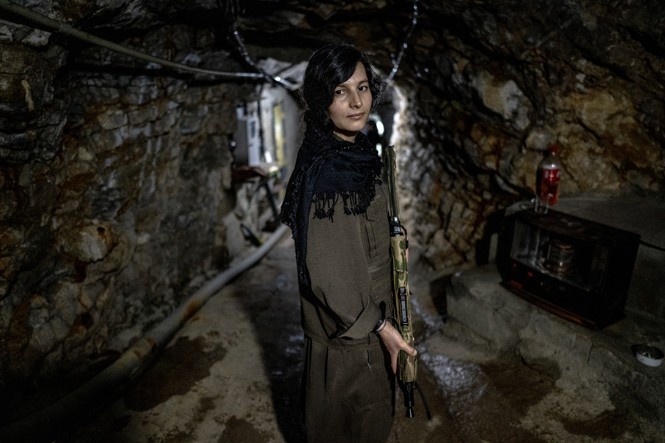
The Kurdish Proxy Trap: Mobilizing Peshmerga Against Iran Risks Repeating Cycles of Betrayal and Regional Fracture
Peshmerga mobilization for potential U.S. action against Iran fits a historical pattern of American proxy use that has repeatedly left Kurdish allies exposed, risking Iraqi stability, Turkish backlash, and wider regional escalation.
The Atlantic's dispatch from the Iraq-Iran border captures Peshmerga fighters who are both eager to join what they see as an American campaign against Tehran and deeply uneasy about the destination. Yet this reporting, while vivid on the ground-level mood, misses the deeper structural pattern: the United States once again reaching for Kurdish forces as disposable shock troops in a larger geopolitical contest.
Observation shows this is not an isolated development but the latest chapter in a century-long pattern of external powers courting Kurdish militias for short-term tactical gains while remaining indifferent to their long-term political aspirations. From the 1991 uprising against Saddam Hussein that Washington encouraged and then abandoned, to the post-ISIS drawdown in Syria that left Kurdish partners exposed to Turkish incursions, the historical record is consistent. The original coverage underplays how this current mobilization could destabilize the delicate Kurdish Regional Government arrangement inside Iraq, potentially inviting Iranian proxy retaliation or Turkish cross-border operations.
Synthesizing the Atlantic piece with a 2023 Foreign Affairs analysis of U.S. proxy reliance in the Middle East and the International Crisis Group's reporting on Iran's Kurdish provinces during the 2022 Mahsa Amini protests reveals what was overlooked: the risk of igniting transnational Kurdish unrest. Iran's Kurdish population, long marginalized, could view Peshmerga involvement as either opportunity or provocation, further fracturing Tehran’s control while complicating U.S. efforts to isolate the regime.
The piece also underestimates the NATO dimension. Turkey, already conducting operations against Kurdish groups it labels terrorists, will interpret American-backed Peshmerga activity near its borders as direct threat. This creates a dangerous feedback loop where U.S. policy in Iraq-Iran tensions undermines its relationship with Ankara.
In analysis distinct from mere observation, this episode signals a troubling continuity in American foreign policy: the substitution of local ground forces for sustained diplomatic strategy or domestic political will. After the chaotic Afghanistan withdrawal, re-embracing proxy warfare without credible security guarantees for partners risks further eroding U.S. credibility across the region. The broader pattern suggests that such escalations rarely produce stable outcomes; instead they redraw temporary battle lines while leaving underlying ethnic and sectarian grievances unresolved, often empowering the very adversaries Washington seeks to contain. The unease voiced by Peshmerga commanders is not mere battlefield jitters, it is institutional memory warning that this road has been traveled before, with painful results.
PRAXIS: This mobilization will likely yield short-term tactical pressure on Iran but at the cost of long-term erosion of Kurdish trust in U.S. commitments, potentially destabilizing Iraq's fragile federal structure and straining NATO cohesion with Turkey.
Sources (3)
- [1]The Kurdish Ground Force Preparing to Fight in Iran(https://www.theatlantic.com/international/2026/03/kurdish-troops-us-iran-war/686572/)
- [2]The Limits of American Proxy Warfare(https://www.foreignaffairs.com/articles/middle-east/2023-06-13/limits-american-proxy-warfare)
- [3]Iran's Kurds: Between Protest and Suppression(https://www.crisisgroup.org/middle-east-north-africa/gulf-and-arabian-peninsula/iran/2023-irans-kurds)