Commerce issues interim rule requiring licenses for remote access to advanced AI chips by China and for shipments to five diversion hubs
BIS has issued an interim final rule that licenses large-scale remote access to advanced U.S. AI chips by companies tied to China and other embargoed countries, and adds license requirements for chip shipments to Singapore, Malaysia, Indonesia, Thailand, and Brazil. The move follows Jensen Huang’s resignation amid a spy-related scandal, but the rule itself is a documented export-control change, not a finding about that scandal.
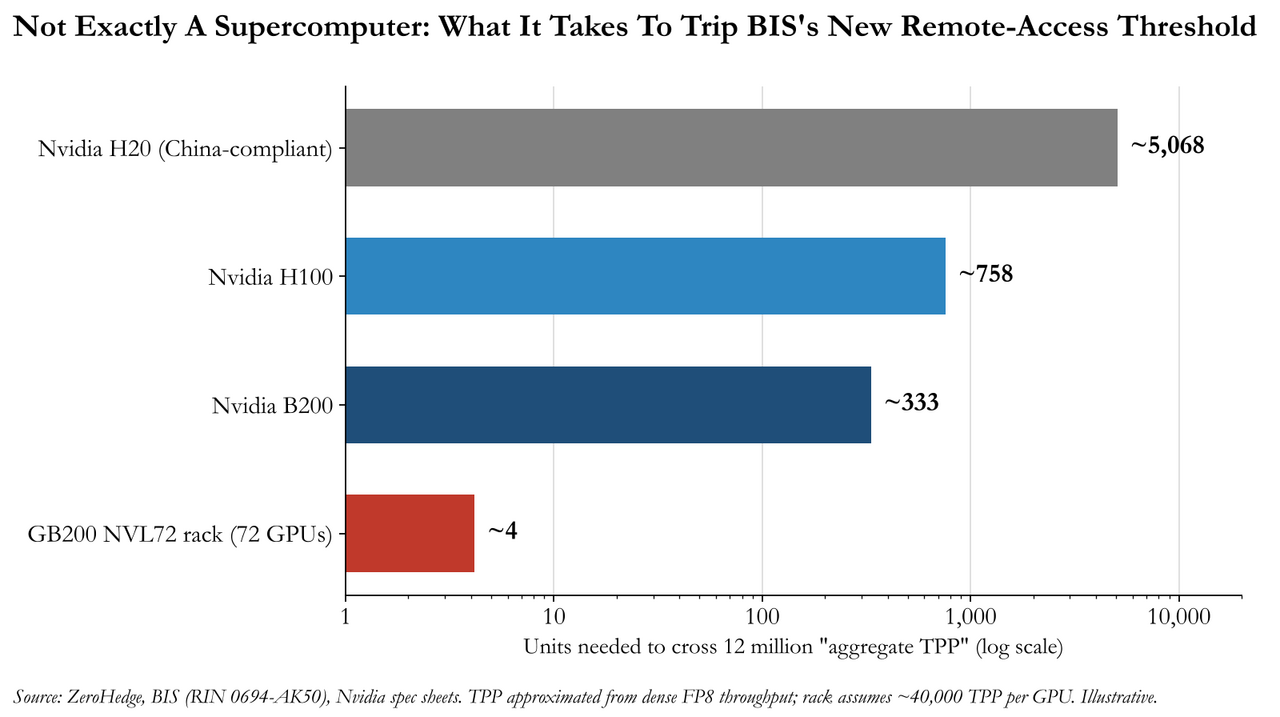
Documented: On November 16, 2026, the Commerce Department’s Bureau of Industry and Security released an interim final rule, RIN 0694-AK50, written at the direction of the Treasury Department and the National Security Council. BIS said the rule is meant to stop existing limits on sensitive American technology from being bypassed through remote computing in data centers in third countries, aligning those protections with controls on physical shipments. The rule text and contemporaneous reporting describe a new end-use control: a license is required to export, reexport, or transfer covered advanced chips or servers to a data center anywhere in the world when the exporter knows the facility will provide more than 12 million aggregate total processing performance (TPP) to companies headquartered in Macau or a Country Group D:5 destination—including China—or whose ultimate parent is headquartered there. Linked data centers, including digitally linked facilities, count toward that threshold. Reporting puts 12 million TPP in the neighborhood of several hundred Nvidia H100- or H200-class chips. Indirect arrangements are in scope when a non-D:5 customer trains models for, participates in training for, or provides models to a covered company. Operators already supplying significant covered compute have 90 days from the effective date to obtain a license. Separately, the rule adds a destination license requirement for advanced semiconductors going to Indonesia, Malaysia, Singapore, Thailand, and Brazil, which BIS describes as presenting a higher-than-normal risk of diversion. The Secretary of Commerce can designate additional countries. Shipments to U.S.-headquartered companies, or companies whose ultimate parent is U.S.-headquartered, are carved out of that five-country requirement if specified reporting is met. The rule also rescinds the Biden-era AI Diffusion Rule framework, which the Trump administration had already said it would not enforce, including country tiers, model-weight controls, and the data-center validated end-user program. BIS’s own release uses “super intelligence” rather than “artificial intelligence,” consistent with Executive Order terminology referenced in the rule text. Claimed, and corroborated in outline by Reuters, CBS, Politico, and Forbes but not independently verified in the rule itself: the timing sits four days after Nvidia CEO Jensen Huang resigned on November 12, 2026. Nvidia named CFO Colette Kress interim CEO. Reuters reported that Huang stepped down after revelations of extramarital affairs, including one with a Chinese businesswoman whom U.S. authorities have identified or suspected as a spy, and a second with a direct report. Coverage ties the policy debate to Megaspeed, a Singapore-based data-center customer long suspected of routing Nvidia compute toward Chinese users. What the rule does not do, on the published record, is adjudicate that scandal, name Megaspeed, or prove that any particular model was trained on diverted chips. Speculated, and not established by the rule or by the mainstream accounts above: that the regulation was drafted specifically as a response to Huang’s personal conduct, or that every Southeast Asian cloud rental of U.S. chips was a deliberate diversion scheme. What is documented is narrower and more structural. Physical export bans did not, by themselves, stop a Chinese-headquartered lab from renting equivalent compute hosted abroad. The new control treats large-scale remote access as an export event when the exporter has knowledge of the end use, and it raises the licensing bar for five countries that have functioned as chip and data-center transit points. That is a governance shift in the AI supply chain: cloud intermediaries, not only chip shippers, now sit inside the license regime, and Chinese developers who relied on overseas clusters face a compliance wall even when the silicon never enters China.
Chinese AI developers and the overseas data centers that rented them U.S. chips now need licenses for large-scale remote compute, and chip shipments to five transit countries face new licensing. That changes who can legally train on American hardware without the chips ever entering China.
Sources (7)
- [1]BIS Issues Rule Addressing Remote Access to American Super Intelligence Technology(https://www.bis.gov/press-release/bis-issues-rule-addressing-remote-access-american-super-intelligence-technology)
- [2]RIN 0694-AK50 rule text (BIS)(https://www.bis.gov/media/documents/rin-0694-ak50.pdf)
- [3]US tightens AI chip export controls to deter Chinese companies from accessing compute remotely(https://techcrunch.com/2026/11/16/us-tightens-ai-chip-export-controls-to-deter-chinese-companies-from-accessing-compute-remotely/)
- [4]Commerce closes China’s backdoor to Nvidia chips after White House steps in(https://www.politico.com/news/2026/11/16/commerce-closes-chinas-backdoor-to-nvidia-chips-after-white-house-steps-in-01167199)
- [5]US Closes Loophole That Allowed China To Remotely Access Nvidia Chips(https://www.forbes.com/sites/zacharyfolk/2026/11/16/us-closes-loophole-that-allowed-china-to-remotely-access-nvidia-chips/)
- [6]Nvidia CEO Jensen Huang resigns in blow to AI boom he helped foster(https://www.reuters.com/business/retail-consumer/nvidia-ceo-jensen-huang-step-down-big-blow-ai-boom-2026-11-12/)
- [7]After Nvidia scandal, Commerce Department moves to curb remote access to AI chips(https://www.cbsnews.com/news/nvidia-jensen-huang-commerce-department-limit-remote-access-ai-chips/)