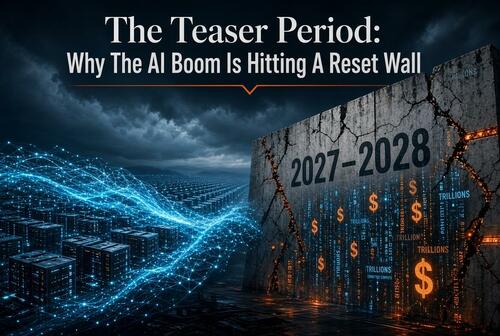
AI Compute Commitments Mirror Mortgage Teaser Structures, With $Trillions in Obligations Ramping Up in 2027-2028
Fringe analysis of AI financing as a 'teaser period' cycle finds support in documented multi-trillion commitments, take-or-pay structures, and 2027-2028 payment ramps across credible financial and regulatory sources. It highlights systemic limits on AI scaling tied to construction delays, power constraints, and revenue dependency, revealing underappreciated interconnections in the five-layer AI economy (labs, clouds, neoclouds, chips, utilities).
The AI infrastructure buildout relies heavily on long-term take-or-pay compute and power contracts where payments often commence only upon capacity delivery, typically 24-36 months after signing due to construction and energization timelines. This creates a synchronized 'reset wall' of full-rate obligations peaking in 2027-2028, following the 2025-2026 signing surge, akin to the 2/28 ARM resets that fueled the 2008 crisis—though here driven by data center development rather than home prices.
Corroborating reports detail massive off-balance-sheet commitments: nine major tech firms hold around $3 trillion in AI-related obligations not yet on balance sheets, with leases and purchase commitments activating as facilities come online. OpenAI's $300 billion Oracle deal, for instance, begins revenue recognition and payments ramping in 2027, far exceeding the lab's current ~$10-20 billion annual revenue run rate. Broader hyperscaler capex is projected to exceed $700-800 billion in 2026 alone, climbing toward $1 trillion+, financed partly through circular equity ties, asset-backed debt, and Nvidia backstops.
Deeper connections emerge in power and utility layers: data centers increasingly sign 15-20+ year take-or-pay electricity contracts with minimum bills (e.g., $19 million/month at full ramp for one Oracle-linked project starting late 2027), locking in obligations regardless of utilization. This compounds sustainability challenges—data centers could drive nearly half of US electricity demand growth by 2030—while exposing concentration risks among a handful of frontier labs and hyperscalers. BIS analysis highlights how contest-driven overinvestment and circular financing amplify boom-bust potential, with net economic surplus turning negative beyond ~$3 trillion in buildout if revenue disappoints.
Unlike 2008, physical assets (GPUs, facilities) retain residual value, and backers like Nvidia provide guarantees, but the structure still ties rapid AI progress to continuous revenue acceleration and innovation to service fixed costs. Unexplained anomalies in official data remain limited, but institutional warnings from the BIS, IMF scenarios, and Fed notes on tail risks underscore vulnerabilities in sustaining the pace without broader economic productivity gains.
Groundbreaker/ZeroHedge lens: Payment synchronization in 2027-2028 will test whether AI revenue growth can match committed scale, potentially forcing renegotiations or slower buildouts if utilization lags.
Sources (8)
- [1]The Teaser Period: Why the AI Boom Is Hitting a Reset Wall(https://www.groundbrkr.com/p/the-teaser-period-why-the-ai-boom)
- [2]Exclusive | Oracle, OpenAI Sign $300 Billion Cloud Deal(https://www.wsj.com/business/openai-oracle-sign-300-billion-computing-deal-among-biggest-in-history-ff27c8fe)
- [3]Nvidia GPU Debt Backstop Unleashes the AI Project Trinity(https://newsletter.semianalysis.com/p/nvidia-gpu-debt-backstop-unleashes)
- [4]Capacity reservation and take-or-pay contracts for AI compute(https://computelaw.blog/deals/capacity-reservation-take-or-pay-ai-compute/)
- [5]OpenAI signs record Ohio data center lease with Nvidia backing(https://the-decoder.com/openai-signs-record-ohio-data-center-lease-with-nvidia-backing-up-to-105-billion/)
- [6]Is there a pending AI ‘debt bomb’ crisis? No. This isn’t Enron 2.0(https://www.theguardian.com/technology/2026/aug/23/ai-debt-bomb-crisis)
- [7]Big Tech Firms Like Oracle Turn to Bonds to Finance A.I. Data Centers(https://www.nytimes.com/2026/07/17/business/ai-spending-oracle-stocks-bonds.html)
- [8]BIS Working Paper on AI boom and financial stability(https://www.bis.org/publ/work1367.pdf)