Iran's Coordinated Infrastructure Strikes Expose Critical Air Defense Gaps and Hybrid Escalation Risks
Iran executed precision strikes on key US airpower enablers across five Gulf states, revealing hybrid warfare tactics, air defense shortcomings, and elevated risks of American strategic entanglement in the Middle East.
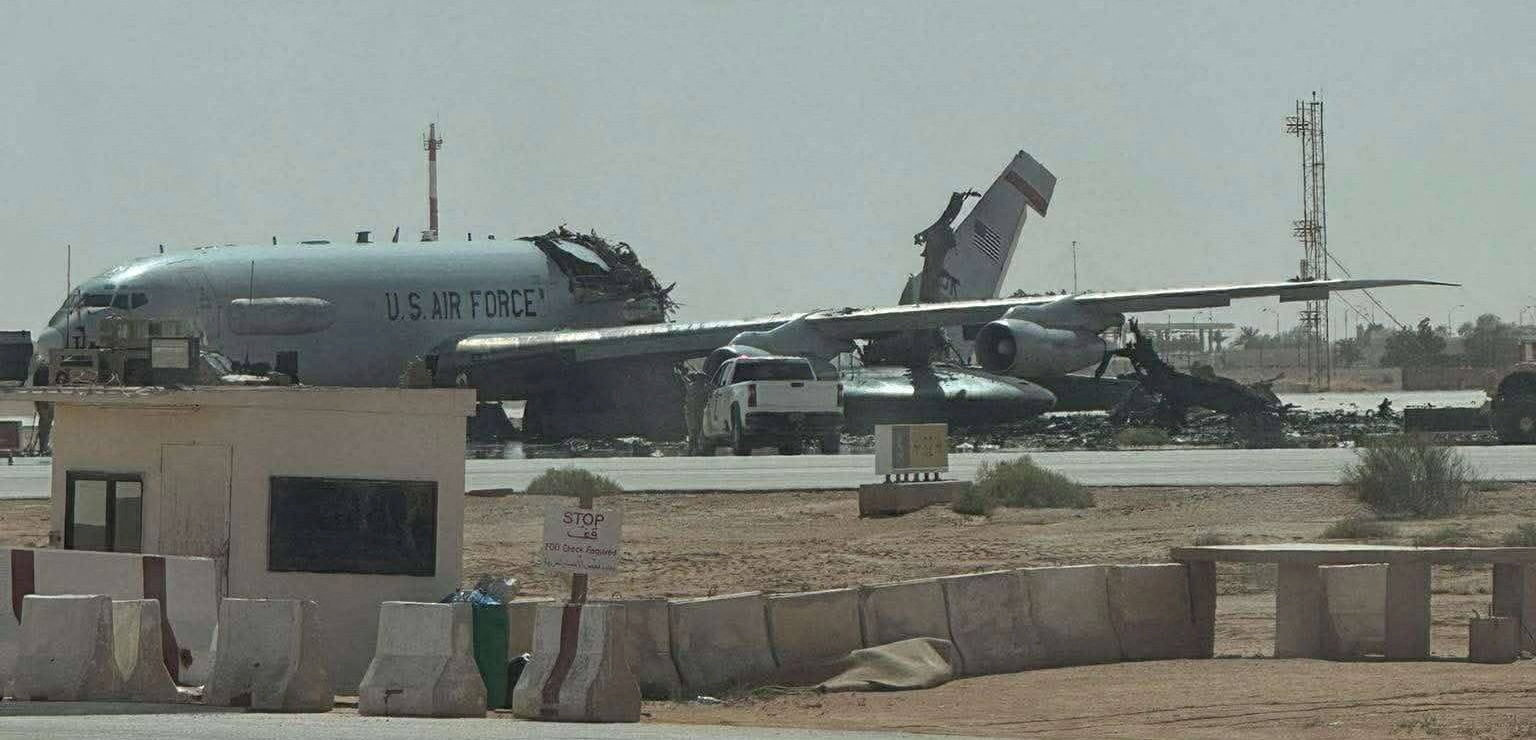
Iran's simultaneous strikes on radar systems, satellite communications nodes, and mission-critical aircraft at US bases spanning Bahrain, Qatar, Kuwait, Saudi Arabia, and the UAE represent a calibrated escalation that transcends the tactical details reported in initial coverage. While Defense News accurately cataloged the targets, it understates the operational sophistication and strategic signaling involved. By focusing on the enabling infrastructure rather than kinetic aircraft destruction, Tehran is employing a classic hybrid playbook: degrade US power projection without crossing the threshold into direct combat with American pilots, thereby complicating Washington's retaliation calculus.
This operation builds directly on patterns established in the 2020 Al Asad base attack following the Soleimani strike, the 2019 Abqaiq–Khurais drone assaults on Saudi Arabia, and more recent Iranian-supplied Houthi precision strikes in the Red Sea. A 2024 CSIS Missile Threat Project assessment documented Iran's rapid evolution in ballistic and cruise missile accuracy, including the integration of loitering munitions and decoys designed specifically to overwhelm layered air defenses like Patriot PAC-3 and THAAD batteries. The current strikes suggest these capabilities have matured further, exposing persistent vulnerabilities in Gulf Cooperation Council integrated air and missile defense architectures despite over $100 billion in US arms sales since 2015.
What mainstream coverage has missed is the intelligence dimension. Hitting multiple classified sites across five sovereign nations in a single wave implies either extensive human intelligence penetration, successful cyber mapping of US networks, or highly effective use of commercial geospatial intelligence. This connects to the broader pattern of Iranian gray-zone operations seen in the 2022-2023 maritime harassment campaigns and proxy militia attacks on US forces in Iraq and Syria. RAND's 2023 study on Iranian hybrid warfare correctly identified this preference for infrastructure targeting as a means to impose costs while maintaining plausible deniability and avoiding unified Western responses.
The implications extend beyond the Gulf. These strikes test American commitment at a moment when US strategic focus remains divided between European security and Indo-Pacific competition. They also risk forcing a wider entanglement: any substantial US retaliation will likely trigger Iranian proxy responses across multiple theaters, stretching already stressed logistics and munitions stockpiles. Air defense vulnerabilities exposed here mirror challenges observed in Ukraine, where even advanced Western systems struggle against massed low-cost threats combined with sophisticated electronic warfare.
This episode reveals a dangerous evolution in regional conflict dynamics where the distinction between peace and war becomes deliberately blurred. Tehran is demonstrating that US air dominance, long taken for granted, now carries a prohibitive infrastructure tax that Washington and its partners appear unprepared to fully mitigate.
SENTINEL: Iran's infrastructure-focused strikes indicate a sustained campaign to raise the operational cost of US presence in the Gulf, exploiting air defense gaps that could force resource diversion from other theaters and increase the probability of direct confrontation within the next 90 days.
Sources (3)
- [1]Primary Source(https://www.defensenews.com/global/mideast-africa/2026/04/01/iranian-strikes-target-the-infrastructure-behind-us-airpower/)
- [2]CSIS Missile Threat Project - Iran(https://missilethreat.csis.org/country/iran/)
- [3]RAND Report on Iranian Hybrid Warfare(https://www.rand.org/pubs/research_reports/RRA123-1.html)