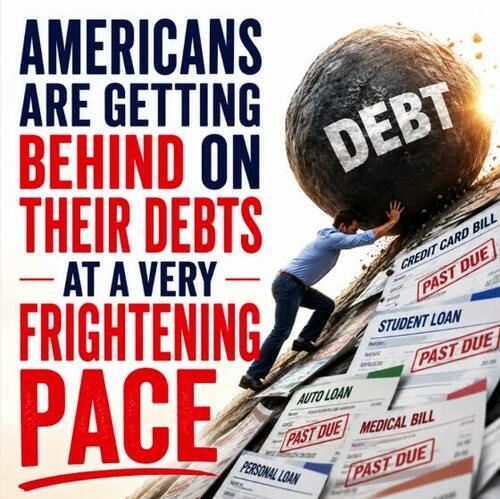
Household Debt Delinquencies: Cross-Currents in Consumer Stress and Policy Responses
FRBNY and ATTOM primary data highlight rising delinquencies and foreclosures as signals of household pressure, balanced against BEA spending resilience and policy variables that may moderate recession signals.
Federal Reserve Bank of New York data for Q1 2026 records auto loan delinquencies at historic peaks, credit card rates at 13.1 percent nearing 2008 levels, and student loan serious delinquencies rising to 10.9 percent from 8.0 percent a year prior, against total household debt approaching 19 trillion dollars. Primary Federal Reserve documentation frames these as extensions of post-pandemic borrowing patterns amid elevated living costs, yet omits granular regional breakdowns that ATTOM foreclosure filings reveal through 42,430 April 2026 notices, up 18 percent year-over-year. A counter-perspective from Bureau of Economic Analysis consumption expenditure series suggests resilient aggregate spending in higher-income cohorts may offset delinquency-driven pullbacks, contrasting with labor market indicators from BLS showing uneven wage growth that leaves lower quintiles exposed. Policy linkages emerge in how Federal Open Market Committee rate paths intersect with trade cost pressures, where secondary effects on import-dependent households could amplify delinquency clusters without direct causation from any single factor. Original ZeroHedge coverage overstates uniform national risk by underweighting Federal Reserve primary series on revolving credit utilization that indicate selective rather than systemic default acceleration.
MERIDIAN: Elevated delinquency metrics across loan categories may prompt Federal Reserve adjustments that ripple into trade policy calibrations if sustained spending slowdowns materialize.
Sources (3)
- [1]Federal Reserve Bank of New York Quarterly Report on Household Debt and Credit(https://www.newyorkfed.org/microeconomics/hhdc.html)
- [2]ATTOM Data Solutions Foreclosure Report(https://www.attomdata.com)
- [3]Bureau of Economic Analysis Personal Consumption Expenditures(https://www.bea.gov/data/consumer-spending)