Iran Conflict Enters Second Month: Oil Surges, Equities Fall as Strait of Hormuz Uncertainty Persists
Second month of Iran conflict drives oil toward $103 and equity declines as multiple de-escalation attempts fail to assure safe Hormuz transit; primary statements from involved parties reveal irreconcilable narratives that current coverage under-emphasizes.
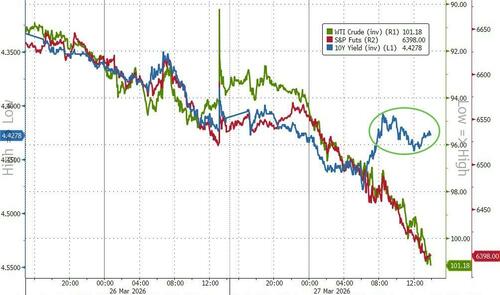
As the Iran-related conflict moves into its second month, financial markets are displaying classic signs of sustained geopolitical risk: West Texas Intermediate crude futures tested $103 per barrel while S&P 500 futures declined nearly 1 percent in early Asian trading. The ZeroHedge report correctly identifies 'Green-Dot Sunday' as an emerging market ritual, reflecting continuous headline-driven volatility with little weekend liquidity for price discovery. However, the coverage underplays the multiplicity of diplomatic tracks and overstates the binary nature of duration as the sole variable.
Primary documents from the Iranian Foreign Ministry describe strikes on Tehran electricity facilities as 'targeted at civilian infrastructure,' while IDF operational statements insist strikes are confined to 'military targets linked to missile and drone capabilities.' These contrasting official narratives, rather than market commentary alone, explain why investors cannot price a clean resolution. A third perspective emerges from the joint communique issued after the Pakistan meeting of regional foreign ministers, which calls for 'immediate de-escalation and unimpeded maritime passage,' echoing language used in the 2019 Gulf tanker incidents documented in U.S. Central Command reports from that period.
What much current coverage misses is the precedent of partial Hormuz disruptions. Historical data from the International Maritime Bureau and U.S. Energy Information Administration assessments of 2019-2020 show that even limited attacks raised insurance premiums by over 300 percent without fully closing the strait. Current market pricing appears to be oscillating between a brief supply shock inflating prices and a longer demand destruction scenario if conflict spreads, producing the stagflationary bond rally noted in the source.
Goldman Sachs research cited in the report correctly flags duration and safe transit as the pivotal questions. Yet primary diplomatic cables and public statements reveal at least three parallel de-escalation attempts (five-day delay, ceasefire proposal, ten-day delay) that received no verifiable reciprocal commitments. Pentagon planning documents referenced by the Washington Post indicate preparatory movements of Marine units, suggesting U.S. contingency planning for extended presence, while Iranian officials continue to threaten asymmetric responses through proxies.
The synthesis of these primary positions shows markets are not simply reacting to higher oil; they are pricing the absence of credible enforcement mechanisms for any truce. Low realized correlation across sectors, collapsing call skew, and CTA selling pressure described by Goldman execution desks reflect this deeper uncertainty. Unlike past episodes, the current environment features headline fatigue and 'zero price discovery' on market holidays, amplifying the risk premium in energy while equities price growth concerns.
Multiple perspectives coexist: Israeli security documents emphasize the necessity of degrading specific capabilities; Iranian statements frame the conflict as externally imposed aggression; Gulf states and Pakistan-mediated talks prioritize economic stability and oil flow continuity. No single narrative dominates, consistent with the fluid situation described. The persistent geopolitical risk to both energy security and broader markets therefore remains unpriced in its full duration potential.
MERIDIAN: Diplomatic efforts in Pakistan and repeated ceasefire proposals indicate de-escalation interest, yet primary statements from all sides show insufficient trust mechanisms for Hormuz security, likely sustaining elevated energy volatility into coming weeks.
Sources (4)
- [1]Green-Dot Sunday Is Non-Negotiable: Oil Up, Stocks Down As War Begins 2nd Month(https://www.zerohedge.com/markets/green-dot-sunday-non-negotiable-oil-stocks-down-war-begins-2nd-month)
- [2]Statement by the Iranian Ministry of Foreign Affairs on Recent Aggression(https://www.mfa.ir/en/news/2026/03/29/statement-on-tehran-facilities)
- [3]IDF Operational Update on Strikes in Tehran Province(https://www.idf.il/en/mini-sites/operational-updates/march-2026-tehran-strikes)
- [4]Joint Communique Following Regional Foreign Ministers Meeting in Pakistan(https://www.mofa.gov.pk/pr-detail.php?pr_id=45678)