Europe's Youth Unemployment Divide: Structural Rigidities and Demographic Shifts Beyond Cyclical Narratives
Youth unemployment in Europe shows stable but geographically stark patterns per Eurostat, driven by vocational training differences, labor regulations, and demographic imbalances rather than solely economic cycles.
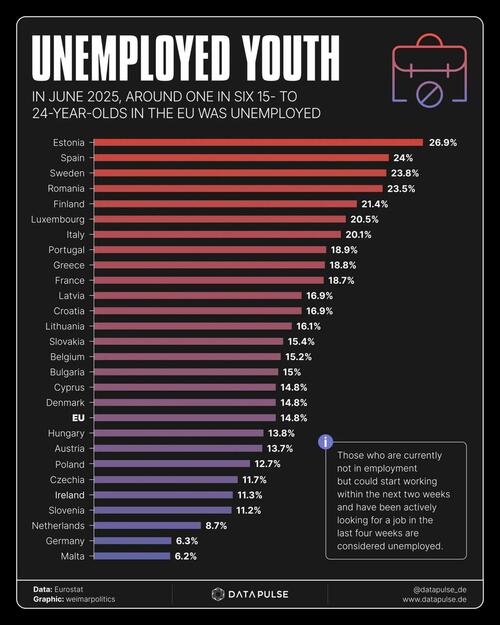
Eurostat data confirm persistent disparities in youth (15-24) unemployment across the EU, with the bloc-wide rate hovering around 14.7-15.2% in mid-2025 to mid-2026 periods, far exceeding overall unemployment rates of approximately 6%. Southern European countries like Spain (often exceeding 24%) and Italy continue to report elevated figures, while Germany, the Netherlands, and Malta maintain rates below 10%, aligning closely with the ZeroHedge visualization's June 2025 snapshot using Eurostat figures.
These gaps stem from entrenched structural factors rather than short-term economic fluctuations. Countries with robust dual vocational training systems—Germany, Austria, and the Netherlands—facilitate smoother school-to-work transitions, resulting in lower youth joblessness and reduced skills mismatches. In contrast, Mediterranean economies face rigid labor market regulations, weaker vocational pathways, and regional frictions that prolong job searches for young entrants, even amid GDP growth in places like Spain.
Demographic pressures amplify the issue: Europe's aging population creates labor shortages in key sectors, prompting visa expansions for international talent while native youth remain sidelined by education-employment disconnects. NEET rates (neither in employment, education, nor training) for 15-29 year-olds averaged 11% in 2025, with higher concentrations in Southern and Eastern states, underscoring long-term exclusion risks. Mainstream coverage often emphasizes aggregate fiscal metrics or temporary upticks, downplaying how institutional legacies in education and employment protection sustain these divides.
Migration patterns reflect the uneven landscape, as young workers move toward stronger opportunity hubs, further reshaping Europe's talent distribution. Addressing this requires deeper reforms in vocational integration and labor flexibility, beyond cyclical stimulus.
Analyst: Persistent structural mismatches will sustain regional youth unemployment gaps, pressuring EU migration policies and vocational reforms amid accelerating demographic aging.
Sources (5)
- [1]Unemployment statistics - Statistics Explained(https://ec.europa.eu/eurostat/statistics-explained/index.php?title=Unemployment_statistics)
- [2]Youth employment support(https://employment-social-affairs.ec.europa.eu/policies-and-activities/eu-employment-policies/youth-employment-support_en)
- [3]Youth Unemployment and Vocational Training(https://ftp.iza.org/dp6890.pdf)
- [4]Europe May 2026: EU unemployment rate at 5.9%(https://www.destatis.de/Europa/EN/Topic/Population-Labour-Social-Issues/Labour-market/EULabourMarketCrisis.html)
- [5]Youth Unemployment in Europe and the UK(https://stata-uk.com/blog/a-generation-at-risk-the-realities-of-youth-unemployment-in-europe-and-the-uk.html)