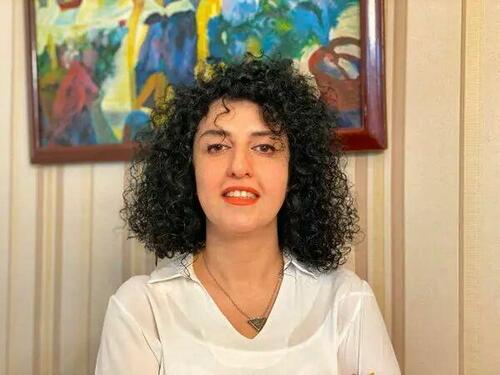
Narges Mohammadi's Critical Collapse: How Iran's Medical Neglect of Dissidents Fits a Global Authoritarian Playbook
Narges Mohammadi's May 2026 cardiac crisis in Iranian prison, corroborated across major outlets, exemplifies the use of medical neglect as repression. This connects to wider global patterns of authoritarian regimes slowly neutralizing dissidents through denied care, a trend mainstream reporting often isolates rather than links as convergent statecraft.
The hospitalization of Narges Mohammadi, the 2023 Nobel Peace Prize laureate, in critical condition at a Zanjan hospital underscores not merely a personal health crisis but a deliberate strategy of slow-motion repression employed by the Iranian regime. According to multiple reports, the 54-year-old activist collapsed in Zanjan Prison on May 1, 2026, suffering severe cardiac distress, loss of consciousness, and blood pressure fluctuations—following a suspected heart attack in late March that left her unconscious for over an hour with eyes rolled back, as witnessed by fellow inmates. Prison authorities initially refused transfers or specialist care, opting for on-site treatment despite her documented history of chronic heart disease, pulmonary embolism, and prison-induced ailments including headaches from reported beatings. Her family and the Narges Foundation have pleaded for relocation to Tehran for proper cardiology, but judicial officials have denied these requests, leaving her in unstable condition on oxygen.
Mainstream coverage from outlets like The New York Times and NPR has framed this as an individual tragedy amid Iran's crackdowns on women's rights advocates. Yet this misses the deeper pattern: denial of medical care as a calibrated tool of state control, effectively turning prisons into sites of gradual elimination without the optics of direct execution. Mohammadi's rearrest in December 2025 during a memorial for a slain activist—followed by an additional 7.5-year sentence in February 2026 for "collusion against national security" and propaganda—extends her total imprisonment to nearly 18 years. This follows a medical furlough in 2024 that was revoked, a cycle repeated against numerous political prisoners since the 2022 Woman, Life, Freedom uprising triggered by Mahsa Amini's death in custody.
Corroborating investigations by human rights organizations reveal this is systemic. Similar medical neglect has been documented in cases across Iran's prison network, where activists are held in remote facilities far from family and specialists, exacerbating conditions to break spirits or induce fatal declines. This mirrors overlooked global trends among authoritarian states: from Alexei Navalny's documented health deterioration in Russian penal colonies before his death, to the mysterious ailments of Uyghur detainees in China's camps and Belarusian opposition figures denied treatment. Regimes increasingly avoid overt assassinations, instead weaponizing bureaucracy and "healthcare" to neutralize threats while maintaining plausible deniability. Mainstream narratives often silo these as country-specific human rights issues, failing to connect them as convergent adaptations in hybrid warfare against domestic dissent—especially potent during periods of regional instability, as Iran faces external pressures.
Mohammadi's lifelong documentation of executions, opposition to the death penalty, and advocacy against compulsory hijab laws made her a symbolic threat. Her Nobel, awarded while imprisoned, was intended to spotlight these abuses, yet the regime's response—escalating sentences and medical indifference—demonstrates how such international recognition can accelerate targeting rather than protect. As her husband Taghi Rahmani stated from exile, her life hangs in the balance from basic, urgent care denied. This case reveals authoritarian evolution: not loud purges, but quiet, deniable attrition that tests how far the international community will tolerate normalized medical hostage-taking. The pattern suggests these tactics are spreading because they work—suppressing opposition waves before they crest into broader instability.
LIMINAL: Mohammadi's ordeal signals authoritarian refinement of 'invisible violence' via healthcare denial, likely to intensify as regimes worldwide adopt it to manage dissent without triggering mass mobilization or unified sanctions.
Sources (5)
- [1]Narges Mohammadi, Iranian Nobel Laureate, Is Hospitalized(https://www.nytimes.com/2026/05/01/world/middleeast/narges-mohammadi-iran-hospialized.html)
- [2]Imprisoned Iranian Nobel Peace Prize winner in critical condition(https://www.npr.org/2026/05/02/nx-s1-5808841/jailed-iranian-nobel-prize-winner-critical-condition)
- [3]Iranian Nobel laureate Narges Mohammadi hospitalised as health deteriorates(https://www.aljazeera.com/news/2026/5/1/iranian-nobel-laureate-narges-mohammadi-hospitalised-as-health-deteriorates)
- [4]Family of ailing Iranian Nobel laureate say keeping her in prison is 'cruel'(https://www.theguardian.com/global-development/2026/apr/29/family-jailed-iranian-nobel-laureate-suspected-heart-attack-narges-mohammadi)
- [5]Iran: Narges Mohammadi denied essential medical care after reported heart attack in prison(https://www.fidh.org/en/region/asia/iran/iran-narges-mohammadi-denied-essential-medical-care-after-reported)