Triple Carrier Deployment in Middle East Marks Strategic Shift Toward Direct Iran Confrontation
The first simultaneous deployment of three U.S. aircraft carriers in the Middle East since 2003, paired with an active naval blockade of Iran, indicates a major escalation from containment to potential direct conflict. This posture enables independent strike operations while exposing vulnerabilities to Iranian A2/AD systems. Analysis drawing on CSIS, IISS, and historical patterns reveals Washington has prioritized the Iranian theater over other global commitments, raising risks of rapid escalation into wider war.
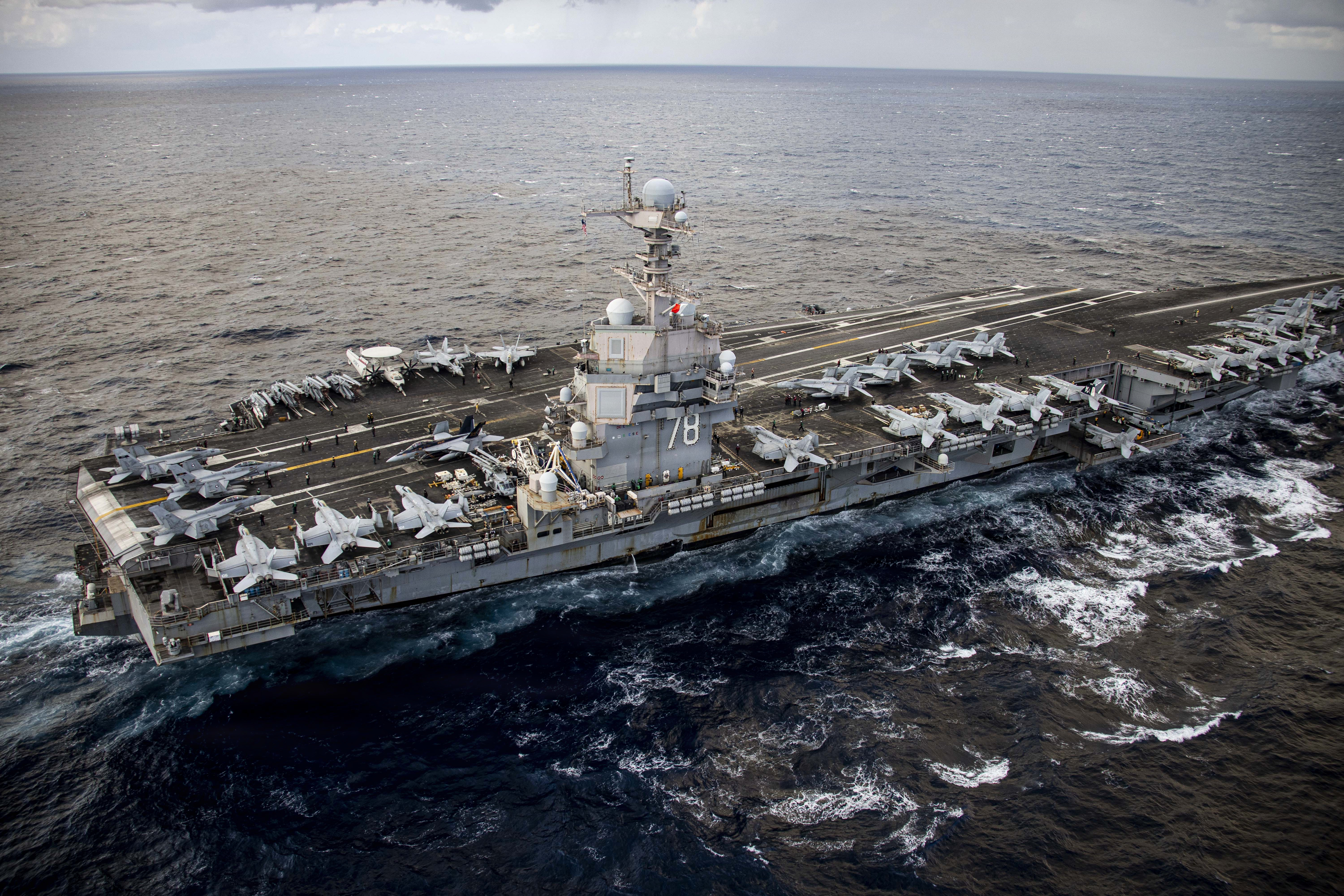
The simultaneous presence of three U.S. supercarriers — USS Abraham Lincoln, USS Gerald R. Ford, and USS George H.W. Bush — in Middle East waters for the first time since the 2003 Iraq invasion represents far more than a show of force. While the original Defense News dispatch accurately catalogs the 200+ aircraft, 15,000 sailors and Marines, and accompanying strike group vessels, it fails to connect this deployment to a decisive policy pivot: the U.S. has moved from sanctions and proxy management to active blockade and potential kinetic enforcement against Iran.
This concentration of naval power, capable of independent sustained air operations without reliance on vulnerable Gulf airbases, is explicitly tied to the April 13 blockade that has already redirected 34 Iranian-linked vessels. Defense Secretary Pete Hegseth’s statement that it will continue “as long as it takes” echoes the open-ended commitments of past conflicts. Historical patterns confirm the gravity: the last comparable three-carrier presence supported the initial phase of Operation Iraqi Freedom. Today’s deployment occurs amid heightened Iranian proxy activity, Houthi disruptions in the Red Sea, and fears of Tehran attempting to mine or close the Strait of Hormuz, through which roughly 21% of global seaborne oil passes.
What existing coverage misses is the extraordinary strain this places on U.S. naval readiness. With ongoing commitments in the Indo-Pacific to counter China, pulling three carrier strike groups into CENTCOM simultaneously signals that Washington now views the Iranian threat as the immediate priority — a judgment that itself constitutes major intelligence assessment. The original report also understates Iranian A2/AD capabilities: years of Russian and Chinese technology transfers have given Tehran advanced coastal defense cruise missiles, loitering munitions, and submarine capabilities demonstrated in exercises that closely mirror tactics used by Russia in the Black Sea. A 2024 CSIS report on Iranian naval strategy warned precisely that massed carriers in confined waters create tempting targets for saturation attacks.
Synthesizing this with analysis from the International Institute for Strategic Studies’ 2025 Military Balance and recent RAND wargames on Persian Gulf escalation, the current posture suggests pre-positioning for a broader campaign. The carriers’ inclusion of F-35Cs, EA-18G Growlers, and CMV-22B Ospreys points toward both offensive strike packages and intensive electronic warfare/sead missions — the exact toolkit needed to suppress Iranian coastal defenses. The blockade itself risks repeating the 1980s Tanker War dynamics, only this time with far more sophisticated weaponry on both sides.
The Trump administration’s approach reveals calculation that economic pressure alone has failed to curb Iran’s nuclear progress and regional aggression. By removing dependence on regional bases that could be overrun or politically denied, the U.S. is signaling willingness to absorb and respond to initial Iranian retaliation. However, this creates classic crisis instability: Iran may feel compelled to strike first before American air wings can fully degrade its capabilities. The risk of miscalculation is compounded by Tehran’s alliances with Moscow and Beijing, both of which have increased naval diplomacy in the Indian Ocean in recent months.
Ultimately, this deployment is not routine deterrence. It is the logistical backbone for a potential sustained offensive should Iran test the blockade with force. Global energy security, Israeli calculation on striking Iranian nuclear sites, and the possibility of direct U.S.-Iran naval clashes now sit on a hair trigger. The era of managed competition with Iran appears to have ended.
SENTINEL: The three-carrier concentration combined with the active blockade indicates the U.S. has accepted elevated risk of direct kinetic conflict with Iran within the next 60-90 days, likely triggered by any attempt to interfere with redirected shipping or proxy attacks on U.S. assets.
Sources (3)
- [1]Three’s company: Trio of US carriers operating in Middle East for first time in decades(https://www.defensenews.com/news/your-military/2026/04/24/threes-company-trio-of-us-carriers-operating-in-middle-east-for-first-time-in-decades/)
- [2]Iran’s Anti-Access Area Denial Strategy(https://www.csis.org/analysis/irans-anti-access-area-denial-strategy)
- [3]The Military Balance 2025(https://www.iiss.org/publications/the-military-balance/)