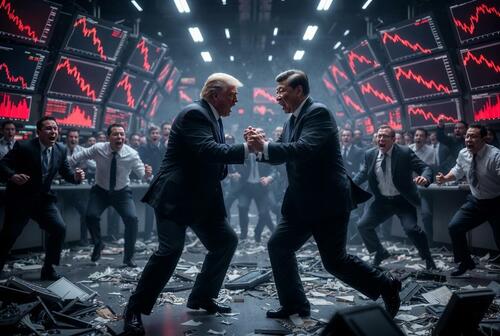
Xi's Thucydides Trap Warning to Trump at Beijing Summit Exposes Fragile US-China Balance, Amplifying Market Volatility
Xi Jinping's invocation of the Thucydides Trap during the Trump summit, tied to Taiwan tensions and overlapping Iran/Hormuz dynamics, correlated with sharp equity selloffs, oil spiking above $100, and rising bond yields, revealing how great-power rhetoric can rapidly destabilize interconnected markets in ways that extend beyond standard trade coverage.
During a high-stakes summit in Beijing this week, Chinese President Xi Jinping directly invoked the "Thucydides Trap" – the historical pattern in which a rising power threatens to displace a ruling one, often leading to conflict – while engaging President Donald Trump on Taiwan, trade, and global stability. According to multiple reports, Xi asked whether the United States and China could "transcend the so-called Thucydides Trap" and forge a new paradigm for major-power relations, framing the Taiwan issue as a potential flashpoint that could push both nations into an "extremely dangerous place." Trump responded by emphasizing his administration's successes, later posting on Truth Social that any reference by Xi to American decline applied only to the Biden years, not the current period of economic and military resurgence. Mainstream coverage has highlighted the summit's mixed outcomes on tariffs, technology exports, and beef trade approvals that were quickly walked back, but the deeper signal – a deliberate historical analogy long favored by Chinese leadership to underscore perceived inevitability – appears to have rattled investors already navigating parallel tensions from U.S. actions around Iran and the Strait of Hormuz. Oil prices climbed above $100 per barrel for WTI amid these intertwined geopolitical signals, global bond yields broke out to multi-year highs (with the 30-year U.S. Treasury approaching 5.1%), and Asian equities sold off sharply, including a more than 6% drop in South Korea's Kospi and notable declines in semiconductor and momentum stocks. These moves suggest markets are pricing in elevated tail risks from great-power friction faster than diplomatic rhetoric can soothe them. The Thucydides Trap concept, popularized by Harvard's Graham Allison, has been a recurring Chinese talking point in U.S. meetings, yet its use here – paired with warnings on Taiwan independence and unresolved questions over U.S. arms sales – reveals connections often missed in day-to-day reporting: how inflammatory historical framing can function as strategic ambiguity, deterring aggressive policy while simultaneously eroding confidence in fragile supply chains and energy routes. Trump's parallel emphasis on "military decimation" of Iran and openness of the Hormuz Strait adds another layer; energy chokepoints in the Middle East are not isolated from Indo-Pacific tensions but compound them, creating a feedback loop where rhetoric in one theater instantly transmits volatility to commodity and equity markets worldwide. Mainstream outlets have tended to portray the summit as transactional horse-trading with some stabilization, yet the overnight mayhem in global assets underscores an underreported reality: in an era of concentrated tech exposure, leveraged ETFs, and record debt loads, even subtle shifts in superpower signaling can trigger cascading liquidations that expose the thin line between economic interdependence and outright confrontation. This episode illustrates the volatile intersection of domestic U.S. political narratives and global economics, where attempts to reframe decline or assert strength risk amplifying the very conflicts leaders claim to avoid.
LIMINAL: Xi's calibrated historical warning combined with unresolved Taiwan and Hormuz flashpoints is accelerating market repricing of conflict risk, showing how superpower signaling now moves financial assets faster than diplomacy can contain the fallout.
Sources (6)
- [1]Xi Warned Trump About the 'Thucydides Trap' for U.S. and China(https://www.nytimes.com/2026/05/14/world/asia/trump-xi-thucydides-trap-us-china.html)
- [2]What is the Thucydides Trap and why did Xi Jinping mention it in his meeting with Donald Trump?(https://www.theguardian.com/us-news/2026/may/15/thucydides-trap-explained-xi-jinping-donald-trump-us-china-taiwan)
- [3]What Is The Thucydides Trap and Why Did Xi Raise It With Trump?(https://www.bloomberg.com/news/articles/2026-05-14/what-is-the-thucydides-trap-and-why-did-xi-raise-it-with-trump)
- [4]Xi warns Trump: Mishandling Taiwan will put U.S.-China relationship in 'great jeopardy'(https://www.cnbc.com/2026/05/14/trump-xi-beijing-summit-trade-taiwan-ai-iran-rare-earths-tariffs.html)
- [5]‘Thucydides’ Trap’: What to Know About China’s Favorite Reference for U.S. Relations(https://time.com/article/2026/05/15/thucydides-trap-greek-reference-china-us-relations-xi-jinping-trump/)
- [6]Trump responds to Xi's 'Thucydides Trap' comment about U.S. being a declining nation(https://www.aol.com/articles/trump-responds-xis-thucydides-trap-013841887.html)