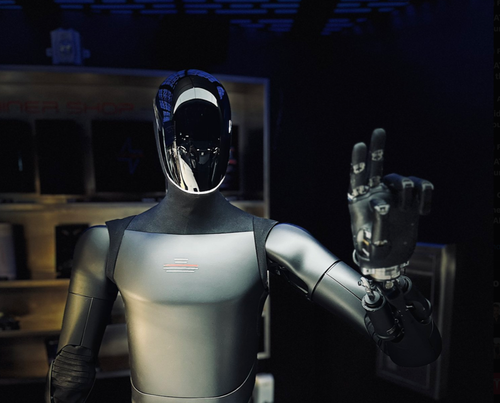
Tesla's Fremont Pivot: From Model S/X to Optimus Humanoids Signals Manufacturing's Robotic Future
Corroborated reports confirm Tesla is converting Fremont's former Model S/X lines to Optimus production, with JPMorgan noting on-schedule progress toward 2026-2027 deployments. This highlights a strategic shift to humanoid robotics manufacturing with significant implications for industrial processes, cost efficiencies, and workforce evolution.
JPMorgan analyst Rajat Gupta's recent tour of Tesla's Fremont factory, as detailed in client notes and widely reported, reveals a deliberate industrial transformation underway at the historic 5-million-square-foot site. Production of the Model S and Model X ended in early May 2026, with the decommissioned lines now being reconfigured for Tesla's Optimus humanoid robots. The area was tarped off during the visit, consistent with a roughly four-month transition timeline. Initial Optimus deployments are targeted for the second half of 2026 at an 'Optimus Academy' for training and real-world data collection, followed by internal factory use and potential external sales as early as the second half of 2027. Gen 3 design is finalized with the supply chain largely secured. This aligns with Tesla's own updates, including time-lapse videos of the 46-day teardown and confirmations of low-volume production ramps aiming for 1 million units annually at Fremont, with larger capacity planned for Giga Texas. Beyond the factory floor, the shift underscores Tesla's vertical integration advantage in physical AI—leveraging automotive manufacturing expertise, custom alloys from SpaceX collaborations, gigacasting, and unboxed processes to build robots at scale. Analysts note parallels to Amazon's Kiva robotics, where internal deployment first validates and refines the technology before external commercialization, potentially reducing Tesla's own automotive costs of goods sold by around 5%. City of Fremont statements emphasize no job losses from the pivot, with potential headcount increases due to robotics expansion. Broader implications point to a manufacturing paradigm where humanoid robots could transform labor-intensive assembly, data collection loops accelerate AI training, and employment evolves from traditional auto roles toward robotics oversight, programming, and maintenance. This factory conversion serves as a tangible testbed for the physical AI economy, with timelines now moving from speculation to executable phases amid global competition in humanoids.
[Manufacturing Analyst]: The Fremont conversion demonstrates how legacy auto infrastructure can rapidly pivot to robotics production, potentially accelerating industry-wide adoption of humanoids for repetitive tasks while shifting employment toward higher-skill AI integration roles by 2028-2030.
Sources (6)
- [1]Here are the latest findings from JPMorgan's research on Tesla's factories(https://www.moomoo.com/news/post/74925929/here-are-the-latest-findings-from-jpmorgan-s-research-on)
- [2]Tesla Optimus Robots: JPMorgan Hints At Another Delay(https://www.investors.com/news/tesla-optimus-robots-elon-musk-tesla-stock/)
- [3]Tesla stock receives an upgrade from one of its longest-standing bears(https://www.tradingview.com/news/invezz:b88cf28ed094b:0-tesla-stock-receives-an-upgrade-from-one-of-its-longest-standing-bears/)
- [4]Tesla Tears Down Model S/X Lines for Optimus Production(https://www.notateslaapp.com/news/4427/tesla-tears-down-model-sx-lines-for-optimus-production)
- [5]Tesla says FSD v15 is a 'step-change,' Optimus sells in 2027(https://electrek.co/2026/08/20/tesla-jpmorgan-fremont-fsd-v15-hw4-optimus-2027/)
- [6]Tesla Builds Final Model S and Model X at Fremont as Line Pivots to Optimus(https://teslant.com/en/news/tesla-last-model-s-x-fremont-production-may-2026)