Edge Warfare: How GRU's Router DNS Hijacks Are Systematically Undermining Cloud MFA and OAuth Identity Systems
Russian GRU actors compromised 18k+ SOHO routers via known vulns to hijack DNS and steal post-MFA Microsoft OAuth tokens at scale. This edge-focused TTP undermines core cloud identity assumptions, connects to years of Russian router campaigns, and reveals a doctrinal shift receiving too little attention from defenders focused on endpoints.
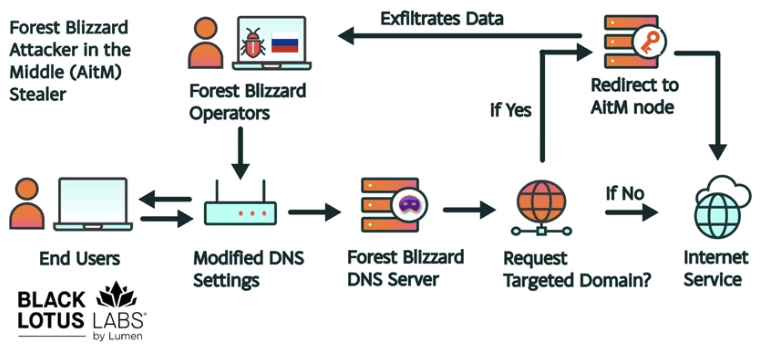
The Krebs on Security report detailing Forest Blizzard (APT28/Fancy Bear) operations against more than 18,000 mostly SOHO routers marks an important disclosure, yet it understates the strategic significance of this campaign. By leveraging known vulnerabilities in end-of-life Mikrotik and TP-Link devices to alter DNS settings without installing malware, Russia's GRU-linked actors have created a massive adversary-in-the-middle (AiTM) capability that intercepts OAuth authentication tokens after MFA has already succeeded. This represents a sophisticated evolution in tradecraft that mainstream coverage has largely framed as a clever but unsexy technical trick rather than a fundamental challenge to cloud identity architectures.
What the original reporting missed is the broader pattern of nation-state convergence on "edge" infrastructure as the soft underbelly of cloud security. While Krebs, Microsoft, and Black Lotus Labs correctly describe the technical mechanics—redirecting DNS queries to attacker-controlled servers that enable token harvesting—they fail to connect this to parallel campaigns. This TTP mirrors techniques outlined in the UK's NCSC 2024 advisory on Russian state actors compromising SOHO routers, as well as earlier VPNFilter malware operations attributed to Sandworm (also GRU). The current operation scales these concepts by avoiding detectable malware entirely, instead living off legitimate router functionality.
Synthesizing the Microsoft Threat Intelligence blog from April 2026, the Black Lotus Labs technical report 'Operation RouterHarvest,' and declassified NCSC analysis from 2024 reveals a consistent Russian doctrinal emphasis on degrading trust in Western cloud providers. APT28, the same actor that conducted the 2016 DNC breaches and Clinton campaign intrusions, has shifted from noisy phishing and malware deployment to this low-and-slow approach. By targeting foreign ministries, law enforcement, and third-party email providers across 200 organizations, Moscow is achieving persistent access to sensitive diplomatic and intelligence communications without triggering endpoint detection.
The deeper analytical point is that nation-states are deliberately undermining the assumed security boundaries of cloud MFA and identity systems. Modern zero-trust architectures presume that once a user authenticates via MFA and receives an OAuth token, that token represents a secure session. By compromising the network edge—the router most consumers and small offices never properly patch—adversaries invalidate that assumption. This approach bypasses Microsoft's sophisticated cloud defenses entirely because the interception occurs before TLS-encrypted traffic reaches Azure infrastructure.
This campaign connects to larger geopolitical patterns. As Russia prosecutes its war in Ukraine and prepares for potential conflict with NATO, such operations serve dual purposes: immediate intelligence collection and prepositioning for future disruptive activity. Similar Chinese campaigns (Volt Typhoon targeting edge devices in critical infrastructure) and Iranian operations against Israeli and Gulf networks demonstrate that multiple adversaries now view SOHO and enterprise edge devices as high-value, low-risk targets. The 18,000 compromised routers at peak activity in December 2025 represent not an isolated espionage effort but a maturing doctrine of infrastructure dominance at the network periphery.
Security vendors have over-focused on endpoint and cloud-native threats while neglecting the millions of consumer and small-business routers that serve as gateways to Microsoft 365, Google Workspace, and other critical SaaS platforms. The ' unsexy' nature of DNS reconfiguration that Ryan English described is precisely why it succeeds—defenders aren't looking for it. This should force a reckoning in identity security strategies, including greater emphasis on device posture monitoring, router firmware integrity checks, certificate pinning beyond standard TLS, and potentially shifting toward hardware-backed authentication that cannot be trivially tokenized.
The original coverage also glosses over the consumer impact: 5,000 individual devices were affected. In an era of hybrid work and blurred enterprise-consumer boundaries, this creates a massive blind spot. Forest Blizzard's ability to propagate malicious DNS settings to all users on local networks means a single compromised home router can expose an entire remote workforce. As cloud adoption accelerates and MFA becomes table stakes, state actors are adapting by attacking the last unmonitored link in the chain.
This TTP will likely spread. Other adversaries are already experimenting with similar edge exploitation. The insufficient mainstream focus on these operations risks leaving organizations and governments unprepared for the next evolution: combining router compromise with supply-chain attacks or wiper malware deployment during crisis. The routers we ignore may ultimately determine who controls the information environment in future conflicts.
SENTINEL: Russian success exploiting edge routers to bypass cloud MFA will accelerate adoption of this TTP by China and Iran, particularly against hybrid-work environments and diplomatic networks. Organizations must treat SOHO routers as enterprise attack surface or risk persistent undetected access to identity systems.
Sources (4)
- [1]Krebs on Security: Russia Hacked Routers to Steal Microsoft Office Tokens(https://krebsonsecurity.com/2026/04/russia-hacked-routers-to-steal-microsoft-office-tokens/)
- [2]Microsoft Threat Intelligence: Forest Blizzard AiTM Campaign via DNS Hijacking(https://www.microsoft.com/en-us/security/security-insider/forest-blizzard-apt28-dns-hijacking)
- [3]Black Lotus Labs: Operation RouterHarvest Technical Report(https://www.blacklotuslabs.com/reports/routerharvest-apt28-gru)
- [4]NCSC Advisory: Russian State Actors Targeting Routers and Edge Devices(https://www.ncsc.gov.uk/advisory/russian-actors-compromising-soho-routers)