North Korea's AI-Guided Missile Test Accelerates Proliferation of Autonomous Weapons Beyond Great Power Control
North Korea's May 2026 test of AI terminal guidance in tactical cruise missiles, overseen by Kim Jong Un, represents the public debut of autonomous targeting tech in its arsenal. Corroborated across Reuters, NHK, and South Korean analysts, the 100km-range systems targeted for border deployment signal both regional escalation risks to South Korea and broader global proliferation of dual-use AI that evades sanctions via software transfers, connecting to Pyongyang's prior AI drone work and military research documented since 2024.
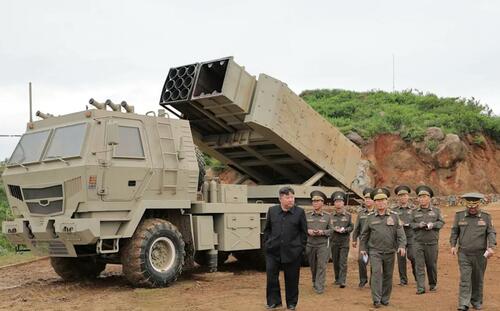
In a milestone that received relatively muted coverage in mainstream outlets, North Korea under Kim Jong Un conducted its first publicly acknowledged test of AI-guided tactical cruise missiles on May 26, 2026. State media KCNA reported that the tests, which also included tactical ballistic missiles and long-range artillery rockets, confirmed the combat readiness of precision cruise missiles equipped with 'AI terminal guidance' capable of striking targets up to 100 km away—placing much of Seoul within range from border deployments. Kim expressed satisfaction, stating the upgrades to weapons and automated launch systems were designed to suit 'modern warfare conditions' and deliver overwhelming destructive power.[1][2]
Analysts describe this as the first time Pyongyang has explicitly claimed AI integration in its missile systems, though the regime previously touted AI use in drones. Experts like Yang Uk of the Asan Institute interpret it as AI-assisted target recognition and terminal-phase guidance, while Hong Min at the Korea Institute for National Unification suggests it likely builds on existing inertial and terrain-matching navigation enhanced with automatic target recognition. Independent verification of the AI's sophistication remains impossible from available imagery and statements.[1]
This development fits a longer pattern of North Korean AI/ML research with clear military applications. A 2024 38 North analysis documented Pyongyang's work on AI for wargaming, surveillance, and potential weapons systems, highlighting risks of intangible technology transfers via cloud computing and academic collaboration that evade traditional sanctions. The current test demonstrates translation of that research into deployable hardware, potentially refined by real-world data from missiles supplied to Russia for use in Ukraine.[3]
The strategic implications extend far beyond the Korean Peninsula. North Korea's rapid adoption of autonomous terminal guidance signals the democratization of precision-strike technology once thought to require advanced industrial bases and satellite infrastructure. Unlike GPS-dependent systems vulnerable to jamming, AI-enabled terminal guidance allows missiles to adapt in contested electromagnetic environments—a capability increasingly sought by Russia, China, Iran, and non-state actors. This proliferation occurs against a backdrop of stalled international efforts to regulate lethal autonomous weapons systems (LAWS), with major powers themselves racing to integrate AI into drones, loitering munitions, and cruise missiles.
Connections often missed in initial reporting include the feedback loop with North Korea's nuclear modernization and artillery buildup near the DMZ. By pairing AI precision with shorter-range systems, Pyongyang lowers the threshold for conventional strikes that could escalate, while complicating South Korean and U.S. missile defenses through improved accuracy and potential swarm tactics. Long-term, this erodes conventional deterrence advantages held by technologically superior forces and raises escalation risks in crises where human oversight of AI decisions becomes compressed.
South Korea has reiterated its commitment to peaceful coexistence while reviewing implications alongside enhanced U.S. military drills—moves North Korea frames as existential threats justifying its buildup. As AI weapons proliferate to sanctioned states, the window for meaningful arms control narrows, pointing toward a future of cheaper, harder-to-attribute autonomous systems that could reshape conflicts from the Taiwan Strait to proxy battlefields worldwide.
LIMINAL: North Korea embedding AI into border-deployed tactical missiles will speed up an unregulated arms race, giving isolated regimes cheap precision strike options that bypass jamming and complicate defenses, raising miscalculation risks in Asia and beyond.
Sources (4)
- [1]North Korea tests AI-guided missiles and artillery rockets designed for modern warfare, KCNA says(https://www.reuters.com/world/asia-pacific/north-korea-tests-mix-enhanced-ballistic-cruise-missiles-artillery-rockets-kcna-2026-05-26/)
- [2]North Korean leader Kim Jong Un oversees AI cruise missile test(https://www3.nhk.or.jp/nhkworld/en/news/20260527_07/)
- [3]N. Korea touts AI-guided tactical weapons in latest missile tests(https://globalnation.inquirer.net/324797/kim-oversees-n-korea-missile-tests-of-ai-guided-tactical-weapons)
- [4]North Korea's Artificial Intelligence Research: Trends and Potential Civilian and Military Applications(https://www.38north.org/2024/01/north-koreas-artificial-intelligence-research-trends-and-potential-civilian-and-military-applications/)