Japan's Yen Intervention: A Symptom of Broader Global Currency and Policy Tensions
Japan's intervention to support the yen amid USDJPY surpassing 160 reflects deeper global currency tensions driven by interest rate differentials, energy security concerns tied to Middle Eastern instability, and the limits of unilateral action. Beyond immediate market impacts, this event signals potential shifts in trade dynamics, investor sentiment, and monetary policy discourse.
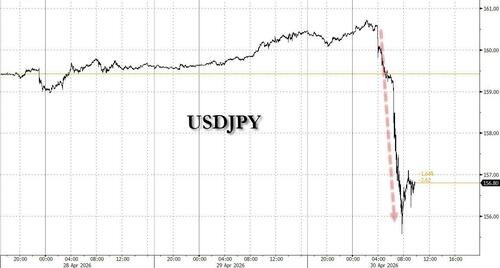
Japan's recent intervention in the foreign exchange market to bolster the yen, as confirmed by the Nikkei and government officials, marks a critical moment in the ongoing struggle for currency stability amid global economic pressures. The USDJPY pair plummeted over 500 pips to 155.57 following the intervention on Thursday, a move driven by the Ministry of Finance and the Bank of Japan (BOJ) in response to the yen breaching the 160 threshold against the dollar for the first time since March. While the original coverage by ZeroHedge emphasizes the immediate market reaction and speculative future trajectories for USDJPY, it overlooks deeper structural issues and geopolitical undercurrents that contextualize this action.
First, Japan's intervention must be understood against the backdrop of persistent interest rate differentials between the U.S. and Japan. The U.S. Federal Reserve's aggressive rate hikes to combat inflation have widened the yield gap, exerting downward pressure on the yen as investors seek higher returns in dollar-denominated assets. The BOJ, however, has maintained ultra-low rates to support domestic growth, a policy stance reiterated in their April 2023 Monetary Policy Statement, which prioritizes economic stimulus over currency defense. This divergence creates a structural vulnerability for the yen, rendering interventions like this one a temporary fix rather than a sustainable solution. ZeroHedge's assertion that the BOJ 'refuses to raise rates' oversimplifies the dilemma: raising rates risks stifling Japan's fragile recovery, while persistent yen depreciation fuels imported inflation, particularly through energy costs.
Second, the timing of the intervention, coinciding with heightened geopolitical tensions in the Middle East and Brent crude prices surging to $125, signals a broader nexus of currency, energy, and security concerns. Japan's Prime Minister Takaichi's reported discussions with Iran's President regarding safe passage through the Strait of Hormuz, as noted by Kyodo News, suggest an intersection of economic policy and geopolitical strategy. Japan, heavily reliant on Middle Eastern oil imports, faces a dual threat: a weakening yen amplifies the cost of energy imports, while regional instability risks supply disruptions. The original coverage speculates on potential BOJ intervention in oil markets, an unsubstantiated claim, but misses the critical link between currency policy and energy security—a connection that could shape Japan's future interventions or push for international coordination on commodity price stability.
Third, the intervention's long-term efficacy remains questionable, a point under-discussed in the ZeroHedge piece. Historical data from the Ministry of Finance shows that Japan's interventions in 2022, totaling over ¥9 trillion, had fleeting impacts as the yen resumed its decline absent fundamental policy shifts. The current move, while significant in scale with USDJPY volumes reaching $57 billion, risks similar outcomes given the BOJ's limited foreign exchange reserves—estimated at $1.29 trillion as of March 2023 per BOJ reports—and the relentless pressure from global capital flows. Moreover, unilateral interventions often invite market speculation, as traders test the BOJ's resolve, potentially driving USDJPY toward ZeroHedge's projected 170 level or beyond. What is missing from the original narrative is the possibility of coordinated action with G7 partners, a strategy Japan employed in 2011 post-earthquake to stabilize the yen, which could mitigate the risk of diminishing returns.
Finally, this event has ripple effects on global trade and investor sentiment. A stronger yen, even temporarily, could bolster Japan's purchasing power for imports but risks dampening export competitiveness, a key driver of its economy. For international investors, the intervention signals heightened volatility in currency markets, potentially redirecting capital flows toward safer assets or alternative emerging markets. The broader implication, unaddressed in the source, is a potential shift in monetary policy discourse: if yen weakness persists, domestic pressure may force the BOJ to reconsider its dovish stance, influencing global expectations for central bank behavior in a high-inflation, high-uncertainty environment.
In synthesizing these perspectives, Japan's yen intervention is not merely a market event but a microcosm of intersecting challenges—monetary policy constraints, geopolitical risks, and global economic imbalances. While the immediate market reaction is clear, the underlying tensions suggest that without structural reforms or international cooperation, such interventions may remain a costly stopgap in an era of relentless currency volatility.
MERIDIAN: Japan's yen intervention may temporarily stabilize the currency, but without addressing structural interest rate disparities or securing coordinated global support, the yen is likely to face renewed downward pressure within months.
Sources (3)
- [1]Japan Intervened In FX Market To Buy Yen - Nikkei Confirmation(https://www.zerohedge.com/markets/japan-interveneed-fx-market-buy-yen)
- [2]Bank of Japan Monetary Policy Statement April 2023(https://www.boj.or.jp/en/mopo/mpmdeci/state_2023/index.htm)
- [3]Japan Ministry of Finance Historical Intervention Data(https://www.mof.go.jp/english/policy/international_policy/reference/feio/index.htm)