Japan's El Niño Declaration: Converging Weather, Food, Energy, and Migration Shocks Signal 2026-2027 Inflation Cascade
JMA's pioneering El Niño declaration ties Pacific warming explicitly to imminent food inflation, energy demand shifts, and secondary migration risks, revealing interconnected supply shocks across sectors typically analyzed separately. Corroborated forecasts warn of strong event status with multi-year price and stability impacts.
The Japanese Meteorological Agency (JMA) has become the first major meteorological organization to formally declare the onset of El Niño conditions in the equatorial Pacific, citing sea surface temperature anomalies exceeding +1.2°C in key monitoring regions as of May 2026. This marks the first such event in three years and comes with warnings that it could rank among the strongest on record, with near-certain persistence through boreal autumn. Official JMA outlooks confirm El Niño conditions are present from spring 2026 and are highly likely to continue, shifting global rainfall and temperature patterns in ways that directly threaten agricultural yields worldwide.[1][2]
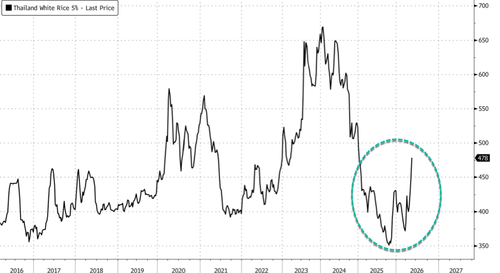
While mainstream coverage often silos these impacts—drought in one region, heavy rains in another—the explicit linkage to near-term global food price spikes reveals deeper systemic connections. Historical data and current forecasts show El Niño events suppress yields in critical breadbaskets: delayed Indian monsoons threaten rice production that feeds billions, while disruptions to Peruvian anchovy fisheries compound protein supply issues. Thailand white rice prices have already surged 20% in a single month, the largest jump since 2008 records began. These agricultural shocks do not exist in isolation; they intersect with energy markets through heightened summer cooling demand, strained hydropower in drought-hit areas, and fertilizer production vulnerabilities tied to energy prices.[3]
Analyses from the European Central Bank and Reuters indicate that a strong El Niño could drive global food commodity prices up by 9-50% or more across soybeans, corn, rice, palm oil, sugar, and cocoa, with lagged effects peaking 12-16 months after onset. This arrives amid existing pressures from geopolitical tensions, creating compound supply shocks rarely analyzed together. HSBC research highlights particular risks to emerging market inflation, where food carries heavy CPI weight, potentially complicating monetary policy into 2027. JPMorgan notes how El Niño layers atop fertilizer constraints and energy volatility to intensify food security risks, especially in tropical import-dependent regions.[4][5]
Connections others miss include migration pressures: past strong El Niños have triggered droughts across the Horn of Africa, Central America, and parts of Asia, displacing populations through harvest failures and water scarcity—dynamics that could amplify existing migration stories when combined with current global instability. WMO updates underscore an 80%+ probability of El Niño emergence by August 2026, warning of above-average temperatures nearly everywhere and extreme weather that links these domains: failed crops drive up energy-intensive food imports, power demand spikes strain grids, and resulting economic stress fuels social and migratory flows.[6][7]
This declaration shifts El Niño from forecast to active driver. Unlike isolated weather reporting, the data shows a feedback loop where Pacific warming alters jet streams and monsoon systems, directly feeding into global inflation, commodity volatility, and human movement. Policymakers ignoring these intersections risk under-preparing for cascading effects that could define the latter half of the decade.
LIMINAL: This El Niño declaration will likely catalyze overlooked feedback loops between crop failures, energy volatility, and displacement, pushing global inflation higher through 2027 while forcing governments to treat weather data as core economic intelligence.
Sources (6)
- [1]El Nino Monitoring and Outlook(https://ds.data.jma.go.jp/tcc/tcc/products/elnino/outlook.html)
- [2]WMO: Prepare for El Niño(https://wmo.int/news/media-centre/wmo-prepare-el-nino)
- [3]Japan Calls It: The Dreaded El Niño Has Arrived(https://gizmodo.com/japan-calls-it-the-dreaded-el-nino-has-arrived-2000769995)
- [4]‘Super’ El Nino could trigger a global food price shock(https://www.reuters.com/sustainability/land-use-biodiversity/super-el-nino-could-trigger-global-food-price-shock-heres-how-companies-can--ecmii-2026-06-03/)
- [5]Risks to global food commodity prices from El Niño(https://www.ecb.europa.eu/press/economic-bulletin/focus/2023/html/ecb.ebbox202306_01~36e78cc75e.en.html)
- [6]El Niño and EM food prices(https://www.business.hsbc.com/en-gb/insights/el-nino-and-em-food-prices)