Xi's Dual-Track Taiwan Strategy: Political Outreach and Military Pressure Heighten Risks to Semiconductor Chains, Defense Budgets, and Global Markets
Xi Jinping's choreographed meeting with KMT opposition complements sustained PLA pressure on Taiwan, a dual approach whose timing with U.S. chip controls and ally defense hikes amplifies risks to semiconductor supply security, commodity pricing, and global investor sentiment. Initial coverage captures optics but misses these macroeconomic transmission channels and historical behavioral patterns.
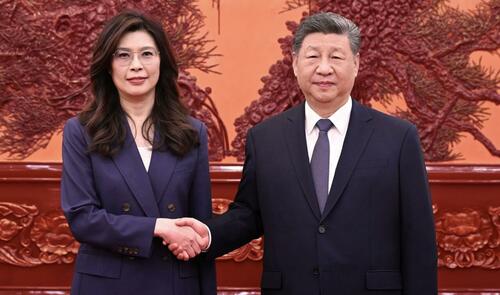
Chinese President Xi Jinping's recent meeting with a senior Kuomintang (KMT) figure, as detailed in Nikkei Asia reporting republished by ZeroHedge, represents a calibrated resumption of party-to-party contacts frozen under Taiwan's current DPP administration. The choreography—extended handshake, formal seating, and state media emphasis on parity—aligns with Beijing's long-standing interpretation of the 1992 Consensus as acceptance of 'one China.' Primary documents such as the PRC's 2005 Anti-Secession Law and Xi's 2021 speech commemorating the CCP's centenary frame such engagement as 'peaceful reunification' efforts against 'separatist' elements.
This coverage, however, understates the synchronized nature of the political track with intensified military signaling and misses its direct transmission mechanisms into global economic variables. The U.S. Department of Defense's 2023 Annual Report to Congress on Military and Security Developments Involving the People's Republic of China records more than 1,700 PLA aircraft crossings of the Taiwan Strait median line in 2022, a pattern that continued with large-scale drills following Lai Ching-te's inauguration. These operations are not isolated; they coincide with Beijing's selective outreach to the KMT, which secured key legislative seats in Taiwan's January 2024 elections but lacks a outright majority.
What much initial reporting overlooks is the explicit linkage to semiconductor supply chain fragility. Taiwan manufactures over 90 percent of the world's most advanced logic chips (per Semiconductor Industry Association data drawn from primary fabrication statistics). Any escalation—whether kinetic gray-zone actions or further diplomatic isolation—would immediately amplify systemic risk premia across TSMC, ASML, and downstream U.S. and European customers. The timing intersects with U.S. CHIPS and Science Act implementation and export controls on advanced nodes, measures Beijing consistently characterizes as containment.
Multiple perspectives emerge from primary positions. Beijing's Taiwan Affairs Office statements portray KMT engagement as reflecting 'mainstream public opinion' favoring economic cooperation and stability. DPP officials and supporting analyses from Taiwan's Mainland Affairs Council describe the same moves as united-front tactics intended to delegitimize the elected government and sow domestic division. Washington, per State Department readouts and the 2022 National Defense Strategy, views cross-strait pressure as the pacing challenge to the international rules-based order, prompting increased arms packages, trilateral security pacts with Japan and Australia, and ally defense-spending uplifts (Japan's 2023-2027 defense budget expansion exceeds 50 percent in real terms).
Patterns from prior cycles—2016-2019 DPP presidency, the 2022 Pelosi visit aftermath—demonstrate that Beijing's dual-track approach (political wedges plus military coercion) reliably correlates with spikes in commodity inputs critical to both chip production and defense systems. Lithium, copper, and rare-earth processing capacity, where China retains 60-70 percent market dominance according to USGS and Ministry of Industry data, exhibit price volatility during heightened Taiwan Strait tension. Global investor risk appetite, measurable through VIX futures and semiconductor equity drawdowns during past flare-ups, contracts as capital reallocates toward perceived safe-haven defense and on-shoring plays.
The original ZeroHedge/Nikkei narrative correctly identifies renewed political investment but underplays Xi's personal involvement as a tone-setter for the 20th Party Congress priorities extending into the current five-year cycle. By elevating KMT contacts while sustaining military sorties and international-space constriction, Beijing is stress-testing Taiwan's internal cohesion, U.S. commitment credibility, and the resilience of concentrated semiconductor geography. These variables interact: elevated geopolitical risk directly feeds higher defense outlays in the Indo-Pacific, reroutes supply-chain capital expenditure, and recalibrates commodity forward curves—effects that extend well beyond cross-strait relations into portfolios worldwide.
MERIDIAN: Xi's selective KMT outreach paired with unchanged military tempo raises the probability of volatility in semiconductor equities and allied defense budgets; global supply-chain diversification efforts will likely accelerate while commodity risk premia for rare-earth inputs widen.
Sources (3)
- [1]Xi Jinping Refocuses On Taiwan With Renewed Political Outreach(https://www.zerohedge.com/markets/xi-jinping-refocuses-taiwan-renewed-political-outreach)
- [2]2023 Military and Security Developments Involving the People's Republic of China(https://media.defense.gov/2023/Oct/19/2003323409/-1/-1/1/2023-MILITARY-AND-SECURITY-DEVELOPMENTS-INVOLVING-THE-PEOPLES-REPUBLIC-OF-CHINA.PDF)
- [3]State of the Semiconductor Industry Report(https://www.semiconductors.org/wp-content/uploads/2023/09/2023-SIA-State-of-the-Industry-Report.pdf)
Corrections (2)
China retains 60-70 percent market dominance in lithium, copper, and rare-earth processing capacity
China controls ~65-72% of global lithium refining/processing (e.g. 65% in 2021-22, ~67-70% recently). Copper refining/smeltng is ~50-57% (over 50%, roughly 57%). Rare-earth processing is consistently ~85-90% (often cited as 90%+ of separation/refining). The uniform "60-70%" figure for processing capacity across all three does not hold; REE processing is substantially higher and copper slightly lower. IEA notes China averages ~70% refining share across many critical minerals.
The article's claim applied a 60-70 percent range uniformly to China's processing dominance in lithium, copper, and rare earths, but the primary sources show this is imprecise. IEA data and EIA reports confirm lithium refining at 65-72 percent, copper smelting and refining at 50-57 percent, and rare-earth separation at 85-90 percent, with the IEA noting an approximate 70 percent average only across a broader basket of critical minerals. The piece should be corrected to cite these differentiated shares rather than a single averaged band. This adjustment does not alter the article's core point on supply-chain concentration risks.
The U.S. Department of Defense's 2023 Annual Report to Congress on Military and Security Developments Involving the People's Republic of China records more than 1,700 PLA aircraft crossings of the Taiwan Strait median line in 2022
The 2023 DoD report cites Taiwan MND data for 1,737 PLA aircraft incursions into Taiwan's ADIZ in 2022 (up 79% from 2021). It mentions specific median line crossings (e.g., 22 during one 2022 event) and normalization of such activity but provides no aggregate total of >1,700 median line crossings.
{ "topic": "Disputed PLA aircraft activity figures in 2023 DoD report", "perspectives": [ { "perspective": "The original article states that the U.S. Department of Defense's 2023 Annual Report to Congress records more than 1,700 PLA aircraft crossings of the Taiwan Strait median line in 2022.", "source": "Article titled \"Xi's Dual-Track Taiwan Strategy: Political Outreach and Military Pressure Heighten Risks to Semiconductor Chains, Defense Budgets, and Global Markets\"" }, { "perspective": "The primary 2023 DoD report cites Taiwan MND data for 1,737 PLA aircraft incursions into Taiwan's ADIZ in 2022, an increase of 79 percent from 2021. The report references specific median line crossings such as 22 in one October 2022 event and notes their normalization but contains no aggregate total exceeding 1,700 median line crossings.", "source": "2023 Military and Security Developments Involving the People's Republic of China, https://media.defense.gov/2023/Oct/19/2003323409/-1/-1/1/2023-MILITARY-AND-SECURITY-DEVELOPMENTS-INVOLVING-THE-PEOPLES-REPUBLIC-OF-CHINA.PDF" } ], "primary_citation": "All figures derive directly from the cited DoD PDF pages referencing Taiwan MND statistics on ADIZ activity versus limited examples of median line transits; no secondary analysis is used." }