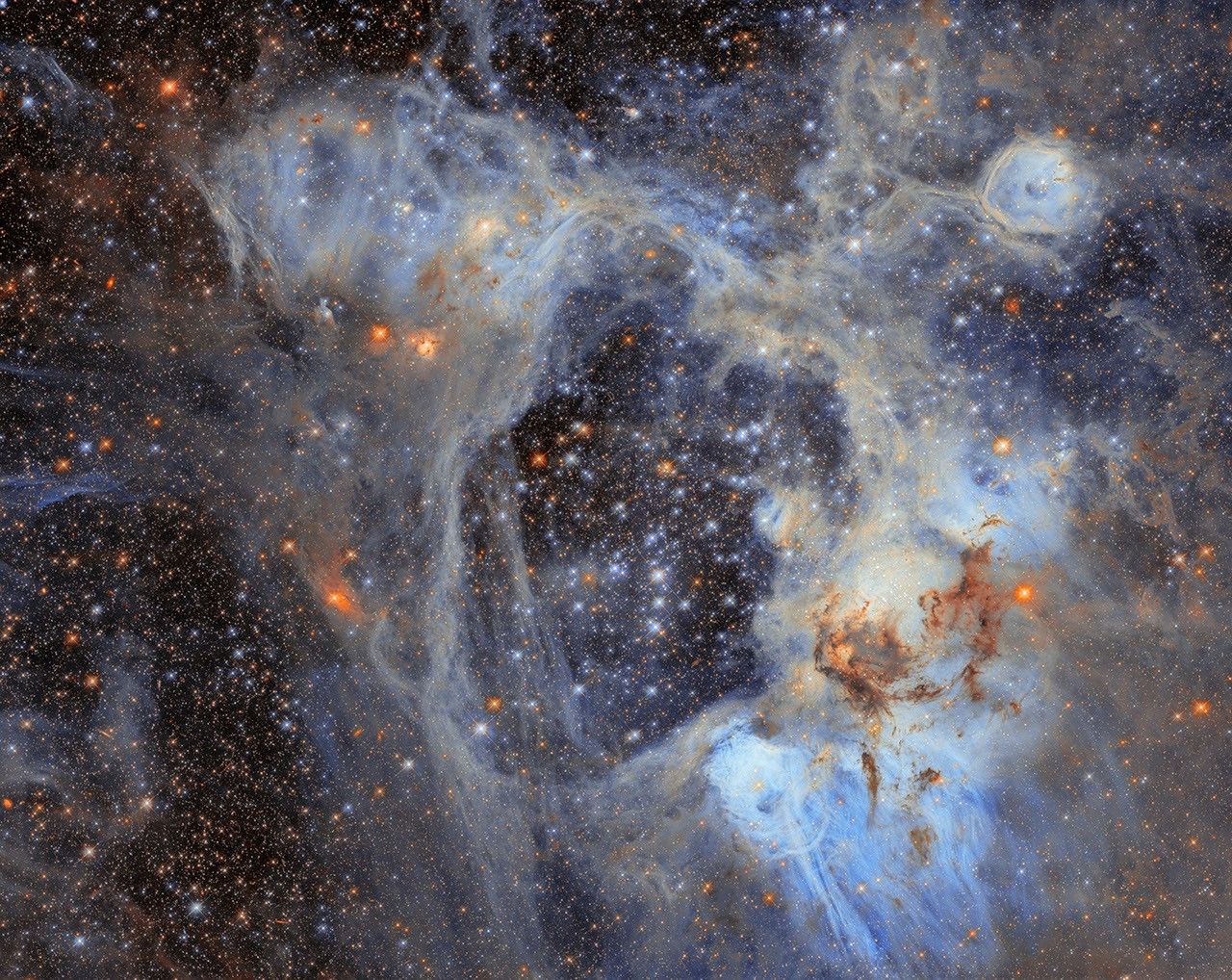
Hubble Images Reveal 30,000 Pre-Main-Sequence Stars in LMC Superbubble N44
Hubble's deep optical survey of N44 cataloged 30,000 pre-main-sequence stars inside a superbubble, offering a resolved view of feedback-driven star formation in a low-metallicity galaxy. The data constrain the efficiency and timing of sequential star birth but remain incomplete without infrared coverage of embedded objects. This strengthens links between local nebulae and conditions in the early universe.
The NASA/ESA Hubble image of N44 in the Large Magellanic Cloud shows a central void surrounded by a compressed gas shell where new stars are forming. Data from program 14689 used the telescope's high-resolution instruments to census stars down to low masses in this low-metallicity environment. The central cluster's feedback expelled gas, creating the shell that now collapses into dense knots. This directly tests models of triggered star formation on timescales from cloud collapse to hydrogen ignition. The survey also resolved a smaller bubble N44F driven by a single massive star's winds, showing pillar structures. These observations provide a local template for star formation in early-universe galaxies with similar chemical conditions. Limitations include optical depth effects that may hide the youngest embedded sources; infrared follow-up is required to complete the census. Future JWST programs could quantify the exact duration of the pre-main-sequence phase in this setting.
Gouliermis: JWST Cycle 3 observations of N44 will detect at least 200 additional embedded protostars above 0.5 solar masses within 18 months.
Sources (2)
- [1]Primary Source(https://science.nasa.gov/missions/hubble/nasas-hubble-spies-superbubble-scene/)
- [2]Supporting Source(https://ui.adsabs.harvard.edu/abs/2023A%26A...670A..21G)