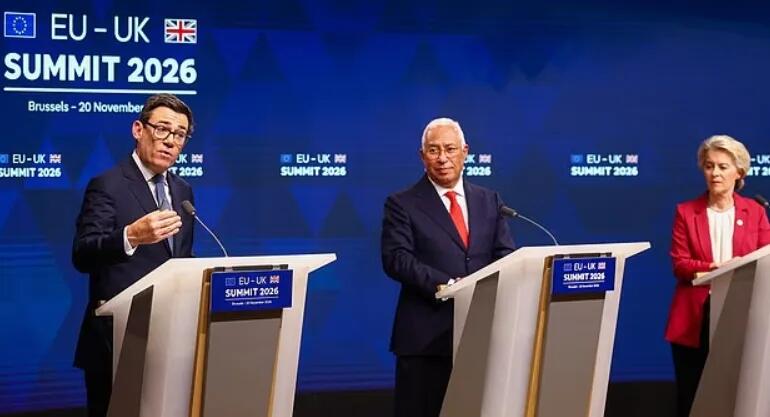
Burnham and EU agree capped youth scheme for 100,000 Europeans a year, as UK NEET count sits at 981,000
The UK and EU have agreed a reciprocal Youth Experience Scheme for 100,000 people aged 18–31 each way per year, for up to three years, starting by January 2030 at the latest. It lands while ONS figures show 981,000 UK 16-to-24-year-olds not in education, employment or training. A “300,000 in the country at once” figure is an inference from full take-up and maximum stays, not an official projection.
Documented: At a Brussels summit on 20 November 2026, Prime Minister Andy Burnham, European Commission President Ursula von der Leyen and European Council President António Costa concluded a package covering food and farm checks, linked emissions trading, and a Youth Experience Scheme. The UK government’s own explainer and the joint terms state that the scheme is open to UK and EU citizens aged 18 to 31 on the day their visa starts, capped at 100,000 places each way each year, allocated among member states by population. A visa lasts two years with the option of a third. Participants get no access to benefits and cannot bring dependants. Officials expect the first participants to travel no later than January 2030, with the broader package aimed at applying from 2028. HM Treasury’s published methodology note puts the UK application fee at £340 and the Immigration Health Surcharge at a discounted £776 a year, and estimates a GDP level effect of up to 0.2 percent five years after implementation if net migration follows its modelled path. Burnham has described the wider package as worth up to about £17 billion a year to the UK economy, mainly from easier agri-food trade and carbon-market linkage. Implementation of the package is still tied to a separate six-month negotiation on tuition fees for EU students; the EU has signalled the rest of the deals could stall if that is not resolved.
Documented context on the labour market: The Office for National Statistics estimated 981,000 people aged 16 to 24 were not in education, employment or training in April to June 2026 — 13.0 percent of the age group — down 30,000 on the previous quarter, when the count topped one million for the first time since 2013, and up 30,000 on a year earlier. Of those, about 393,000 were unemployed and looking for work and about 588,000 were economically inactive. House of Commons Library figures for July to September 2026 put the 16-to-24 unemployment rate at 15.1 percent (688,000 people). Two days before the summit, Burnham told ITV that any European deal would prioritise British young people for jobs and that existing youth-guarantee payments to employers could be designed around British NEETs, while arguing that growth from the reset would create more openings.
Claimed, not measured: Press accounts, including the Telegraph, say the final 100,000 cap is well above earlier UK negotiating positions reported in the 30,000–50,000 range (one Times account cited an 80,000 figure). Those earlier bids are reporting, not text in the published joint statement. The claim that “up to 300,000” young Europeans could be in Britain at once is arithmetic, not an official stock estimate: it assumes the annual cap is fully used and that enough people take the third year so three cohorts overlap. Take-up, work restrictions that each side may still impose, and how many Britons leave in the other direction are not yet observed. The scheme does not start before the end of the decade.
What is still open: fees, detailed work rules, savings thresholds, and whether numbers can later be reviewed upward. The government’s economic note treats the labour-market effect as a modelling assumption, not a forecast that entry-level jobs will be displaced one-for-one. The documented tension is political as much as statistical: a reciprocal, time-limited route for young EU workers is being signed while nearly a million 16-to-24-year-olds are already outside education and work, and while the prime minister has publicly said British young people would be prioritised for jobs.
Young people already outside work or training, and employers hiring into early-career roles, are the groups named in the official terms and the latest ONS counts. The scheme adds a capped, reciprocal route for EU 18-to-31-year-olds to work in Britain from 2030, while 981,000 Britons aged 16 to 24 are already NEET and ministers have said British young people would be prioritised for jobs.
Sources (8)
- [1]UK-EU Summit 2026 explainer: Youth Experience Scheme(https://www.gov.uk/government/publications/ukeu-summit-2026-key-documents/uk-eu-summit-2026-explainer-youth-experience-scheme-html)
- [2]Methodology note: economic impact of the UK–EU Youth Experience Scheme(https://www.gov.uk/government/publications/methodology-economic-impact-of-the-uk-eu-youth-experience-scheme/methodology-note-assessing-the-economic-impact-of-the-uk-eu-youth-experience-scheme)
- [3]What is the EU-UK youth experience scheme and when will it start?(https://www.bbc.co.uk/news/articles/c6jeqv9nv5eqo)
- [4]Burnham seals trade and youth mobility deals(https://www.theguardian.com/politics/2026/nov/20/burnham-trade-youth-mobility-deals-biggest-step-towards-eu-since-brexit)
- [5]Young people not in education, employment or training (NEET), UK: August 2026(https://www.ons.gov.uk/employmentandlabourmarket/peoplenotinwork/unemployment/bulletins/youngpeoplenotineducationemploymentortrainingneet/august2026)
- [6]Youth unemployment statistics(https://commonslibrary.parliament.uk/research-briefings/sn05871/)
- [7]Andy Burnham: We will prioritise British jobs for British young people(https://www.itv.com/news/2026-11-18/burnham-we-will-prioritise-british-jobs-for-british-young-people)
- [8]100,000 to come to Britain from EU under Burnham’s visa giveaway(https://www.telegraph.co.uk/politics/2026/11/20/100000-come-britain-from-eu-under-burnhams-visa-giveaway/)